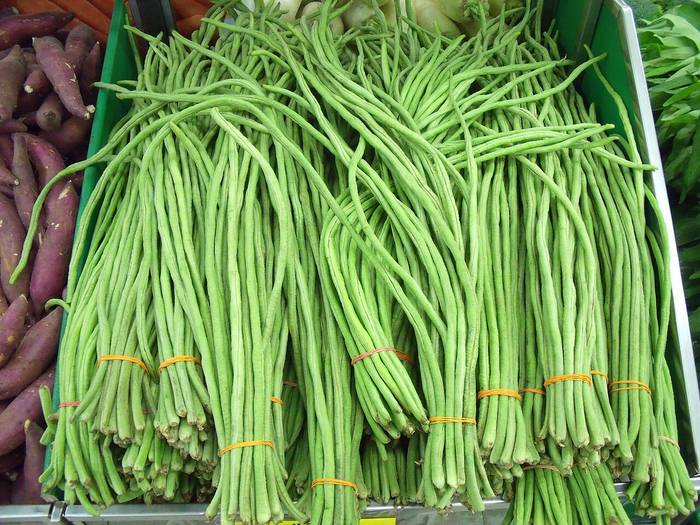
Asparagus bean
Plant·Vigna unguiculata subsp. sesquipedalis
Full sun
Sun
Moist soil
Water
Well-drained soil
Drainage
Not recorded
Hardiness
Coverage · 105 fields
No obvious inconsistencies found.
Growth and size10 fields
Plant type
Plant
AI estimate100 % agree
Height
50 cm · other sources: 200 cm“Vigna unguiculata is a ANNUAL growing to 0.5 m (1ft 8in).”Wikipedia“Cowpeas can either be short and bushy (as short as 20 cm or 8 in) or act like a vine by climbing supports or trailing along the ground (to a height of 2 m or 6 ft 7 in).”
Spread
60 cm
AI estimate58 % agree
Height at age
—
empty
Spacing
30 cm (at least 15 cm)
AI estimate55 % agree
Growth rate
—
empty
Root depth
Taproot“The taproot can penetrate to a depth of 2.4 m (7 ft 10 in) after eight weeks.”
Forest garden layer
Herb layer
AI estimate90 % agree
Lifespan
~1 years
AI estimatenot measured yet
Roots6 fields
Root form
Taproot“The taproot can penetrate to a depth of 2.4 m (7 ft 10 in) after eight weeks.”
Storage organ
None
AI estimate100 % agree
Spreads
No
AI estimate75 % agree
Lateral spread in cm
—
empty
Root depth in cm
Deepest 240 cm“The taproot can penetrate to a depth of 2.4 m (7 ft 10 in) after eight weeks.”
Mycorrhiza
Arbuscular (AM)
AI estimatenot measured yet
Light, water and soil9 fields
Hours of sun
6–12 h
AI estimatenot measured yet
Drought tolerant
Yes“Drought lowers the growth rate and development, ultimately reducing yield, although cowpea is considered more drought tolerant than most other crops.”
Tolerates waterlogging
—
empty
Soil type
Sand, loam · best: sand“The ideal soils are sandy and it has better tolerance for infertile and acid soil than most other crops.”Wikipedia“Cowpeas thrive in poor dry conditions, growing well in soils up to 85% sand.”PFAF“Suitable for: light (sandy) and medium (loamy) soils and prefers well-drained soil.”
Drainage
Well drained“Suitable for: light (sandy) and medium (loamy) soils and prefers well-drained soil.”
Compacted soil
Copes fairly well
AI estimatenot measured yet
Climate5 fields
Hardiness
—
empty
Killing frost
—
empty
Growing temperature
15–40 °C · optimal 25–35 °C
AI estimatenot measured yet
Chill hours
0 h
AI estimatenot measured yet
Care (becomes tasks in Manage)6 fields
Starting indoors
After the last frost · -28 days after“Pre-soak the seed for 12 hours in warm water and sow in trays in early to mid spring in a greenhouse.”
PFAFpartly
Planting out
After the last frost“Grow the plants on fast and plant them out after the last expected frosts.”
Protection
After the last frost · lasts 21 days“Consider giving them the protection of a cloche for their first few weeks outdoors to ensure that they do not suffer a check to their growth.”
Sowing
After the last frost“An outdoor sowing in situ in late spring may succeed in a warm summer, though it is much more likely to be a disappointment in Britain.”
PFAFpartly
Watering
July · lasts 60 days
AI estimatenot measured yet
Weeding
After the previous stage · 7 days after · lasts 30 days
AI estimatenot measured yet
Through the year4 fields
Flowering
July · lasts 92 days“It is in flower from July to September, and the seeds ripen from August to October.”
Fruiting
After the first frost“In temperate climates, the plants can produce beans until the first frost.”
Harvest
After the previous stage“The plants take longer to reach maturity than bush beans, but once they start producing, the pods are quick-growing, and daily checking and harvesting are often necessary.”
Dying back
After the first frost
AI estimatenot measured yet
Edible parts and pollination4 fields
Immature green pods
Eaten fresh or cooked“cultivated for its edible green pods containing immature seeds”Wikipedia“The crisp, tender pods are eaten both fresh and cooked.”
Pollination
Self-fertile · hermaphrodite“The species is hermaphrodite (has both male and female organs) and is pollinated by Insects.”Wikipedia“However, as the plant is primarily self-pollinating, its genetic diversity within varieties is relatively low.”
Ecology5 fields
Attracts
Bees, beneficial insects, wasps, ants“The plant attracts many pollinators, specifically various types of wasps and ants.”
Pests
Aphids, pod borers, leafhoppers
AI estimatenot measured yet
Diseases
Cowpea mosaic virus, rust
AI estimatenot measured yet
Takes up
—
empty
Propagation and names4 fields
Methods
Seed sown in trays in a greenhouse, direct sowing in situ outdoors“Pre-soak the seed for 12 hours in warm water and sow in trays in early to mid spring in a greenhouse.”PFAF“An outdoor sowing in situ in late spring may succeed in a warm summer, though it is much more likely to be a disappointment in Britain.”
Difficulty
1 / 5
AI estimatenot measured yet
Seed
none
AI estimatenot measured yet
Not sorted yet52 fields
Fields the parser stores that this page has no row for yet. They show up here automatically, so nothing is hidden.
forage.DK.edibility_basis
inferred
AI estimatenot measured yet
forage.DK.foraging_months.notes
In temperate climates, the plants can produce beans until the first frost.“In temperate climates, the plants can produce beans until the first frost.”
forage.US.edible_parts
[{"part":"immature green pods","preparation":"eaten fresh or cooked"},{"part":"mature pods","preparation":"used like dry beans"}]“cultivated for its edible green pods containing immature seeds”Wikipedia“overlooked mature pods can be used like dry beans”Wikipedia“The crisp, tender pods are eaten both fresh and cooked.”
forage.US.edibility_basis
inferred
AI estimatenot measured yet
forage.US.foraging_months.notes
In temperate climates, the plants can produce beans until the first frost.“In temperate climates, the plants can produce beans until the first frost.”
forage.TROPICAL.edible_parts
[{"part":"immature green pods","preparation":"eaten fresh or cooked"},{"part":"mature pods","preparation":"used like dry beans"}]“cultivated for its edible green pods containing immature seeds”Wikipedia“overlooked mature pods can be used like dry beans”Wikipedia“The crisp, tender pods are eaten both fresh and cooked.”
forage.TROPICAL.edibility_basis
inferred
AI estimatenot measured yet
ornamental.basis
documented
AI estimatenot measured yet
ornamental.fragrance.source
none
AI estimate100 % agree
ornamental.confidence
high
AI estimatenot measured yet
ornamental.fall_interest
false
AI estimatenot measured yet
ornamental.flower_colour
purple, pink, yellow, white, blue“Flower colour varies through different shades of purple, pink, yellow, and white and blue.”
ornamental.evidence_quote
Vigna unguiculata, commonly known as cowpea, produces flowers that can be white, cream, yellow, or purple. Its foliage is green and it does not exhibit significant autumn color change. The foliage texture is medium. It is an annual plant and does not have winter ornamental structure or notable fragrance.
AI estimatenot measured yet
ornamental.foliage_colour
green
AI estimate82 % agree
ornamental.foliage_texture
medium
AI estimatenot measured yet
ornamental.winter_structure
none
AI estimatenot measured yet
ornamental.autumn_foliage_colour
none
AI estimatenot measured yet
care_regime
routine
AI estimatenot measured yet
propagation.self_seeding
moderate
AI estimate20 % agree
propagation.establishment_years
0
AI estimate40 % agree
forage_proposals.DK.edibility_tier.tier
edible“The crisp, tender pods are eaten both fresh and cooked.”
forage_proposals.DK.edibility_tier.confidence
low
AI estimatenot measured yet
forage_proposals.DK.edibility_tier.evidence_quote
The crisp, tender pods are eaten both fresh and cooked.
AI estimatenot measured yet
forage_proposals.US.edibility_tier.tier
edible“The crisp, tender pods are eaten both fresh and cooked.”
forage_proposals.US.edibility_tier.confidence
medium
AI estimatenot measured yet
forage_proposals.US.edibility_tier.evidence_quote
The crisp, tender pods are eaten both fresh and cooked.
AI estimatenot measured yet
forage_proposals.TROPICAL.edibility_tier.tier
edible“The crisp, tender pods are eaten both fresh and cooked.”
forage_proposals.TROPICAL.edibility_tier.confidence
high
AI estimatenot measured yet
forage_proposals.TROPICAL.edibility_tier.evidence_quote
The crisp, tender pods are eaten both fresh and cooked.
AI estimatenot measured yet
function_profile.biomass_return.confidence
medium“When removing plant remains at the end of the growing season, it is best to only remove the aerial parts of the plant, leaving the roots in the ground to decay and release their nitrogen.”
function_profile.nutrient_flows.consumes
[{"basis":"documented","demand":"moderate","nutrient":"phosphorus","confidence":"high"},{"basis":"documented","demand":"moderate","nutrient":"potassium","confidence":"high"}]“These characteristics, along with its low fertilisation requirements, make the cowpea an ideal crop for resource-poor farmers living in the Sahel region of West Africa.”
Wikipediapartly
function_profile.nutrient_flows.provides
[{"basis":"documented","nutrient":"nitrogen","mechanism":"fixation","confidence":"high","evidence_quote":"It can fix Nitrogen."},{"basis":"documented","nutrient":"nitrogen","mechanism":"biomass_return","confidence":"m…“It can fix Nitrogen.”PFAF“When removing plant remains at the end of the growing season, it is best to only remove the aerial parts of the plant, leaving the roots in the ground to decay and release their nitrogen.”
function_profile.biotic_interactions
[{"taxa":["wasps","ants"],"basis":"documented","valence":"beneficial","relation":"attracts","confidence":"medium","evidence_quote":"The plant attracts many pollinators, specifically various types of wasps and ants.","…“The plant attracts many pollinators, specifically various types of wasps and ants.”
function_profile.aromatic_pest_effect.value
false
AI estimate80 % agree
function_profile.aromatic_pest_effect.confidence
high
AI estimatenot measured yet
function_profile.structural_interfaces.provides_shelter.basis
inferred
AI estimatenot measured yet
function_profile.structural_interfaces.provides_shelter.confidence
low
AI estimatenot measured yet
function_profile.structural_interfaces.requires_shelter.basis
documented
AI estimatenot measured yet
function_profile.structural_interfaces.requires_shelter.stage
establishment
AI estimatenot measured yet
function_profile.structural_interfaces.requires_shelter.confidence
medium
AI estimatenot measured yet
function_profile.structural_interfaces.requires_shelter.evidence_quote
Consider giving them the protection of a cloche for their first few weeks outdoors to ensure that they do not suffer a check to their growth.
AI estimatenot measured yet
function_profile.structural_interfaces.provides_physical_support.basis
inferred
AI estimatenot measured yet
function_profile.structural_interfaces.provides_physical_support.confidence
low
AI estimatenot measured yet
function_profile.structural_interfaces.requires_physical_support.basis
documented
AI estimatenot measured yet
function_profile.structural_interfaces.requires_physical_support.mechanism
twiner
AI estimatenot measured yet
function_profile.structural_interfaces.requires_physical_support.confidence
high
AI estimatenot measured yet
climate_tolerance.photoperiod_response
short_day
AI estimatenot measured yet
soil_interactions.organic_matter_contribution
medium
AI estimatenot measured yet
component_metadata.growth_cycle
annual“Vigna unguiculata is a ANNUAL growing to 0.5 m (1ft 8in).”
resource_interfaces.inputs
[{"resource":"light","quantity_description":"a very warm sunny position; cannot grow in the shade"},{"resource":"water","quantity_description":"moist but well-drained soil; annual rainfall 400 to 700 mm"},{"resource":…“Requires a very warm sunny position in a moist but well drained soil.”Wikipedia“It grows best in regions with an annual rainfall between 400 and 700 mm (16 and 28 in).”PFAF“The species is hermaphrodite (has both male and female organs) and is pollinated by Insects.”
resource_interfaces.outputs
[{"resource":"pollinator_services","quantity_description":"attracts many pollinators, including wasps and ants"},{"resource":"fruit","quantity_description":"immature green pods, 35–75 cm long"}]“The plant attracts many pollinators, specifically various types of wasps and ants.”Wikipedia“A variety of the cowpea, the asparagus bean is grown primarily for its strikingly long (35 to 75 centimetres (1.15 to 2.46 ft)) immature green pods and has uses very similar to those of the green bean.”Wikipediapartly“The asparagus bean (Vigna unguiculata subsp. sesquipedalis) is a legume cultivated for its edible green pods containing immature seeds, like the green bean.”