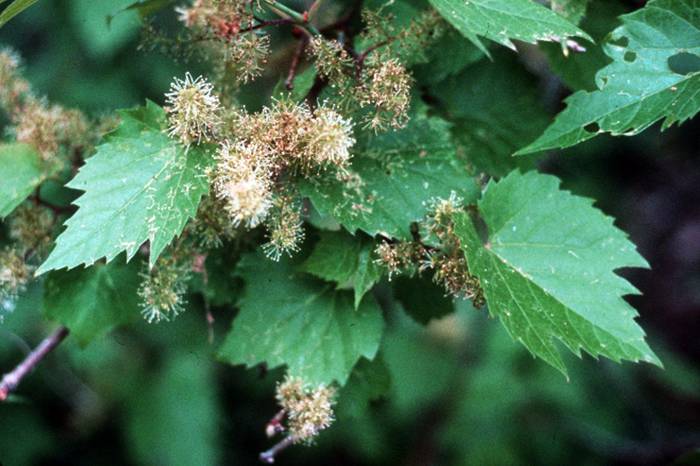
riverbank grape
Plant·Vitis riparia
Part shade to full sun
Sun
Dry to moist soil
Water
Well-drained soil
Drainage
Zones 2–8
Hardiness
Coverage · 110 fields
No obvious inconsistencies found.
Growth and size10 fields
Plant type
Deciduous plant“Vitis riparia is a deciduous Climber growing to 15 m (49ft 3in) at a fast rate.”
Spread
500 cm
AI estimate58 % agree
Height at age
—
empty
Spacing
300 cm (at least 150 cm)
AI estimate55 % agree
Growth rate
Fast“Vitis riparia is a deciduous Climber growing to 15 m (49ft 3in) at a fast rate.”
Root depth
Deep
AI estimate63 % agree
Lifespan
~30 years
AI estimatenot measured yet
Roots6 fields
Root form
—
empty
Storage organ
None
AI estimate100 % agree
Spreads
No
AI estimate75 % agree
Lateral spread in cm
—
empty
Root depth in cm
—
empty
Mycorrhiza
—
empty
Light, water and soil9 fields
Sun
Full sun, light shade, part shade · best: full sun“It can grow in semi-shade (light woodland) or no shade.”
Hours of sun
6–12 h
AI estimatenot measured yet
Drought tolerant
—
empty
Tolerates waterlogging
—
empty
Soil type
Sand, loam, clay · best: loam“Prefers a deep rich moist well-drained moderately fertile loam.”PFAF“Suitable for: light (sandy), medium (loamy) and heavy (clay) soils and prefers well-drained soil.”
Drainage
Well drained“Suitable for: light (sandy), medium (loamy) and heavy (clay) soils and prefers well-drained soil.”
Compacted soil
Copes fairly well
AI estimatenot measured yet
Climate5 fields
Hardiness
Zone 2–8
AI estimatenot measured yet
Killing frost
-40 °C
AI estimatenot measured yet
Growing temperature
5–35 °C · optimal 20–30 °C
AI estimatenot measured yet
Chill hours
400 h
AI estimatenot measured yet
Care (becomes tasks in Manage)4 fields
Pruning
After the previous stage“Any pruning should be carried out in winter when the plants are dormant otherwise they bleed profusely.”
Pruning
February · lasts 28 days · healthy fruiting wood · dead, damaged, or crossing canes
AI estimatenot measured yet
Mulching
April · lasts 30 days
AI estimatenot measured yet
Support
May · lasts 30 days
AI estimatenot measured yet
Through the year6 fields
Flowering
May · lasts 92 days“It is in flower from May to July, and the seeds ripen from August to September.”
Fruiting
August · lasts 61 days“It is in flower from May to July, and the seeds ripen from August to September.”
Harvest
September“Grapes are usually harvested in late summer to early autumn, specifically from late summer through fall, depending on the variety and climate.”
Dying back
After the first frost“Vitis riparia is a deciduous Climber growing to 15 m (49ft 3in) at a fast rate.”
PFAFpartly
Dormant
After the first frost“Any pruning should be carried out in winter when the plants are dormant otherwise they bleed profusely.”
PFAFpartly
Edible parts and pollination2 fields
Ecology6 fields
Attracts
Birds, wildlife, beneficial insects, mammals“It produces dark fruit that are appealing to both birds and people, and has been used extensively in commercial viticulture as grafted rootstock and in hybrid grape breeding programs.”PFAF“It is noted for attracting wildlife.”PFAF“Yes – Grape flowers are attractive to a variety of pollinators, including bees and other beneficial insects, as they produce nectar.”PFAF“Yes – The fruit (grapes) is highly nutritious and consumed by birds, mammals, and insects.”
Pests
Grape phylloxera, japanese beetle, grape berry moth
AI estimatenot measured yet
Diseases
Honey fungus, mildew, black rot“Plants in this genus are notably susceptible to honey fungus.”Wikipedia“The berries, however, are often sensitive to mildew and black rot if the vine is exposed to prolonged wet and humid conditions.”
Takes up
Potassium, calcium
AI estimatenot measured yet
Fixes nitrogen
No
AI estimatenot measured yet
Mycorrhiza
Yes
AI estimatenot measured yet
Propagation and names4 fields
Methods
Seed, cuttings, layering“Seed - best sown in a cold frame as soon as it is ripe[K].”PFAF“Cuttings of mature wood of the current seasons growth, December/January in a frame.”
Difficulty
2 / 5
AI estimatenot measured yet
Seed
Six weeks cold stratification improves the germination rate, and so stored seed is best sown in a cold frame as soon as it is obtained.“Six weeks cold stratification improves the germination rate, and so stored seed is best sown in a cold frame as soon as it is obtained.”
Not sorted yet58 fields
Fields the parser stores that this page has no row for yet. They show up here automatically, so nothing is hidden.
forage.DK.edibility_basis
inferred
AI estimatenot measured yet
forage.DK.foraging_months.year_round
false
AI estimatenot measured yet
forage.US.local_name
Riverbank grape
AI estimatenot measured yet
forage.US.edible_parts
[{"part":"fruit","caution":null,"preparation":"raw or dried for later use","season_months":[8,9]},{"part":"leaves","caution":null,"preparation":"cooked; young leaves wrapped around other foods and baked"},{"part":"you…“Edible Parts: Fruit Leaves Sap Shoots”PFAF“Young tendrils - raw or cooked.”PFAF“The sap can be harvested in the spring and early summer, though it should not be taken in quantity or it will weaken the plant[K].”PFAF“Fruit - raw or dried for later use.”Wikipedia“in August or September produces a small 6–15 mm (0.24–0.59 in) blue-black berry (grape) with a bloom”PFAFpartly“Leaves - cooked.”PFAFpartly“A sweet flavour, it is used as a drink.”
forage.US.prep_cautions
Ensure positive identification as some wild grapes can be toxic., Remove seeds from fruit if consuming in large quantities as they can be astringent.
AI estimatenot measured yet
forage.US.edibility_basis
inferred
AI estimatenot measured yet
forage.US.foraging_months.notes
Fruit ripens August to September; sap can be taken in spring and early summer.“The sap can be harvested in the spring and early summer, though it should not be taken in quantity or it will weaken the plant[K].”
forage.US.foraging_months.months
8, 9“in August or September produces a small 6–15 mm (0.24–0.59 in) blue-black berry (grape) with a bloom”
forage.US.foraging_months.year_round
false
AI estimatenot measured yet
forage.US.habitat_affinity
riverbank, woodland, verge“Riverbanks, bottomlands, rich thickets and woodland margins.”Wikipediapartly“In the wild, the vine thrives along exposed areas with good sun exposure and adequate soil moisture, such as riverbanks, forest clearings, fence lines and along road sides.”
forage.TROPICAL.edibility_basis
inferred
AI estimatenot measured yet
forage.TROPICAL.foraging_months.year_round
false
AI estimatenot measured yet
ornamental.basis
documented
AI estimatenot measured yet
ornamental.confidence
high
AI estimatenot measured yet
ornamental.fall_interest
true
AI estimatenot measured yet
ornamental.flower_colour
white, green“The inflorescence is a panicle 4–15 cm (1.6–5.9 in) long and loose, and the flowers are small, fragrant, and white or greenish in color.”
ornamental.evidence_quote
Vitis riparia, commonly known as riverbank grape, is a vigorous vine with green foliage that turns yellow-green to red in autumn. Its flowers are insignificant but emit a strong, sweet fragrance. The vine provides architectural interest in winter.
AI estimatenot measured yet
ornamental.foliage_colour
green
AI estimate82 % agree
ornamental.foliage_texture
medium
AI estimatenot measured yet
ornamental.winter_structure
architectural_skeleton
AI estimatenot measured yet
ornamental.autumn_foliage_colour
yellow_green, red
AI estimatenot measured yet
care_regime
light
AI estimatenot measured yet
propagation.self_seeding
moderate
AI estimate20 % agree
propagation.division_season
spring
AI estimatenot measured yet
propagation.establishment_years
4“Grapes are considered fast-growing vines, often reaching maturity within 3 to 4 years, depending on the variety and growing conditions.”
sun_requirement.best
full_sun“Succeeds in sun or partial shade though a warm sunny position is required for the fruit to ripen.”
sun_requirement.best_for
fruit“Succeeds in sun or partial shade though a warm sunny position is required for the fruit to ripen.”
forage_proposals.DK.edibility_tier.confidence
low
AI estimatenot measured yet
forage_proposals.US.edibility_tier.tier
edible
AI estimatenot measured yet
forage_proposals.US.edibility_tier.confidence
high
AI estimatenot measured yet
forage_proposals.US.edibility_tier.evidence_quote
The fruit of Vitis riparia is edible and often used for making jams, jellies, and wine. While tart when raw, it sweetens after a frost.
AI estimatenot measured yet
forage_proposals.TROPICAL.edibility_tier.confidence
low
AI estimatenot measured yet
function_profile.biomass_return.confidence
high
AI estimatenot measured yet
function_profile.nutrient_flows.consumes
[{"basis":"documented","demand":"high","nutrient":"nitrogen","confidence":"high"},{"basis":"documented","demand":"moderate","nutrient":"phosphorus","confidence":"high"},{"basis":"documented","demand":"high","nutrient"…
AI estimatenot measured yet
function_profile.nutrient_flows.provides
[{"basis":"inferred","nutrient":"potassium","mechanism":"mineral_extraction","confidence":"low"},{"basis":"inferred","nutrient":"calcium","mechanism":"mineral_extraction","confidence":"low"}]
AI estimatenot measured yet
function_profile.biotic_interactions
[{"taxa":["birds"],"basis":"documented","valence":"neutral","relation":"attracts","confidence":"medium","evidence_quote":"It produces dark fruit that are appealing to both birds and people, and has been used extensive…“It produces dark fruit that are appealing to both birds and people, and has been used extensively in commercial viticulture as grafted rootstock and in hybrid grape breeding programs.”PFAF“Yes – Grape flowers are attractive to a variety of pollinators, including bees and other beneficial insects, as they produce nectar.”PFAF“Yes – The fruit (grapes) is highly nutritious and consumed by birds, mammals, and insects.”PFAF“They also provide habitat for various beneficial insects and wildlife.”PFAF“It is noted for attracting wildlife.”PFAF“Plants in this genus are notably susceptible to honey fungus.”Wikipedia“The berries, however, are often sensitive to mildew and black rot if the vine is exposed to prolonged wet and humid conditions.”
function_profile.aromatic_pest_effect.value
false
AI estimate80 % agree
function_profile.aromatic_pest_effect.confidence
high
AI estimatenot measured yet
function_profile.structural_interfaces.provides_shelter.basis
documented
AI estimatenot measured yet
function_profile.structural_interfaces.provides_shelter.kinds
shade
AI estimatenot measured yet
function_profile.structural_interfaces.provides_shelter.confidence
high
AI estimatenot measured yet
function_profile.structural_interfaces.requires_shelter.basis
inferred
AI estimatenot measured yet
function_profile.structural_interfaces.requires_shelter.kinds
frost“The young growth in spring can be damaged by late frosts.”
function_profile.structural_interfaces.requires_shelter.confidence
low
AI estimatenot measured yet
function_profile.structural_interfaces.requires_shelter.evidence_quote
The young growth in spring can be damaged by late frosts.
AI estimatenot measured yet
function_profile.structural_interfaces.provides_physical_support.basis
inferred
AI estimatenot measured yet
function_profile.structural_interfaces.provides_physical_support.confidence
low
AI estimatenot measured yet
function_profile.structural_interfaces.requires_physical_support.basis
documented
AI estimatenot measured yet
function_profile.structural_interfaces.requires_physical_support.mechanism
tendril“Plants climb by means of tendrils.”
function_profile.structural_interfaces.requires_physical_support.confidence
high
AI estimatenot measured yet
function_profile.structural_interfaces.requires_physical_support.evidence_quote
Plants climb by means of tendrils.
AI estimatenot measured yet
climate_tolerance.photoperiod_response
day_neutral
AI estimatenot measured yet
soil_interactions.organic_matter_contribution
high
AI estimatenot measured yet
component_metadata.growth_cycle
perennial“It is long-lived and capable of reaching into the upper canopy of the tallest trees.”
Wikipediapartly
resource_interfaces.inputs
[{"resource":"light","quantity_description":"full sun or partial shade; a warm sunny position is needed for the fruit to ripen"},{"resource":"water","quantity_description":"prefers dry or moist soil"},{"resource":"phy…“Succeeds in sun or partial shade though a warm sunny position is required for the fruit to ripen.”PFAF“It prefers dry or moist soil.”PFAFpartly“Plants climb by means of tendrils.”
resource_interfaces.outputs
[{"resource":"ground_cover","quantity_description":"can be grown as ground cover to prevent soil erosion"},{"resource":"fruit","quantity_description":"small edible berries carried in fairly large bunches"},{"resource"…“Grapes can be used as ground cover to prevent soil erosion and enhance biodiversity.”PFAF“Yes – Grape flowers are attractive to a variety of pollinators, including bees and other beneficial insects, as they produce nectar.”PFAF“They also provide habitat for various beneficial insects and wildlife.”PFAF“The flowers are powerfully scented of mignonette.”PFAFpartly“The fruit is about 6 - 12mm in diameter and is carried in fairly large bunches[K].”