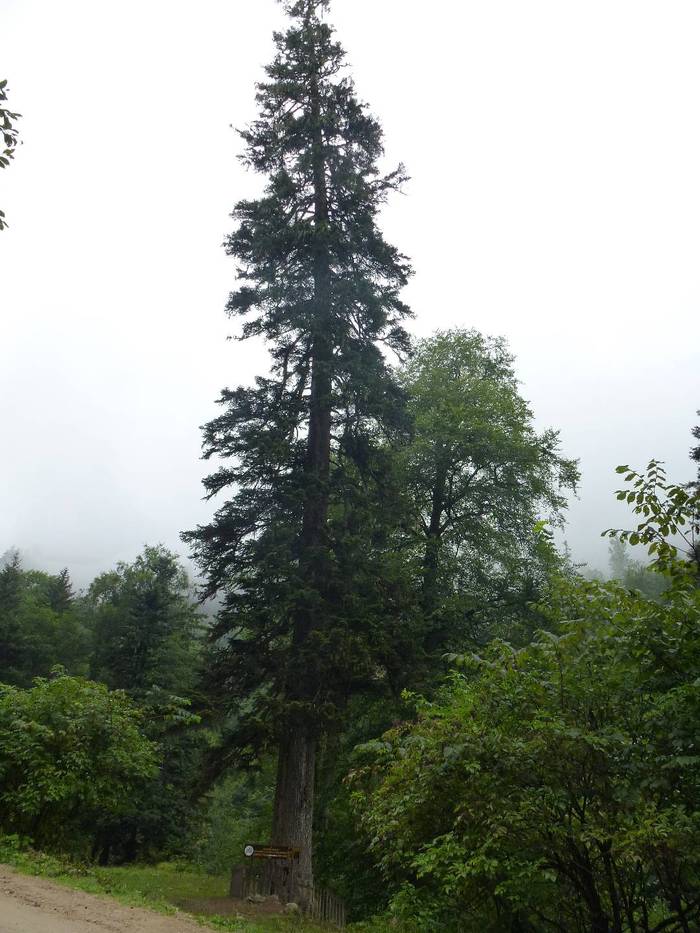
Şahin 1 · CC BY-SA 4.0
Nordmann fir
Tree·Abies nordmanniana
Shade to full sun
Sun
Moist soil
Water
Not recorded
Drainage
Zones 4–7
Hardiness
Coverage · 110 fields
No obvious inconsistencies found.
Growth and size10 fields
Plant type
Evergreen tree“Abies nordmanniana is an evergreen Tree growing to 50 m (164ft) by 5 m (16ft) at a medium rate.”
Height
5,000 cm · other sources: 5,500 cm, 6,100 cm“Abies nordmanniana is an evergreen Tree growing to 50 m (164ft) by 5 m (16ft) at a medium rate.”Wikipedia“It is a large evergreen coniferous tree growing to 55–61 m tall and with a trunk diameter of up to 2 m.”
Spread
500 cm“Abies nordmanniana is an evergreen Tree growing to 50 m (164ft) by 5 m (16ft) at a medium rate.”
Height at age
—
empty
Spacing
900 cm (at least 600 cm)
AI estimate55 % agree
Growth rate
Medium“Abies nordmanniana is an evergreen Tree growing to 50 m (164ft) by 5 m (16ft) at a medium rate.”
Root depth
Deep
AI estimate63 % agree
Forest garden layer
Canopy
AI estimate90 % agree
Lifespan
~200 years
AI estimatenot measured yet
Roots6 fields
Root form
Heart root
AI estimate43 % agree
Storage organ
None
AI estimate100 % agree
Spreads
No
AI estimate75 % agree
Lateral spread in cm
—
empty
Root depth in cm
—
empty
Mycorrhiza
Ectomycorrhizal (EcM)
AI estimatenot measured yet
Light, water and soil9 fields
Sun
Full sun, light shade, part shade, shade · best: full sun“It can grow in full shade (deep woodland) semi-shade (light woodland) or no shade.”
Hours of sun
6 h
AI estimatenot measured yet
Drought tolerant
Yes“The species are able to tolerate long droughts in summer and tend to form pure stands when in optimal habitats.”
JRC forest tree atlaspartly
Soil type
Sand, loam, clay“Suitable for: light (sandy), medium (loamy) and heavy (clay) soils and can grow in heavy clay soil.”PFAF“Grows well in heavy clay soils.”
pH
5“Prefers slightly acid conditions down to a pH of about 5, but it tolerates more alkaline conditions than many other members of the genus.”PFAF“Suitable pH: mildly acid, neutral and basic (mildly alkaline) soils.”
Compacted soil
Copes badly
AI estimatenot measured yet
Climate5 fields
Hardiness
Zone 4–7
AI estimatenot measured yet
Killing frost
-25 °C
AI estimatenot measured yet
Growing temperature
0–25 °C · optimal 5–20 °C
AI estimatenot measured yet
Chill hours
1,000 h
AI estimatenot measured yet
Care (becomes tasks in Manage)6 fields
Planting out
After the last frost“Plant them out into their permanent positions in late spring or early summer, after the last expected frosts.”
PFAFpartly
Starting indoors
February · lasts 14 days
AI estimatenot measured yet
Mulching
April · lasts 30 days
AI estimatenot measured yet
Watering
July · lasts 60 days
AI estimatenot measured yet
Pruning
February · lasts 28 days · dead, damaged, or crossing branches
AI estimatenot measured yet
Through the year1 fields
Edible parts and pollination4 fields
The young shoots
Raw or cooked · April–May
AI estimatenot measured yet
The needles
Tea · January–December
AI estimatenot measured yet
Pollination
Self-fertile · monoecious“The species is monoecious (individual flowers are either male or female, but both sexes can be found on the same plant) and is pollinated by Wind.”
Pollinated by
Wind“The species is monoecious (individual flowers are either male or female, but both sexes can be found on the same plant) and is pollinated by Wind.”
Ecology5 fields
Attracts
—
empty
Pests
Aphis“This species grows well in most parts of Britain but it is very susceptible to damage by aphis in some parts of the country.”
Diseases
Needle rust, root rot
AI estimatenot measured yet
Takes up
—
empty
Fixes nitrogen
No
AI estimatenot measured yet
Propagation and names4 fields
Difficulty
3 / 5
AI estimatenot measured yet
Seed
Said to give a more even germination; sowing in a cold frame as soon as the seed is ripe in autumn is probably best.“Stratification is said to produce a more even germination so it is probably best to sow the seed in a cold frame as soon as it is ripe in the autumn.”
Not sorted yet60 fields
Fields the parser stores that this page has no row for yet. They show up here automatically, so nothing is hidden.
forage.DK.local_name
Nordmannsgran
AI estimatenot measured yet
forage.DK.edibility_basis
inferred
AI estimatenot measured yet
forage.DK.foraging_months.notes
Young shoots are seasonal, but needles for tea can be harvested year-round.
AI estimatenot measured yet
forage.DK.foraging_months.months
1, 2, 3, 4, 5, 6, 7, 8, 9, 10, 11, 12
AI estimatenot measured yet
forage.DK.foraging_months.year_round
true
AI estimatenot measured yet
forage.DK.habitat_affinity
woodland
AI estimatenot measured yet
forage.US.edible_parts
[{"part":"young shoots","caution":null,"preparation":"raw or cooked","season_months":[4,5]},{"part":"needles","caution":null,"preparation":"tea","season_months":[1,2,3,4,5,6,7,8,9,10,11,12]}]
AI estimatenot measured yet
forage.US.edibility_basis
inferred
AI estimatenot measured yet
forage.US.foraging_months.notes
Young shoots are seasonal, but needles for tea can be harvested year-round.
AI estimatenot measured yet
forage.US.foraging_months.months
1, 2, 3, 4, 5, 6, 7, 8, 9, 10, 11, 12
AI estimatenot measured yet
forage.US.foraging_months.year_round
true
AI estimatenot measured yet
forage.US.habitat_affinity
woodland
AI estimatenot measured yet
forage.TROPICAL.edibility_basis
inferred
AI estimatenot measured yet
forage.TROPICAL.foraging_months.year_round
false
AI estimatenot measured yet
ornamental.basis
documented
AI estimatenot measured yet
ornamental.fragrance.source
foliage
AI estimate100 % agree
ornamental.fragrance.intensity
subtle
AI estimatenot measured yet
ornamental.confidence
high
AI estimatenot measured yet
ornamental.fall_interest
false
AI estimatenot measured yet
ornamental.evidence_quote
The needles are dark green, glossy, and have a slight fragrance when crushed. As an evergreen, it retains its foliage through autumn and winter.
AI estimatenot measured yet
ornamental.foliage_colour
dark_green“The leaves are needle-like, flattened, 1.8–3.5 cm long and 2 mm wide by 0.5 mm thick, glossy dark green above, and with two blue-white bands of stomata below.”
ornamental.foliage_texture
fine
AI estimatenot measured yet
ornamental.winter_structure
evergreen_form“Abies nordmanniana is an evergreen Tree growing to 50 m (164ft) by 5 m (16ft) at a medium rate.”
PFAFpartly
ornamental.autumn_foliage_colour
none
AI estimatenot measured yet
care_regime
light
AI estimatenot measured yet
propagation.self_seeding
light
AI estimate20 % agree
propagation.division_season
not applicable
AI estimatenot measured yet
propagation.establishment_years
3
AI estimate40 % agree
forage_proposals.DK.edibility_tier.tier
edible
AI estimatenot measured yet
forage_proposals.DK.edibility_tier.confidence
high
AI estimatenot measured yet
forage_proposals.DK.edibility_tier.evidence_quote
The young shoots can be eaten raw or cooked, and the needles can be used to make a refreshing tea.
AI estimatenot measured yet
forage_proposals.US.edibility_tier.tier
edible
AI estimatenot measured yet
forage_proposals.US.edibility_tier.confidence
high
AI estimatenot measured yet
forage_proposals.US.edibility_tier.evidence_quote
The young shoots can be eaten raw or cooked, and the needles can be used to make a refreshing tea.
AI estimatenot measured yet
forage_proposals.TROPICAL.edibility_tier.confidence
low
AI estimatenot measured yet
function_profile.biomass_return.confidence
medium
AI estimatenot measured yet
function_profile.nutrient_flows.consumes
[{"basis":"inferred","demand":"moderate","nutrient":"nitrogen","confidence":"medium"},{"basis":"inferred","demand":"moderate","nutrient":"phosphorus","confidence":"medium"},{"basis":"inferred","demand":"moderate","nut…
AI estimatenot measured yet
function_profile.nutrient_flows.provides
[{"basis":"inferred","nutrient":"calcium","mechanism":"mineral_extraction","confidence":"low"},{"basis":"inferred","nutrient":"magnesium","mechanism":"mineral_extraction","confidence":"low"}]
AI estimatenot measured yet
function_profile.biotic_interactions
[{"taxa":["aphis"],"basis":"documented","valence":"harmful","relation":"hosts","confidence":"medium","evidence_quote":"This species grows well in most parts of Britain but it is very susceptible to damage by aphis in …“This species grows well in most parts of Britain but it is very susceptible to damage by aphis in some parts of the country.”JRC forest tree atlas“Goat and cattle grazing activity can be particularly destructive when intensive, damaging seedlings and young shoots of juvenile plants and limiting forest regeneration.”
function_profile.aromatic_pest_effect.value
false
AI estimate80 % agree
function_profile.aromatic_pest_effect.confidence
low
AI estimatenot measured yet
function_profile.structural_interfaces.provides_shelter.basis
documented
AI estimatenot measured yet
function_profile.structural_interfaces.provides_shelter.kinds
wind, shade
AI estimatenot measured yet
function_profile.structural_interfaces.provides_shelter.confidence
high
AI estimatenot measured yet
function_profile.structural_interfaces.requires_shelter.basis
documented“Natural regeneration is normally abundant and easy inside their habitat range, but is best below a level of cover which limits the risk of late frost damage and water transpiration losses.”
function_profile.structural_interfaces.requires_shelter.kinds
frost“Natural regeneration is normally abundant and easy inside their habitat range, but is best below a level of cover which limits the risk of late frost damage and water transpiration losses.”
function_profile.structural_interfaces.requires_shelter.stage
establishment“Natural regeneration is normally abundant and easy inside their habitat range, but is best below a level of cover which limits the risk of late frost damage and water transpiration losses.”
function_profile.structural_interfaces.requires_shelter.confidence
medium“Natural regeneration is normally abundant and easy inside their habitat range, but is best below a level of cover which limits the risk of late frost damage and water transpiration losses.”
function_profile.structural_interfaces.requires_shelter.evidence_quote
Natural regeneration is normally abundant and easy inside their habitat range, but is best below a level of cover which limits the risk of late frost damage and water transpiration losses.“Natural regeneration is normally abundant and easy inside their habitat range, but is best below a level of cover which limits the risk of late frost damage and water transpiration losses.”
function_profile.structural_interfaces.provides_physical_support.form
trunk
AI estimatenot measured yet
function_profile.structural_interfaces.provides_physical_support.basis
taxonomic
AI estimatenot measured yet
function_profile.structural_interfaces.provides_physical_support.confidence
high
AI estimatenot measured yet
function_profile.structural_interfaces.requires_physical_support.basis
taxonomic
AI estimatenot measured yet
function_profile.structural_interfaces.requires_physical_support.confidence
high
AI estimatenot measured yet
climate_tolerance.photoperiod_response
day_neutral
AI estimatenot measured yet
soil_interactions.organic_matter_contribution
medium
AI estimatenot measured yet
component_metadata.growth_cycle
perennial
AI estimate100 % agree
resource_interfaces.inputs
[{"resource":"shade","quantity_description":"tolerates full shade through to no shade; very shade tolerant when young, slower growth in dense shade"},{"resource":"water","quantity_description":"moist soil, not waterlo…“Plants are very shade tolerant, especially when young, but growth is slower in dense shade.”PFAF“Prefers a good moist but not water-logged soil.”PFAF“The species is monoecious (individual flowers are either male or female, but both sexes can be found on the same plant) and is pollinated by Wind.”
resource_interfaces.outputs
[{"resource":"timber","quantity_description":"light, soft wood used for construction and pulp"},{"resource":"seeds","quantity_description":"seeds ripen in October"},{"resource":"leaf_litter","quantity_description":"ho…“Used for construction, pulp etc.”PFAF“It is in leaf all year, and the seeds ripen in October.”PFAF“A very ornamental tree, it can hold its leaves for up to 26 years.”