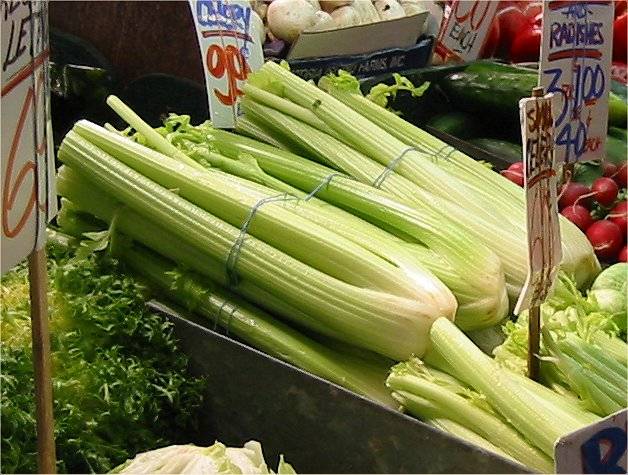
celery
celery (Apium graveolens var. dulce) is a plant. It grows best in full sun and has moderate water needs. It grows well with tomato and common bean.
About celery
Celery is a biennial plant that grows 60 cm tall. It is self-fertile, so you only need one. The leaves are strongly scented.
The flowers attract pollinators.
How to plant celery
Celery does best in full sun, but also copes with part shade. It grows in sandy soil and loam, as long as the soil is well drained. It does best at a pH of 6.6–6.8. In a forest garden it belongs in the herb layer.
Plant plants 30 cm apart, at least 20 cm. It struggles in compacted soil, so keep the soil loose.
A year with celery
Spring. Water during dry spells in March–September. Sow seed in April. Plant out in April and May. Feed it in April–August. Use a balanced liquid fertiliser. Mulch around it in April–September. Spread straw or compost on the soil around the plant. Harvest falls in May and June. The leaves can be eaten. The roots can be eaten cooked. The seeds can be eaten too. Recorded from the source text, not a safety check. Confirm with a trusted guide before eating anything. Harden off young plants in May.
Summer. Harvest falls in August–February.
Autumn. Sow seed in September.
Winter. Start seeds indoors in February.
Pests and diseases
Celery can be attacked by celery_leaf_miner, celery_worm, slugs and snails. Diseases include sclerotinia sclerotiorum and seed-borne diseases of celery.
Companions and wildlife
celeryThe family
celery is a variety of Celery, in the genus Apium. Open a species to see what lies under it.

 celeryvar. dulceThis page
Sources
Added to the wiki 12 October 2026
Plan your garden with perma
Open app