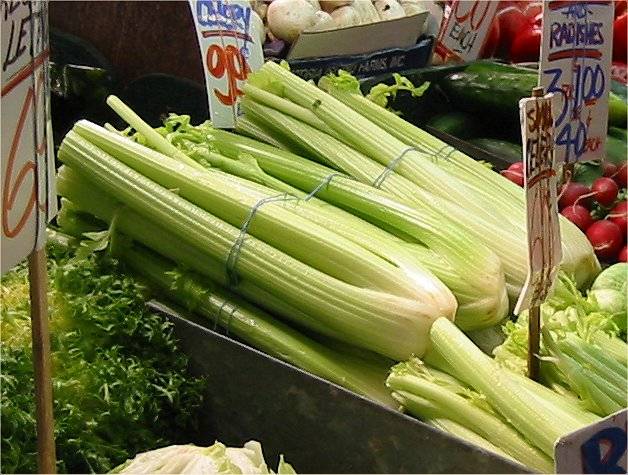
Eric Hunt · CC BY 2.5
celery
Plant·Apium graveolens var. dulce
Part shade to full sun
Sun
Moist soil
Water
Well-drained soil
Drainage
Not recorded
Hardiness
Coverage · 105 fields
Growth and size10 fields
Plant type
Plant“Apium graveolens is a stout biennial or monocarpic perennial herb, producing flowers and seeds only once, during its second or a later year.”
Wikipediapartly
Height at age
—
empty
Spacing
30 cm (at least 20 cm)
AI estimate55 % agree
Growth rate
—
empty
Habit
—
empty
Root depth
Shallow
AI estimate63 % agree
Forest garden layer
Herb layer
AI estimate90 % agree
Lifespan
~2 years
AI estimatenot measured yet
Roots6 fields
Root form
—
empty
Storage organ
None“It does not multiply vegetatively: it has no rhizomes, runners, suckers or offspring bulbs or tubers.”
Spreads
No“It does not multiply vegetatively: it has no rhizomes, runners, suckers or offspring bulbs or tubers.”
Lateral spread in cm
—
empty
Root depth in cm
—
empty
Mycorrhiza
—
empty
Light, water and soil9 fields
Sun
Full sun, light shade, part shade · best: full sun“It can grow in semi-shade (light woodland).”PFAFpartly“Prefers a rich moist soil in sun or semi-shade, but with some shade in the summer.”
Hours of sun
6–8 h
AI estimatenot measured yet
Drought tolerant
—
empty
Tolerates waterlogging
—
empty
Soil type
Sand, loam“Suitable for: light (sandy) and medium (loamy) soils and prefers well-drained soil.”
pH
Drainage
Well drained“Suitable for: light (sandy) and medium (loamy) soils and prefers well-drained soil.”
Compacted soil
Copes badly
AI estimatenot measured yet
Climate5 fields
Hardiness
—
empty
Killing frost
—
empty
Growing temperature
7–27 °C · optimal 15–21 °C
AI estimatenot measured yet
Chill hours
0 h
AI estimatenot measured yet
Native range
—
empty
Care (becomes tasks in Manage)10 fields
Sowing
After the last frost“Seed - sow spring or autumn in situ.”
Sowing appears 3 times with different timing.
PFAFpartly
Sowing
After the first frost“Seed - sow spring or autumn in situ.”
Sowing appears 3 times with different timing.
PFAFpartly
Sowing
April“The maincrop can be sown as late as mid-April.”
Sowing appears 3 times with different timing.
Starting indoors
February“Seed - germination can be erratic and the seed is best surface sow February in a greenhouse.”
Hardening off
After the previous stage · 60 days after · lasts 14 days
AI estimatenot measured yet
Planting out
After the last frost · 14 days after · lasts 14 days
Planting out appears 2 times with different timing.
AI estimatenot measured yet
Watering
After the previous stage · lasts 180 days
AI estimatenot measured yet
Feeding
After the previous stage · 30 days after · lasts 120 days · a balanced liquid fertiliser
AI estimatenot measured yet
Mulching
After the previous stage · 30 days after · lasts 150 days
AI estimatenot measured yet
Through the year4 fields
Flowering
Once the chill need is met“Plants with 5 or more true leaves will flower following exposure to temperatures between 5 - 10°c for 10 days or more.”
Fruiting
August · lasts 61 days“It is in flower from June to August, and the seeds ripen from August to September.”
Harvest
August · lasts 273 days“There are many named varieties and these can supply fresh stalks from late summer to spring.”
Edible parts and pollination6 fields
Leaf stems
Raw or cooked“Leaf stems - raw or cooked.”PFAF“The winter varieties can be bitter if they are not blanched by excluding light from the stems for at least a few weeks prior to harvesting.”
The leaves
Raw or cooked“Leaves - raw or cooked.”PFAF“They can also be eaten raw but have a very strong flavour and are probably best as a minor ingredient in a mixed salad.”
The seeds
As a flavouring for sauces, soups, pickles · August–September“Seed - used as a flavouring for sauces, soups, pickles etc.”PFAF“It is in flower from June to August, and the seeds ripen from August to September.”
Ecology6 fields
Attracts
Flies (pollinators), flies“The species is hermaphrodite (has both male and female organs) and is pollinated by Flies.”
Pests
Celery_leaf_miner, celery_worm, slugs, snails
AI estimatenot measured yet
Diseases
Sclerotinia sclerotiorum, seed-borne diseases of celery“If the plant is infected with the fungus Sclerotinia sclerotiorum, skin contact with the sap can cause dermatitis in sensitive people.”PFAF“The seed can harbour certain diseases of celery”
Takes up
Potassium, calcium
AI estimatenot measured yet
Fixes nitrogen
No
AI estimatenot measured yet
Mycorrhiza
No
AI estimatenot measured yet
Propagation and names3 fields
Difficulty
2 / 5
AI estimatenot measured yet
Seed
none
AI estimatenot measured yet
Not sorted yet46 fields
Fields the parser stores that this page has no row for yet. They show up here automatically, so nothing is hidden.
forage.DK.prep_cautions
Sap from a plant infected with Sclerotinia sclerotiorum can cause dermatitis in sensitive people., Many people find the raw stalks somewhat indigestible.“If the plant is infected with the fungus Sclerotinia sclerotiorum, skin contact with the sap can cause dermatitis in sensitive people.”PFAF“Many people find the raw stalks are somewhat indigestible.”
forage.DK.edibility_basis
inferred
AI estimatenot measured yet
forage.DK.foraging_months.notes
There are many named varieties and these can supply fresh stalks from late summer to spring.“There are many named varieties and these can supply fresh stalks from late summer to spring.”
forage.US.edible_parts
[{"part":"leaf stems","caution":"The winter varieties can be bitter if they are not blanched by excluding light from the stems for at least a few weeks prior to harvesting.","preparation":"raw or cooked"},{"part":"lea…“Leaf stems - raw or cooked.”PFAF“Leaves - raw or cooked.”PFAF“Root - cooked.”PFAF“Seed - used as a flavouring for sauces, soups, pickles etc.”PFAF“The winter varieties can be bitter if they are not blanched by excluding light from the stems for at least a few weeks prior to harvesting.”PFAF“They can also be eaten raw but have a very strong flavour and are probably best as a minor ingredient in a mixed salad.”PFAF“It is in flower from June to August, and the seeds ripen from August to September.”
forage.US.prep_cautions
Sap from a plant infected with Sclerotinia sclerotiorum can cause dermatitis in sensitive people., Many people find the raw stalks somewhat indigestible.“If the plant is infected with the fungus Sclerotinia sclerotiorum, skin contact with the sap can cause dermatitis in sensitive people.”PFAF“Many people find the raw stalks are somewhat indigestible.”
forage.US.edibility_basis
inferred
AI estimatenot measured yet
forage.US.foraging_months.notes
There are many named varieties and these can supply fresh stalks from late summer to spring.“There are many named varieties and these can supply fresh stalks from late summer to spring.”
forage.TROPICAL.edible_parts
[{"part":"leaf stems","caution":"The winter varieties can be bitter if they are not blanched by excluding light from the stems for at least a few weeks prior to harvesting.","preparation":"raw or cooked"},{"part":"lea…“Leaf stems - raw or cooked.”PFAF“Leaves - raw or cooked.”PFAF“Root - cooked.”PFAF“Seed - used as a flavouring for sauces, soups, pickles etc.”PFAF“The winter varieties can be bitter if they are not blanched by excluding light from the stems for at least a few weeks prior to harvesting.”PFAF“They can also be eaten raw but have a very strong flavour and are probably best as a minor ingredient in a mixed salad.”PFAF“It is in flower from June to August, and the seeds ripen from August to September.”
forage.TROPICAL.prep_cautions
Sap from a plant infected with Sclerotinia sclerotiorum can cause dermatitis in sensitive people., Many people find the raw stalks somewhat indigestible.“If the plant is infected with the fungus Sclerotinia sclerotiorum, skin contact with the sap can cause dermatitis in sensitive people.”PFAF“Many people find the raw stalks are somewhat indigestible.”
forage.TROPICAL.edibility_basis
inferred
AI estimatenot measured yet
forage.TROPICAL.foraging_months.notes
There are many named varieties and these can supply fresh stalks from late summer to spring.“There are many named varieties and these can supply fresh stalks from late summer to spring.”
ornamental.basis
documented
AI estimatenot measured yet
ornamental.fragrance.source
foliage“A very aromatic plant, the aroma being most noticeable when the foliage is bruised.”
ornamental.fragrance.intensity
strong“with all parts of the plant having a strong celery odour”
ornamental.confidence
high
AI estimatenot measured yet
ornamental.fall_interest
false
AI estimatenot measured yet
ornamental.flower_colour
cream, white“The individual flowers are creamy-white to greenish-white, 2–3 mm (3⁄32–1⁄8 in) across.”
ornamental.evidence_quote
Celery (Apium graveolens) has small white flowers and green foliage. It is an annual/biennial and does not typically have autumn foliage color or significant winter structure. The foliage has a characteristic moderate fragrance.
AI estimatenot measured yet
ornamental.foliage_colour
green, yellow_green“The leaves are bright green to yellowish-green, 1- to 2-pinnate with leaflets that are variously shaped, often rhomboid, up to 6 cm (2+1⁄2 in) long and 4 cm (1+1⁄2 in) broad.”
ornamental.foliage_texture
medium
AI estimatenot measured yet
ornamental.winter_structure
none
AI estimatenot measured yet
ornamental.autumn_foliage_colour
none
AI estimatenot measured yet
care_regime
light
AI estimatenot measured yet
propagation.self_seeding
light
AI estimate20 % agree
propagation.division_season
none
AI estimatenot measured yet
propagation.establishment_years
1
AI estimate40 % agree
spatial_profile.canopy_density
medium
AI estimatenot measured yet
function_profile.biomass_return.confidence
low
AI estimatenot measured yet
function_profile.nutrient_flows.consumes
[{"basis":"documented","demand":"heavy","nutrient":"nitrogen","confidence":"high"},{"basis":"documented","demand":"moderate","nutrient":"phosphorus","confidence":"high"},{"basis":"documented","demand":"high","nutrient…
AI estimatenot measured yet
function_profile.nutrient_flows.provides
[{"basis":"inferred","nutrient":"potassium","mechanism":"biomass_return","confidence":"low"},{"basis":"inferred","nutrient":"calcium","mechanism":"biomass_return","confidence":"low"}]
AI estimatenot measured yet
function_profile.biotic_interactions
[{"taxa":["flies"],"basis":"documented","valence":"beneficial","relation":"attracts","confidence":"high","evidence_quote":"The species is hermaphrodite (has both male and female organs) and is pollinated by Flies.","o…“The species is hermaphrodite (has both male and female organs) and is pollinated by Flies.”PFAF“The growing plant is an insect repellent, it repels the cabbage white butterfly so is a good companion for brassicas.”PFAF“If the plant is infected with the fungus Sclerotinia sclerotiorum, skin contact with the sap can cause dermatitis in sensitive people.”PFAF“The seed can harbour certain diseases of celery, it is usually treated by seed companies before being sold but if you save your own seed you should make sure that only seed from healthy plants is used.”
function_profile.aromatic_pest_effect.value
true“The growing plant is an insect repellent, it repels the cabbage white butterfly so is a good companion for brassicas.”
function_profile.aromatic_pest_effect.confidence
low
AI estimatenot measured yet
function_profile.structural_interfaces.requires_shelter.basis
documented
AI estimatenot measured yet
function_profile.structural_interfaces.requires_shelter.kinds
shade“Prefers a rich moist soil in sun or semi-shade, but with some shade in the summer.”
function_profile.structural_interfaces.requires_shelter.confidence
medium
AI estimatenot measured yet
function_profile.structural_interfaces.requires_shelter.evidence_quote
Prefers a rich moist soil in sun or semi-shade, but with some shade in the summer.
AI estimatenot measured yet
function_profile.structural_interfaces.provides_physical_support.basis
inferred
AI estimatenot measured yet
function_profile.structural_interfaces.provides_physical_support.confidence
high
AI estimatenot measured yet
climate_tolerance.photoperiod_response
long_day
AI estimatenot measured yet
soil_interactions.organic_matter_contribution
medium
AI estimatenot measured yet
component_metadata.growth_cycle
biennial“Apium graveolens is a BIENNIAL growing to 0.6 m (2ft) by 0.3 m (1ft in).”
resource_interfaces.inputs
[{"resource":"light","quantity_description":"a sunny position"},{"resource":"shade","quantity_description":"some shade in summer"},{"resource":"water","quantity_description":"moist soil"},{"resource":"pollination","qu…“Prefers a sunny position and a pH between 6.6 and 6.8.”PFAF“Prefers a rich light moist soil with some shade in summer.”PFAF“It prefers moist soil.”PFAF“The species is hermaphrodite (has both male and female organs) and is pollinated by Flies.”
resource_interfaces.outputs
[{"resource":"seeds","quantity_description":"seed used as a flavouring for sauces, soups, pickles"},{"resource":"aromatic_compounds","quantity_description":"essential oil from the seed used as a flavouring"}]“Seed - used as a flavouring for sauces, soups, pickles etc.”PFAF“An essential oil from the seed is also used as a flavouring.”
biotic_relationships.repels
cabbage white butterfly“The growing plant is an insect repellent, it repels the cabbage white butterfly so is a good companion for brassicas.”