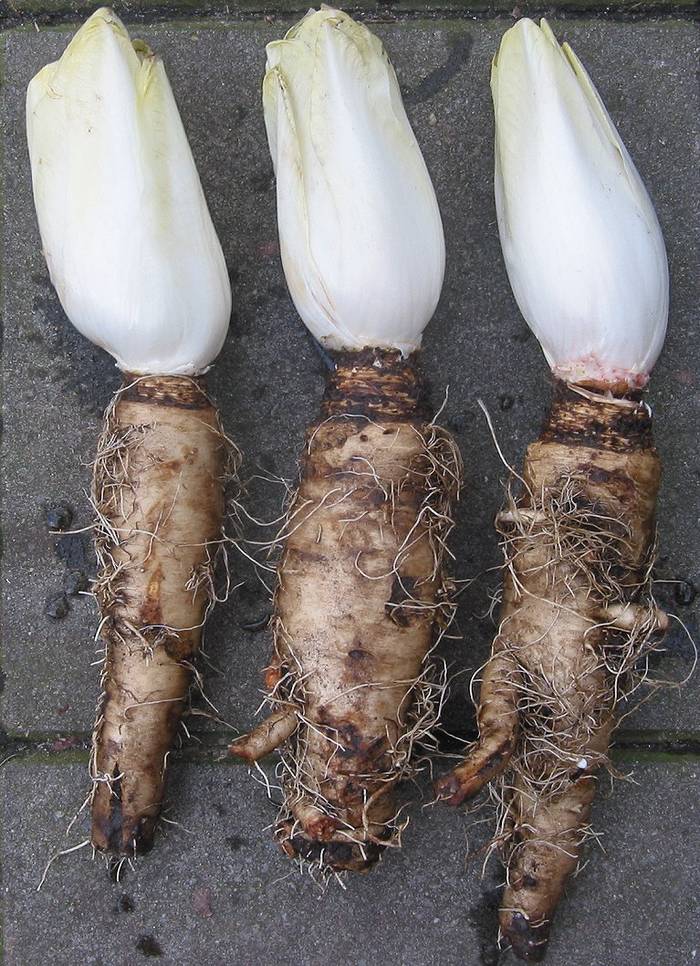
Belgian endive
Belgian endive (Cichorium intybus var. foliosum) is a plant. It grows best in full sun and has moderate water needs.
About Belgian endive
Belgian endive is a biennial plant that grows 1.5 m tall. It grows fast. It is self-fertile, so you only need one.
The flowers give nectar and pollen to pollinators.
How to plant belgian endive
Belgian endive does best in full sun. It grows in sandy soil, loam and clay, as long as the soil is well drained. It does best at a pH of 5.5–7. In a forest garden it belongs in the herb layer.
Plant plants 30 cm apart, at least 15 cm.
A year with Belgian endive
Spring. Harvest falls in March–May. The leaves can be eaten. Recorded from the source text, not a safety check. Confirm with a trusted guide before eating anything. Sow seed in April–August.
Summer. It has blue flowers in June and July.
Winter. Harvest falls in December and January.
Pests and diseases
Belgian endive can be attacked by insects that scar the leaves. Diseases include leaf diseases.
Companions and wildlife
Belgian endiveThe family
Belgian endive is a variety of Chicory, in the genus Cichorium. Open a species to see what lies under it.


Sources
Added to the wiki 12 October 2026
Plan your garden with perma
Open app