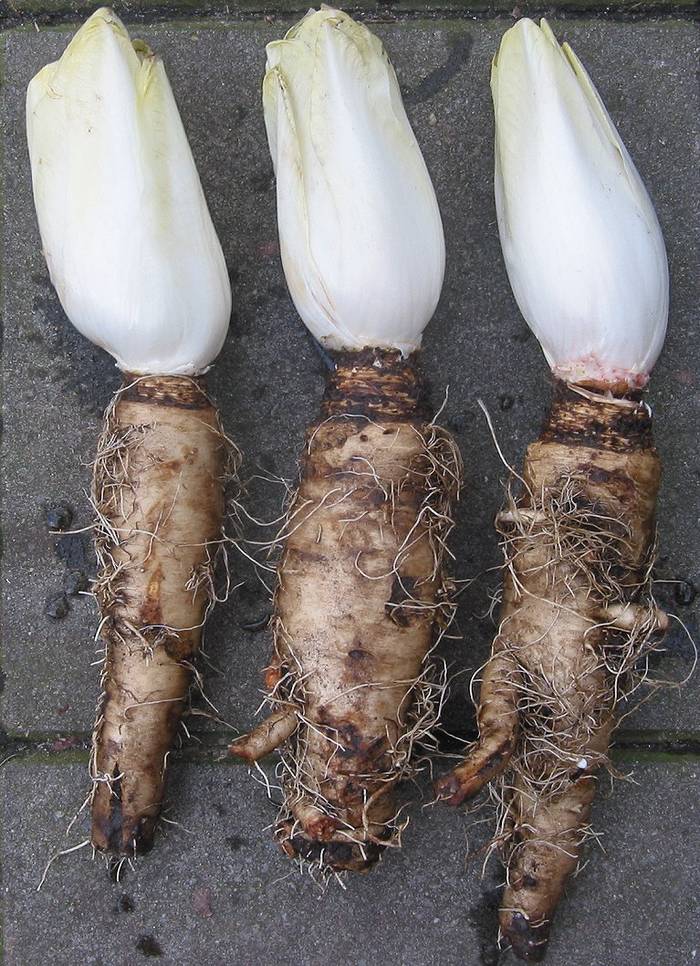
No machine-readable author provided. Rasbak assumed (based on copyright claims). · CC BY-SA 3.0
Belgian endive
Plant·Cichorium intybus var. foliosum
Full sun
Sun
Dry to moist soil
Water
Well-drained soil
Drainage
Not recorded
Hardiness
Coverage · 86 fields
Growth and size10 fields
Plant type
Plant
AI estimate100 % agree
Spread
50 cm“Cichorium intybus is a PERENNIAL growing to 1.5 m (5ft) by 0.5 m (1ft 8in) at a fast rate.”
Height at age
—
empty
Spacing
30 cm (at least 15 cm)
AI estimate55 % agree
Growth rate
Fast“Cichorium intybus is a PERENNIAL growing to 1.5 m (5ft) by 0.5 m (1ft 8in) at a fast rate.”
Habit
—
empty
Root depth
Taproot“The root pattern is a tap root similar to a carrot going directly down [1-2].”
Forest garden layer
Herb layer“Common chicory (Cichorium intybus) is a somewhat woody, perennial herbaceous plant of the family Asteraceae, usually with bright blue flowers, rarely white or pink.”
Lifespan
~2 years
AI estimatenot measured yet
Roots6 fields
Storage organ
None“It does not multiply vegetatively: it has no rhizomes, runners, suckers or offspring bulbs or tubers.”
Spreads
No“It does not multiply vegetatively: it has no rhizomes, runners, suckers or offspring bulbs or tubers.”
Lateral spread in cm
—
empty
Root depth in cm
—
empty
Mycorrhiza
Arbuscular (AM)
AI estimatenot measured yet
Light, water and soil9 fields
Sun
Full sun“Prefers a sunny position in any moderately fertile well-drained moisture retentive soil.”
Hours of sun
6–12 h
AI estimatenot measured yet
Water
Dry, moist · best: moist · Medium · 2–4 l/day“It prefers moist soil.”PFAFpartly“It often self-sows freely when well-sited, especially if it is growing in a dry alkaline soil.”
Tolerates waterlogging
—
empty
Soil type
Sand, loam, clay · best: loam“Suitable for: light (sandy), medium (loamy) and heavy (clay) soils and prefers well-drained soil.”PFAFpartly“grows best on mellow, deeply tilled, fertile soil or sandy loam”
pH
Drainage
Well drained“Suitable for: light (sandy), medium (loamy) and heavy (clay) soils and prefers well-drained soil.”
Compacted soil
Copes fairly well
AI estimatenot measured yet
Climate5 fields
Hardiness
—
empty
Killing frost
—
empty
Growing temperature
6–35 °C · optimal 10–30 °C
AI estimatenot measured yet
Chill hours
0 h
AI estimatenot measured yet
Care (becomes tasks in Manage)5 fields
Sowing
May · lasts 61 days“Seed - sow the wild form or cultivars being grown for their roots in May or June in situ.”
Sowing appears 3 times with different timing.
Sowing
April · lasts 30 days“Cultivars being grown for their edible leaves can be sown in April for a summer crop or in June/July for a winter crop.”
Sowing appears 3 times with different timing.
Sowing
June · lasts 61 days“Cultivars being grown for their edible leaves can be sown in April for a summer crop or in June/July for a winter crop.”
Sowing appears 3 times with different timing.
Watering
After rain · lasts 180 days
AI estimatenot measured yet
Weeding
After the previous stage · 14 days after · lasts 60 days
AI estimatenot measured yet
Through the year4 fields
Flowering
July · lasts 123 days“It is in flower from July to October, and the seeds ripen from August to October.”
Fruiting
August · lasts 92 days“It is in flower from July to October, and the seeds ripen from August to October.”
Harvest
December · lasts 151 days“As traditionally grown, they are available from December to April in temperate climates, making them unusual.”
Leafing out
Once the chill need is met“The root is then allowed to re-sprout indoors in the absence of sunlight, which prevents the leaves from turning green and opening up.”
Edible parts and pollination3 fields
The leaves
Raw or cooked · December–April“The smooth, creamy white leaves may be served cooked or raw.”Wikipedia“The tender leaves are slightly bitter; the whiter the leaf, the less bitter the taste.”Wikipedia“As traditionally grown, they are available from December to April in temperate climates, making them unusual.”
Pollination
Self-fertile · hermaphrodite“The species is hermaphrodite (has both male and female organs) and is pollinated by Bees.”PFAF“The plant is self-fertile.”
Pollinated by
Bees“The species is hermaphrodite (has both male and female organs) and is pollinated by Bees.”
Ecology5 fields
Attracts
Pests
Insects that scar the leaves
AI estimatenot measured yet
Diseases
Leaf diseases
AI estimatenot measured yet
Takes up
Potassium, calcium, magnesium
AI estimatenot measured yet
Fixes nitrogen
No
AI estimatenot measured yet
Propagation and names4 fields
Methods
Seed“Seed - sow the wild form or cultivars being grown for their roots in May or June in situ.”
Difficulty
2 / 5
AI estimatenot measured yet
Seed
cold_moist
AI estimatenot measured yet
Not sorted yet35 fields
Fields the parser stores that this page has no row for yet. They show up here automatically, so nothing is hidden.
forage.DK.local_name
Salat-cikorie
AI estimatenot measured yet
forage.DK.edibility_basis
inferred
AI estimatenot measured yet
forage.DK.foraging_months.notes
Cultivated vegetable rather than a wild-foraged plant; traditionally available December to April in temperate climates. Commercially grown endive is available year-round.“Commercially grown Belgian endive are available year-around.”
Wikipediapartly
forage.DK.foraging_months.months
12, 1, 2, 3, 4“As traditionally grown, they are available from December to April in temperate climates, making them unusual.”
forage.US.edible_parts
[{"part":"leaves","caution":"Slightly bitter; the whiter the leaf, the less bitter the taste.","preparation":"raw in salads or as stuffed appetizer leaves","season_months":[12,1,2,3,4]}]“The smooth, creamy white leaves may be served cooked or raw.”Wikipedia“The tender leaves are slightly bitter; the whiter the leaf, the less bitter the taste.”Wikipedia“In the US, the Belgian endive is typically served raw in salads or used to create appetizer dishes of stuffed individual leaves and is considered a gourmet produce item.”Wikipedia“As traditionally grown, they are available from December to April in temperate climates, making them unusual.”
forage.US.edibility_basis
inferred
AI estimatenot measured yet
forage.US.foraging_months.notes
Cultivated vegetable rather than a wild-foraged plant; traditionally available December to April in temperate climates. Commercially grown endive is available year-round.“Commercially grown Belgian endive are available year-around.”
Wikipediapartly
forage.US.foraging_months.months
12, 1, 2, 3, 4“As traditionally grown, they are available from December to April in temperate climates, making them unusual.”
ornamental.basis
documented
AI estimatenot measured yet
ornamental.fragrance.source
none
AI estimate100 % agree
ornamental.confidence
high
AI estimatenot measured yet
ornamental.fall_interest
false
AI estimatenot measured yet
ornamental.evidence_quote
Chicory (Cichorium intybus) is a perennial herbaceous plant with bright blue flowers and green foliage. It does not typically exhibit significant autumn foliage color change. After flowering, it forms an architectural skeleton of dried stems.
AI estimatenot measured yet
ornamental.foliage_colour
green
AI estimate82 % agree
ornamental.foliage_texture
medium
AI estimatenot measured yet
ornamental.winter_structure
architectural_skeleton
AI estimatenot measured yet
ornamental.autumn_foliage_colour
none
AI estimatenot measured yet
care_regime
light
AI estimatenot measured yet
propagation.self_seeding
moderate“It often self-sows freely when well-sited, especially if it is growing in a dry alkaline soil.”
PFAFpartly
propagation.division_season
spring
AI estimatenot measured yet
propagation.establishment_years
1
AI estimate40 % agree
spatial_profile.canopy_density
light
AI estimatenot measured yet
sun_requirement.best
full_sun“Prefers a sunny position in any moderately fertile well-drained moisture retentive soil.”
function_profile.biomass_return.confidence
medium
AI estimatenot measured yet
function_profile.nutrient_flows.consumes
[{"basis":"documented","demand":"moderate","nutrient":"nitrogen","confidence":"high"},{"basis":"documented","demand":"moderate","nutrient":"phosphorus","confidence":"high"},{"basis":"documented","demand":"moderate","n…
AI estimatenot measured yet
function_profile.nutrient_flows.provides
[{"basis":"documented","nutrient":"potassium","mechanism":"mineral_extraction","confidence":"high"},{"basis":"documented","nutrient":"calcium","mechanism":"mineral_extraction","confidence":"high"},{"basis":"documented…
AI estimatenot measured yet
function_profile.biotic_interactions
[{"taxa":["bees","butterflies","flies"],"basis":"documented","valence":"beneficial","relation":"attracts","confidence":"high","evidence_quote":"A good bee plant.","organism_group":"pollinator","ecological_function":"p…“Bees, butterflies, and flies feed upon it.”Wikipedia“Chicory is also grown as a forage crop for livestock.”PFAFpartly“A good bee plant.”Wikipediapartly“'Forage Feast': A variety from France used for human consumption and also for wildlife plots, where animals such as deer might graze.”PFAFpartly“The species is hermaphrodite (has both male and female organs) and is pollinated by Bees.”
function_profile.aromatic_pest_effect.value
false
AI estimate80 % agree
function_profile.aromatic_pest_effect.confidence
low
AI estimatenot measured yet
climate_tolerance.photoperiod_response
long_day
AI estimatenot measured yet
soil_interactions.organic_matter_contribution
medium
AI estimatenot measured yet
component_metadata.growth_cycle
biennial“The plant is a biennial which had been primarily grown for the value of its first-season root in producing the beverage chicory.”
resource_interfaces.inputs
[{"resource":"light","quantity_description":"sunny position"},{"resource":"water","quantity_description":"moist soil preferred"}]“Prefers a sunny position in any moderately fertile well-drained moisture retentive soil.”PFAF“It prefers moist soil.”
resource_interfaces.outputs
[{"resource":"nectar","quantity_description":"nectary; a good bee plant"},{"resource":"habitat","quantity_description":"insect shelter"},{"resource":"seeds","quantity_description":"ripen August to October"},{"resource…“Nectary, Insect shelter.”PFAF“It is in flower from July to October, and the seeds ripen from August to October.”PFAF“used as fertilizer or to improve mulch.”Wikipedia“Bees, butterflies, and flies feed upon it.”