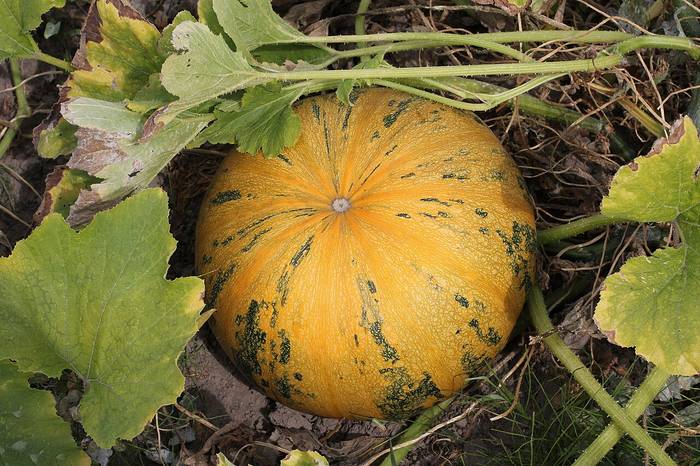
Pumpkin
Pumpkin (Cucurbita pepo) is a plant. It grows best in full sun and has moderate water needs. It grows well with corn maize, garden nasturtium and radish.
About Pumpkin
Pumpkin is an annual plant that grows 30–76 cm tall.[1][2] It grows fast.[1] It is self-fertile, so you only need one.[1]
How to plant pumpkin
Pumpkin does best in full sun, but also copes with part shade.[1] It grows in sandy soil, loam and clay.[1] It does best at a pH of 5.5–5.9.[1] It does not tolerate frost, so wait until the frosts are over before planting out. In a forest garden it climbs the other layers.[1]
Plant plants 90 cm apart, at least 60 cm. It struggles in compacted soil, so keep the soil loose. It can be propagated from seed.[1]
A year with Pumpkin
Spring. Water during dry spells in March–July. Start seeds indoors in April and May.[1] Plant out in April.[1] Protect it from frost and cold in April.[1] Mulch around it in April. Spread well-rotted compost or straw on the soil around the plant. Sow seed in May and June.
Summer. It has yellow flowers in July.[1][2] Feed it in July–October. Use a high-potash liquid feed.
Autumn. Harvest falls in October.[1] The fruit can be eaten.[1] The flowers can be eaten too.[1] The flower buds can be eaten too.[1] The leaves can be eaten too.[1] The young shoots can be eaten too.[1] The seeds can be eaten too.[1] The roots can be eaten cooked.[1] If it tastes bitter, don't eat it. Recorded from the source text, not a safety check. Confirm with a trusted guide before eating anything.
Pests and diseases
Pumpkin can be attacked by melonworm moth, squash vine borer and pickleworm.[2] Diseases include powdery mildew, downy mildew and bacterial wilt.
Companions and wildlife
PumpkinSources
- Plants For A Future — Cucurbita pepo · CC BY 4.0
- Wikipedia — Cucurbita pepo · CC BY-SA 4.0
- CLO-PLA (clonal growth) · Klimešová et al. 2017
Added to the wiki 8 July 2026
Plan your garden with perma
Open app