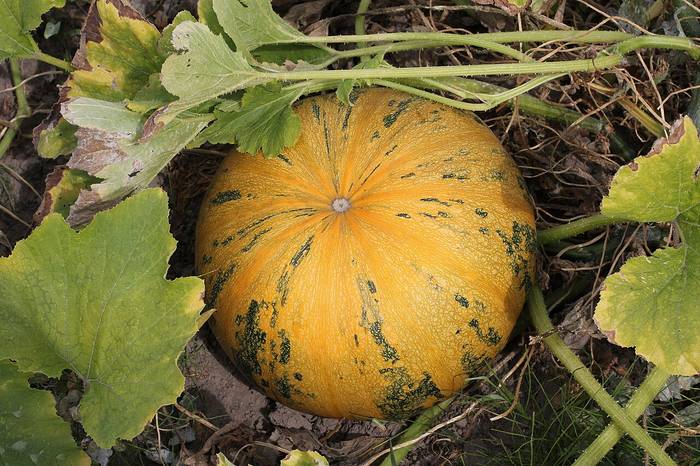
Pumpkin
Plant·Cucurbita pepo
Part shade to full sun
Sun
Moist soil
Water
Not recorded
Drainage
Zones 2–11
Hardiness
Coverage · 129 fields
Growth and size10 fields
Plant type
Plant
AI estimate100 % agree
Height
60 cm · the source gives 30–76 cm“The plants are typically 30–76 centimetres (1–2+1⁄2 ft) high and 61–91 cm (2–3 ft) wide, with yellow flowers.”PFAF“Cucurbita pepo is a ANNUAL CLIMBER growing to 0.6 m (2ft) by 5 m (16ft 5in) at a fast rate.”
Spread
500 cm · other sources: 61 cm, 91 cm“Cucurbita pepo is a ANNUAL CLIMBER growing to 0.6 m (2ft) by 5 m (16ft 5in) at a fast rate.”Wikipedia“The plants are typically 30–76 centimetres (1–2+1⁄2 ft) high and 61–91 cm (2–3 ft) wide, with yellow flowers.”
Height at age
—
empty
Spacing
90 cm (at least 60 cm)
AI estimate55 % agree
Growth rate
Fast“Cucurbita pepo is a ANNUAL CLIMBER growing to 0.6 m (2ft) by 5 m (16ft 5in) at a fast rate.”
Habit
Climbing“Cucurbita pepo is a ANNUAL CLIMBER growing to 0.6 m (2ft) by 5 m (16ft 5in) at a fast rate.”
Root depth
Medium
AI estimate63 % agree
Forest garden layer
Climber“Cucurbita pepo is a ANNUAL CLIMBER growing to 0.6 m (2ft) by 5 m (16ft 5in) at a fast rate.”
Lifespan
~1 years
AI estimatenot measured yet
Roots6 fields
Root form
Fibrous roots
AI estimate43 % agree
Storage organ
None“It does not multiply vegetatively: it has no rhizomes, runners, suckers or offspring bulbs or tubers.”
Spreads
No“It does not multiply vegetatively: it has no rhizomes, runners, suckers or offspring bulbs or tubers.”
Lateral spread in cm
—
empty
Root depth in cm
—
empty
Mycorrhiza
Arbuscular (AM)
AI estimatenot measured yet
Light, water and soil9 fields
Sun
Full sun, light shade, part shade · best: full sun“Requires a rich, well-drained moisture retentive soil and a very warm, sunny and sheltered position.”PFAF“It can grow in semi-shade (light woodland) or no shade.”
Hours of sun
6–8 h
AI estimatenot measured yet
Drought tolerant
—
empty
Tolerates waterlogging
—
empty
Soil type
Sand, loam, clay“Suitable for: light (sandy), medium (loamy) and heavy (clay) soils and prefers well-drained soil.”
pH
4.5–6.8 · best 5.5–5.9“Prefers a pH of 5.5 to 5.9, but tolerates up to 6.8.”PFAF“Suitable pH: mildly acid, neutral and basic (mildly alkaline) soils.”
Drainage
Well-drained, moisture retentive“Suitable for: light (sandy), medium (loamy) and heavy (clay) soils and prefers well-drained soil.”
PFAFpartly
Compacted soil
Copes badly
AI estimatenot measured yet
Climate5 fields
Hardiness
Zone 2–11
AI estimatenot measured yet
Killing frost
-1 °C
AI estimatenot measured yet
Growing temperature
6–40 °C · optimal 17–30 °C“Temperature absolute min: 6 · Temperature absolute max: 40 · Temperature optimal min: 17 · Temperature optimal max: 30”
Chill hours
0 h
AI estimatenot measured yet
Care (becomes tasks in Manage)7 fields
Planting out
After the last frost“Grow them on fast and plant out after the last expected frosts, giving them cloche or frame protection for at least their first few weeks outdoors until they are growing strongly.”
Protection
After the last frost · lasts 21 days · frost“Grow them on fast and plant out after the last expected frosts, giving them cloche or frame protection for at least their first few weeks outdoors until they are growing strongly.”
Sowing
May · lasts 30 days
AI estimatenot measured yet
Watering
After the previous stage · lasts 120 days
AI estimatenot measured yet
Feeding
After the previous stage · lasts 90 days · a high-potash liquid feed
AI estimatenot measured yet
Mulching
After the previous stage · 14 days after · lasts 30 days
AI estimatenot measured yet
Through the year5 fields
Leafing out
Above 13 °C · lasts 14 days“The seed requires a minimum temperature of 13°c to germinate.”PFAF“Germination should take place within 2 weeks.”
Flowering
July · lasts 92 days“It is in flower from July to September, and the seeds ripen from August to October.”
Fruiting
August · lasts 92 days“It is in flower from July to September, and the seeds ripen from August to October.”
Harvest
September · lasts 61 days“The cultivars with larger and rounder fruits are usually called pumpkins, the fruits are harvested in the autumn and can be stored for a few months.”
Dying back
After the first frost
AI estimatenot measured yet
Edible parts and pollination9 fields
The fruit
Young fruit (courgette)
Cooked when picked very small“it is more usual to eat them whilst they are still very small, when they are known as courgettes”PFAF“It is often harvested when still very young when it is called courgettes”
Flowers and flower buds
Cooked or dried for later use · July–September“Flowers and flower buds - cooked or dried for later use”PFAF“It is in flower from July to September”
The seeds
Pollination
Self-fertile · monoecious“The species is monoecious (individual flowers are either male or female, but both sexes can be found on the same plant) and is pollinated by Insects.”Wikipedia“They are also the preferred pollen source for squash bees, which are the primary pollinators in the Americas.”PFAF“The plant is self-fertile.”PFAF“These are insect pollinated but in cool weather it is worthwhile hand pollinating.”Wikipediapartly“Parthenocarpy is known to occur in certain cultivars of C. pepo.”
Pollinated by
Insects, bees“The species is monoecious (individual flowers are either male or female, but both sexes can be found on the same plant) and is pollinated by Insects.”Wikipedia“They are also the preferred pollen source for squash bees, which are the primary pollinators in the Americas.”
Ecology5 fields
Attracts
Insect pollinators, squash bees“The species is monoecious (individual flowers are either male or female, but both sexes can be found on the same plant) and is pollinated by Insects.”Wikipedia“They are also the preferred pollen source for squash bees, which are the primary pollinators in the Americas.”
Pests
Melonworm moth, squash vine borer, pickleworm“It is a host species for the melonworm moth, the squash vine borer, and the pickleworm.”
Diseases
Powdery mildew, downy mildew, bacterial wilt
AI estimatenot measured yet
Takes up
—
empty
Fixes nitrogen
No
AI estimatenot measured yet
Propagation and names4 fields
Difficulty
1 / 5
AI estimatenot measured yet
Seed
—
empty
Not sorted yet69 fields
Fields the parser stores that this page has no row for yet. They show up here automatically, so nothing is hidden.
forage.DK.local_name
Courgette
AI estimatenot measured yet
forage.DK.warnings_da
Undgå at spise hvis planten har en bitter smag.
AI estimatenot measured yet
forage.DK.warnings_en
If it tastes bitter, don't eat it.
AI estimatenot measured yet
forage.DK.prep_cautions
sprouted seed contains a toxic substance in its embryo“The sprouting seed produces a toxic substance in its embryo”
forage.DK.edibility_basis
inferred
AI estimatenot measured yet
forage.DK.foraging_months.notes
Main harvest in late summer and early autumn.“the fruits are harvested in the autumn and can be stored for a few months”
PFAFpartly
forage.DK.foraging_months.months
7, 8, 9“It is in flower from July to September, and the seeds ripen from August to October.”
PFAFpartly
forage.DK.foraging_months.year_round
false
AI estimatenot measured yet
forage.DK.habitat_affinity
disturbed_ground
AI estimatenot measured yet
forage.US.local_name
Zucchini
AI estimatenot measured yet
forage.US.edible_parts
[{"part":"Fruit","caution":null,"preparation":"cooked as a vegetable; picked very young as courgettes"},{"part":"Seed","caution":"The sprouting seed produces a toxic substance in its embryo.","preparation":"raw or coo…
AI estimatenot measured yet
forage.US.prep_cautions
Ensure flowers are free of insects before consumption.
AI estimatenot measured yet
forage.US.edibility_basis
inferred
AI estimatenot measured yet
forage.US.foraging_months.notes
Harvest season varies by climate, generally summer through early fall.
AI estimatenot measured yet
forage.US.foraging_months.months
7, 8, 9
AI estimatenot measured yet
forage.US.foraging_months.year_round
false
AI estimatenot measured yet
forage.US.habitat_affinity
disturbed_ground
AI estimatenot measured yet
forage.TROPICAL.local_name
Courgette
AI estimatenot measured yet
forage.TROPICAL.edible_parts
[{"part":"Fruit","caution":null,"preparation":"cooked as a vegetable"}]
AI estimatenot measured yet
forage.TROPICAL.prep_cautions
Ensure flowers are free of insects before consumption.
AI estimatenot measured yet
forage.TROPICAL.edibility_basis
inferred
AI estimatenot measured yet
forage.TROPICAL.foraging_months.notes
In tropical climates, fruiting can occur year-round with sufficient water and warmth.
AI estimatenot measured yet
forage.TROPICAL.foraging_months.year_round
true
AI estimatenot measured yet
forage.TROPICAL.habitat_affinity
disturbed_ground
AI estimatenot measured yet
ornamental.basis
documented
AI estimatenot measured yet
ornamental.fragrance.source
none
AI estimate100 % agree
ornamental.confidence
high
AI estimatenot measured yet
ornamental.flower_colour
yellow“The plants are typically 30–76 centimetres (1–2+1⁄2 ft) high and 61–91 cm (2–3 ft) wide, with yellow flowers.”
ornamental.evidence_quote
Cucurbita pepo, commonly known as courgette or zucchini, produces prominent yellow flowers and green foliage. As an annual, it does not exhibit autumn foliage color change or significant winter structure.
AI estimatenot measured yet
ornamental.foliage_colour
green
AI estimate82 % agree
ornamental.foliage_texture
medium
AI estimatenot measured yet
ornamental.winter_structure
none
AI estimatenot measured yet
ornamental.autumn_foliage_colour
none
AI estimatenot measured yet
care_regime
routine
AI estimatenot measured yet
propagation.self_seeding
light
AI estimate20 % agree
propagation.establishment_years
0
AI estimate40 % agree
sun_requirement.best
full_sun“Requires a rich, well-drained moisture retentive soil and a very warm, sunny and sheltered position.”
forage_proposals.DK.edibility_tier.tier
choice
AI estimatenot measured yet
forage_proposals.DK.edibility_tier.confidence
high
AI estimatenot measured yet
forage_proposals.DK.edibility_tier.evidence_quote
Courgette (Cucurbita pepo) is widely cultivated and consumed as a vegetable, with both the fruit and flowers being edible and highly regarded culinarily.
AI estimatenot measured yet
forage_proposals.US.edibility_tier.tier
choice
AI estimatenot measured yet
forage_proposals.US.edibility_tier.confidence
high
AI estimatenot measured yet
forage_proposals.US.edibility_tier.evidence_quote
Zucchini (Cucurbita pepo) is a common garden vegetable, with its immature fruits and flowers being edible and popular in various cuisines.
AI estimatenot measured yet
forage_proposals.TROPICAL.edibility_tier.tier
choice
AI estimatenot measured yet
forage_proposals.TROPICAL.edibility_tier.confidence
high
AI estimatenot measured yet
forage_proposals.TROPICAL.edibility_tier.evidence_quote
In tropical regions, Cucurbita pepo varieties are cultivated for their edible fruits and flowers, which are a staple in many diets.
AI estimatenot measured yet
function_profile.biomass_return.confidence
medium
AI estimatenot measured yet
function_profile.nutrient_flows.consumes
[{"basis":"documented","demand":"heavy","nutrient":"nitrogen","confidence":"high"},{"basis":"documented","demand":"high","nutrient":"phosphorus","confidence":"high"},{"basis":"documented","demand":"high","nutrient":"p…
AI estimatenot measured yet
function_profile.biotic_interactions
[{"taxa":["insects"],"basis":"documented","valence":"beneficial","relation":"attracts","confidence":"high","evidence_quote":"The species is monoecious (individual flowers are either male or female, but both sexes can …“The species is monoecious (individual flowers are either male or female, but both sexes can be found on the same plant) and is pollinated by Insects.”Wikipedia“They are also the preferred pollen source for squash bees, which are the primary pollinators in the Americas.”Wikipedia“It is a host species for the melonworm moth, the squash vine borer, and the pickleworm.”
function_profile.aromatic_pest_effect.value
false
AI estimate80 % agree
function_profile.aromatic_pest_effect.confidence
high
AI estimatenot measured yet
function_profile.structural_interfaces.provides_shelter.basis
inferred
AI estimatenot measured yet
function_profile.structural_interfaces.provides_shelter.kinds
shade
AI estimatenot measured yet
function_profile.structural_interfaces.provides_shelter.confidence
medium
AI estimatenot measured yet
function_profile.structural_interfaces.provides_shelter.evidence_quote
Large leaves can provide some ground shade for soil moisture retention.
AI estimatenot measured yet
function_profile.structural_interfaces.requires_shelter.basis
documented
AI estimatenot measured yet
function_profile.structural_interfaces.requires_shelter.kinds
frost
AI estimatenot measured yet
function_profile.structural_interfaces.requires_shelter.stage
establishment
AI estimatenot measured yet
function_profile.structural_interfaces.requires_shelter.confidence
high
AI estimatenot measured yet
function_profile.structural_interfaces.requires_shelter.evidence_quote
Young plants are susceptible to wind damage and frost.
AI estimatenot measured yet
function_profile.structural_interfaces.requires_physical_support.basis
documented
AI estimatenot measured yet
function_profile.structural_interfaces.requires_physical_support.mechanism
scrambler
AI estimatenot measured yet
function_profile.structural_interfaces.requires_physical_support.confidence
high
AI estimatenot measured yet
function_profile.structural_interfaces.requires_physical_support.evidence_quote
Vining varieties of Cucurbita pepo will sprawl and can benefit from trellising or other physical support to keep fruit off the ground and save space.
AI estimatenot measured yet
climate_tolerance.photoperiod_response
day_neutral“Most cultivars are day-length neutral and so are able to flower and fruit throughout the British summer.”
soil_interactions.organic_matter_contribution
medium
AI estimatenot measured yet
component_metadata.growth_cycle
annual“Cucurbita pepo is a ANNUAL CLIMBER growing to 0.6 m (2ft) by 5 m (16ft 5in) at a fast rate.”
resource_interfaces.inputs
[{"resource":"light","quantity_description":"A very warm, sunny and sheltered position."},{"resource":"shade","quantity_description":"Tolerates semi-shade (light woodland) or no shade; tolerates light shade."},{"resou…“Requires a rich, well-drained moisture retentive soil and a very warm, sunny and sheltered position.”PFAF“It can grow in semi-shade (light woodland) or no shade.”PFAF“It prefers moist soil.”PFAF“Cucurbita pepo is a ANNUAL CLIMBER growing to 0.6 m (2ft) by 5 m (16ft 5in) at a fast rate.”PFAFpartly“The species is monoecious (individual flowers are either male or female, but both sexes can be found on the same plant) and is pollinated by Insects.”
resource_interfaces.outputs
[{"resource":"fruit","quantity_description":"Fruit eaten cooked as a vegetable; harvested young as courgettes or left to mature as pumpkins/marrows."},{"resource":"seeds","quantity_description":"Seed contains 34-54% s…“Fruit - cooked. Used as a vegetable, it has a very mild flavour and is very watery[K].”Wikipedia“They are also the preferred pollen source for squash bees, which are the primary pollinators in the Americas.”PFAF“A fast-growing plant, trailing forms can be used to provide a summer screen.”PFAFpartly“The seed contains 34 - 54% of a semi-drying oil.”