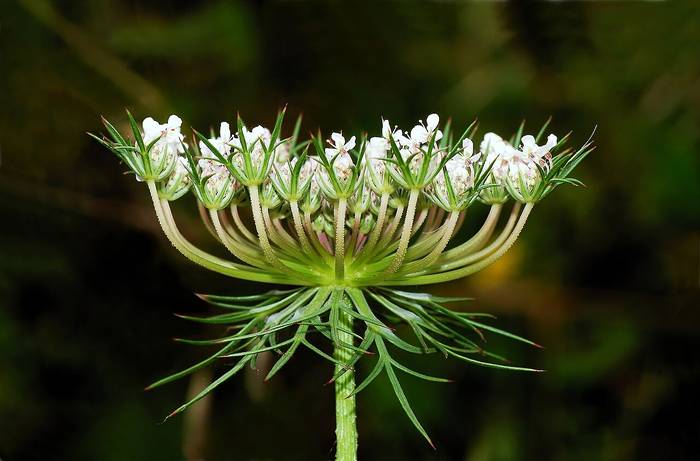
Wild carrot
Wild carrot (Daucus carota) is a plant. It grows best in full sun and has moderate water needs. It grows well with tomato, lettuce and common pea.
About Wild carrot
Wild carrot is a biennial plant that grows 60 cm tall.[1][2] It is self-fertile, so you only need one.[1] Wild carrot grows wild in Denmark.
The flowers give nectar and pollen to pollinators.[1][2] It gives shelter to wildlife.[1]
How to plant wild carrot
Wild carrot does best in full sun, but also copes with part shade.[1][2] It grows in sandy soil, loam and clay, as long as the soil is well drained.[1] It does best at a pH of 5.8–6.8.[1] In a forest garden it belongs in the herb layer.[2]
Plant plants 8 cm apart, at least 5 cm. It struggles in compacted soil, so keep the soil loose. It can be propagated from seed.[1]
A year with Wild carrot
Spring. Sow seed in April and May.[1] It has white and purple flowers in May–July.[1]
Summer. Water during dry spells in June–September. Sow seed in August–October.[1]
Autumn. Harvest falls in September–April.[1] The flowers can be eaten.[1][2] The roots can be eaten cooked.[1][2] The seeds can be eaten too.[1][2] The leaves can be eaten too.[2] Poisonous plants look similar, so be sure what you are picking. Recorded from the source text, not a safety check. Confirm with a trusted guide before eating anything.
Pests and diseases
Wild carrot can be attacked by pests of cultivated carrot.[1] Diseases include diseases of cultivated carrot.[1]
Companions and wildlife
Wild carrotSources
- Plants For A Future — Daucus carota · CC BY 4.0
- Wikipedia — Daucus carota · CC BY-SA 4.0
- CLO-PLA (clonal growth) · Klimešová et al. 2017
Added to the wiki 31 May 2026
Plan your garden with perma
Open app