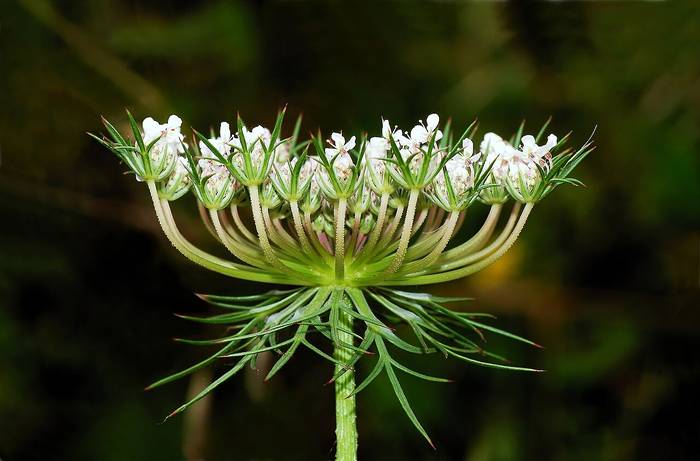
Alvesgaspar · CC BY-SA 3.0
Wild carrot
Plant·Daucus carota
Part shade to full sun
Sun
Moist soil
Water
Well-drained soil
Drainage
Zones 3–9
Hardiness
Coverage · 125 fields
Growth and size10 fields
Height
60 cm · other sources: 100 cm“Daucus carota is a BIENNIAL growing to 0.6 m (2ft) by 0.3 m (1ft in) at a medium rate.”Wikipedia“grows to 30–100 cm (1–3 ft), rarely 120 cm (4 ft) tall”
Spread
30 cm“Daucus carota is a BIENNIAL growing to 0.6 m (2ft) by 0.3 m (1ft in) at a medium rate.”
Height at age
—
empty
Spacing
8 cm (at least 5 cm)
AI estimate55 % agree
Growth rate
Medium“Daucus carota is a BIENNIAL growing to 0.6 m (2ft) by 0.3 m (1ft in) at a medium rate.”
Habit
Columnar
AI estimate50 % agree
Forest garden layer
Herb layer“The wild carrot is a herbaceous, somewhat variable biennial plant”
Lifespan
~2 years
AI estimatenot measured yet
Roots6 fields
Storage organ
None“It does not multiply vegetatively: it has no rhizomes, runners, suckers or offspring bulbs or tubers.”
CLO-PLA (clonal growth)partly
Spreads
No“It does not multiply vegetatively: it has no rhizomes, runners, suckers or offspring bulbs or tubers.”
CLO-PLA (clonal growth)partly
Lateral spread in cm
—
empty
Root depth in cm
—
empty
Mycorrhiza
—
empty
Light, water and soil9 fields
Sun
Full sun, light shade, part shade · best: full sun“Prefers a sunny position and a well-drained neutral to alkaline soil.”Wikipedia“It thrives best in sun to partial shade.”
Hours of sun
6–8 h
AI estimatenot measured yet
Drought tolerant
—
empty
Tolerates waterlogging
—
empty
Soil type
Sand, loam, clay“Suitable for: light (sandy), medium (loamy) and heavy (clay) soils and prefers well-drained soil.”
Compacted soil
Copes badly
AI estimatenot measured yet
Climate5 fields
Hardiness
Zone 3–9
AI estimatenot measured yet
Killing frost
0 °C“Killing temp. early growth: 0”EcoCrop's figure is frost during early growth (spring frost on new shoots), not winter cold.
Growing temperature
3–30 °C · optimal 15–24 °C“Temperature absolute min: 3 · Temperature absolute max: 30 · Temperature optimal min: 15 · Temperature optimal max: 24”
Chill hours
0 h
AI estimatenot measured yet
Native range
AD, AF, AL, AM, AT, AZ, BA, BE, BG, BY, CH, CN, CV, CY, CZ, DE, DK, DZ, EE, ER, ES, ET, FR, GB, GE, GG, GI, GR, HK, HR, HU, IE, IL, IN, IQ, IR, IT, JE, JO, KG, KZ, LB, LI, LT, LU, LV, LY, MA, MC, MD, ME, MK, MO, MT, NL, NO, NP, PK, PL, PT, RO, RS, RU, SE, SI, SK, SM, SY, TJ, TM, TN, TR, TW, UA, UZ, VA, XK
Care (becomes tasks in Manage)7 fields
Sowing
April“Seed - sow August/September or April in situ.”
Sowing appears 3 times with different timing.
Sowing
August · lasts 61 days“Seed - sow August/September or April in situ.”
Sowing appears 3 times with different timing.
Sowing
After the last frost · 14 days after · lasts 30 days
Sowing appears 3 times with different timing.
AI estimatenot measured yet
Watering
June · lasts 90 days
AI estimatenot measured yet
Weeding
After the previous stage · 14 days after · lasts 60 days
AI estimatenot measured yet
Mulching
After the previous stage · 30 days after
AI estimatenot measured yet
Feeding
After the previous stage · 45 days after · balanced liquid feed
AI estimatenot measured yet
Through the year3 fields
Flowering
June · lasts 92 days“It is in flower from June to August, and the seeds ripen from August to September.”
Fruiting
August · lasts 61 days“It is in flower from June to August, and the seeds ripen from August to September.”
Harvest
After the first frost · lasts 180 days
AI estimatenot measured yet
Edible parts and pollination6 fields
The flowers
The roots
The seeds
The leaves
—“The leaves and seeds are also edible.”Wikipedia“Like many other species of Apiaceae, the leaves of the wild carrot may cause phytophotodermatitis; skin contact with the foliage, especially wet foliage, can cause skin irritation in some people, so caution should be used when handling the plant.”
Ecology6 fields
Attracts
Flies, beetles, butterflies, wasps, small insects, wildlife“The species is hermaphrodite (has both male and female organs) and is pollinated by Flies, beetles.”PFAF“Attracts butterflies”Wikipedia“Like most members of the umbellifer family, it attracts wasps to its small flowers in its native land, but where it has been introduced, it attracts very few wasps.”PFAF“It provides nectar and pollen to small insects”PFAF“It is noted for attracting wildlife.”
Pests
Pests of cultivated carrot“It can act as an alternative host for pests and diseases of the cultivated carrots.”
Diseases
Diseases of cultivated carrot“It can act as an alternative host for pests and diseases of the cultivated carrots.”
Takes up
Potassium
AI estimatenot measured yet
Fixes nitrogen
No
AI estimatenot measured yet
Mycorrhiza
Yes
AI estimatenot measured yet
Propagation and names4 fields
Difficulty
2 / 5
AI estimatenot measured yet
Seed
Cold stratification improves germination.“The seed germinates better if it is given a period of cold stratification.”
Names
75 names in 35 languagesAlmindelig Brandbæger, Gulerod, Kanadisk Gyldenris, Klæbrig Brandbæger, Sildig Gyldenris
Not sorted yet69 fields
Fields the parser stores that this page has no row for yet. They show up here automatically, so nothing is hidden.
forage.DK.local_name
Vild gulerod
AI estimatenot measured yet
forage.DK.warnings_da
Giftige planter ligner den, så vær sikker på, hvad du plukker.
AI estimatenot measured yet
forage.DK.warnings_en
Poisonous plants look similar, so be sure what you are picking.
AI estimatenot measured yet
forage.DK.prep_cautions
Handling carrot foliage, especially wet foliage, can cause irritation and vesication., Carrots sometimes cause allergic reactions in some people., Wild carrot must never be collected casually unless identification is certain., Poisonous look-alikes may grow nearby.“Handling carrot foliage, especially wet foliage, can cause irritation and vesication.”PFAF“Carrots sometimes cause allergic reactions in some people.”PFAF“Wild carrot must never be collected casually unless identification is certain.”PFAF“Poisonous look-alikes may grow nearby.”
forage.DK.edibility_basis
inferred
AI estimatenot measured yet
forage.DK.foraging_months.notes
Flowers June to August; seeds ripen August to September.“It is in flower from June to August, and the seeds ripen from August to September.”
forage.DK.foraging_months.months
7, 8, 9, 10“It is in flower from June to August, and the seeds ripen from August to September.”
PFAFpartly
forage.DK.foraging_months.year_round
false
AI estimatenot measured yet
forage.DK.habitat_affinity
coast, disturbed_ground, verge“Cultivated and waste land, amongst grass, especially by the sea and on chalk.”Wikipedia“It is commonly found in meadows, along roadsides and in unused fields.”
forage.US.local_name
Wild Carrot
AI estimatenot measured yet
forage.US.edible_parts
[{"part":"flowers","preparation":"french-fried or battered and fried","season_months":[6,7,8]},{"part":"root","caution":"edible while young; quickly becomes too woody to consume","preparation":"cooked"},{"part":"seeds…“Edible Parts: Flowers Root”Wikipedia“The leaves and seeds are also edible.”Wikipedia“Like the cultivated carrot, the wild carrot root is edible while young, but quickly becomes too woody to consume.”Wikipedia“Like many other species of Apiaceae, the leaves of the wild carrot may cause phytophotodermatitis; skin contact with the foliage, especially wet foliage, can cause skin irritation in some people, so caution should be used when handling the plant.”PFAF“The flower clusters can be french-fried to produce a carrot-flavoured gourmet's delight.”PFAF“Root - cooked.”PFAF“The aromatic seed is used as a flavouring in stews etc.”Wikipedia“The flowers are mainly produced from June to August, rarely also in May or September.”PFAFpartly“It is in flower from June to August, and the seeds ripen from August to September.”
forage.US.prep_cautions
Handling carrot foliage, especially wet foliage, can cause irritation and vesication., Carrots sometimes cause allergic reactions in some people., Wild carrot must never be collected casually unless identification is certain., Poisonous look-alikes may grow nearby.“Handling carrot foliage, especially wet foliage, can cause irritation and vesication.”PFAF“Carrots sometimes cause allergic reactions in some people.”PFAF“Wild carrot must never be collected casually unless identification is certain.”PFAF“Poisonous look-alikes may grow nearby.”
forage.US.edibility_basis
inferred
AI estimatenot measured yet
forage.US.foraging_months.notes
Flowers June to August; seeds ripen August to September.“It is in flower from June to August, and the seeds ripen from August to September.”
forage.US.foraging_months.months
7, 8, 9, 10“It is in flower from June to August, and the seeds ripen from August to September.”
PFAFpartly
forage.US.foraging_months.year_round
false
AI estimatenot measured yet
forage.US.habitat_affinity
verge, disturbed_ground“It is commonly found in meadows, along roadsides and in unused fields.”PFAF“Cultivated and waste land, amongst grass, especially by the sea and on chalk.”
forage.TROPICAL.edible_parts
[{"part":"root","caution":null,"preparation":"raw or cooked","season_months":[]}]
AI estimatenot measured yet
forage.TROPICAL.prep_cautions
Leaves can cause skin irritation in some individuals., Ensure correct identification to avoid poisonous lookalikes.
AI estimatenot measured yet
forage.TROPICAL.edibility_basis
inferred
AI estimatenot measured yet
forage.TROPICAL.foraging_months.notes
Foraging in tropical regions would depend on local climate and growing seasons.
AI estimatenot measured yet
forage.TROPICAL.foraging_months.year_round
false
AI estimatenot measured yet
forage.TROPICAL.habitat_affinity
disturbed_ground
AI estimatenot measured yet
ornamental.basis
documented
AI estimatenot measured yet
ornamental.fragrance.source
foliage“The whole plant, when bruised, gives off an aniseed-like scent.”
ornamental.fragrance.intensity
subtle“The strong carrot smell of crushed root and foliage is helpful but should not be treated as the only test.”
PFAFpartly
ornamental.confidence
high
AI estimatenot measured yet
ornamental.fall_interest
false
AI estimatenot measured yet
ornamental.evidence_quote
The flowers are small and white, borne in dense compound umbels. The foliage is finely divided and green, with a subtle scent when crushed. After flowering, the seed heads remain, providing some winter interest.
AI estimatenot measured yet
ornamental.foliage_colour
green
AI estimate82 % agree
ornamental.foliage_texture
fine“The leaves are tripinnate, finely divided and lacy, and overall triangular in shape.”
ornamental.winter_structure
seed_heads“The dried umbels can detach from the plant, and have been suggested to have tumbleweed characteristics.”
Wikipediapartly
ornamental.autumn_foliage_colour
none
AI estimatenot measured yet
care_regime
light
AI estimatenot measured yet
propagation.establishment_years
2“As a biennial, it germinates and forms a root-and-rosette stage in the first season, then flowers and seeds in the second.”
spatial_profile.canopy_density
light
AI estimatenot measured yet
sun_requirement.best
full_sun“Prefers a sunny position and a well-drained neutral to alkaline soil.”
forage_proposals.DK.edibility_tier.tier
caution“Wild carrot must never be collected casually unless identification is certain.”
PFAFpartly
forage_proposals.DK.edibility_tier.confidence
high
AI estimatenot measured yet
forage_proposals.DK.edibility_tier.evidence_quote
The root of wild carrot is edible and can be eaten raw or cooked. The leaves are also edible when cooked, but some people may experience skin irritation from handling them.
AI estimatenot measured yet
forage_proposals.US.edibility_tier.tier
caution“Wild carrot must never be collected casually unless identification is certain.”
PFAFpartly
forage_proposals.US.edibility_tier.confidence
high
AI estimatenot measured yet
forage_proposals.US.edibility_tier.evidence_quote
Wild carrot roots are edible and can be consumed raw or cooked. The leaves are also edible after cooking, though caution is advised due to potential skin irritation.
AI estimatenot measured yet
forage_proposals.TROPICAL.edibility_tier.tier
edible
AI estimatenot measured yet
forage_proposals.TROPICAL.edibility_tier.confidence
high
AI estimatenot measured yet
forage_proposals.TROPICAL.edibility_tier.evidence_quote
In tropical regions, the roots and cooked leaves of Daucus carota are edible, provided proper identification to avoid toxic lookalikes.
AI estimatenot measured yet
function_profile.biomass_return.confidence
low
AI estimatenot measured yet
function_profile.nutrient_flows.consumes
[{"basis":"documented","demand":"high","nutrient":"potassium","confidence":"high"},{"basis":"documented","demand":"moderate","nutrient":"phosphorus","confidence":"high"},{"basis":"documented","demand":"moderate","nutr…
AI estimatenot measured yet
function_profile.nutrient_flows.provides
[{"basis":"inferred","nutrient":"potassium","mechanism":"mineral_extraction","confidence":"low"}]
AI estimatenot measured yet
function_profile.biotic_interactions
[{"taxa":["flies","beetles"],"basis":"documented","valence":"beneficial","relation":"attracts","confidence":"high","evidence_quote":"The species is hermaphrodite (has both male and female organs) and is pollinated by …“The species is hermaphrodite (has both male and female organs) and is pollinated by Flies, beetles.”PFAF“Attracts butterflies”Wikipedia“Like most members of the umbellifer family, it attracts wasps to its small flowers in its native land, but where it has been introduced, it attracts very few wasps.”Wikipedia“One study in Portugal found that the dark florets contributed to visitation by the varied carpet beetle Anthrenus verbasci”PFAF“It provides nectar and pollen to small insects”PFAF“It is noted for attracting wildlife.”PFAF“contributes fine-textured cover beneath desert shrubs”PFAF“likely feeds small seed-eating animals once fruits mature”PFAF“It can act as an alternative host for pests and diseases of the cultivated carrots.”PFAF“it is a food plant for caterpillars of the Swallow-tail Butterfly”
function_profile.aromatic_pest_effect.value
true
AI estimate80 % agree
function_profile.aromatic_pest_effect.confidence
medium
AI estimatenot measured yet
function_profile.structural_interfaces.provides_shelter.basis
documented“it can provide a microclimate of cooler, moister air for lettuce, when intercropped with it”
function_profile.structural_interfaces.provides_shelter.kinds
shade“it can provide a microclimate of cooler, moister air for lettuce, when intercropped with it”
function_profile.structural_interfaces.provides_shelter.confidence
medium“it can provide a microclimate of cooler, moister air for lettuce, when intercropped with it”
function_profile.structural_interfaces.provides_shelter.evidence_quote
it can provide a microclimate of cooler, moister air for lettuce, when intercropped with it“it can provide a microclimate of cooler, moister air for lettuce, when intercropped with it”
function_profile.structural_interfaces.requires_shelter.basis
inferred
AI estimatenot measured yet
function_profile.structural_interfaces.requires_shelter.confidence
low
AI estimatenot measured yet
function_profile.structural_interfaces.provides_physical_support.basis
inferred
AI estimatenot measured yet
function_profile.structural_interfaces.provides_physical_support.confidence
medium
AI estimatenot measured yet
function_profile.structural_interfaces.requires_physical_support.basis
inferred
AI estimatenot measured yet
function_profile.structural_interfaces.requires_physical_support.confidence
medium
AI estimatenot measured yet
climate_tolerance.photoperiod_response
long_day
AI estimatenot measured yet
soil_interactions.organic_matter_contribution
low
AI estimatenot measured yet
component_metadata.growth_cycle
biennial“Daucus carota is a BIENNIAL growing to 0.6 m (2ft) by 0.3 m (1ft in) at a medium rate.”
resource_interfaces.inputs
[{"resource":"light","quantity_description":"prefers a sunny position"},{"resource":"water","quantity_description":"prefers moist soil"},{"resource":"pollination","quantity_description":"pollinated by flies and beetle…“Prefers a sunny position and a well-drained neutral to alkaline soil.”PFAF“It prefers moist soil.”PFAF“The species is hermaphrodite (has both male and female organs) and is pollinated by Flies, beetles.”
resource_interfaces.outputs
[{"resource":"pollinator_services","quantity_description":"flowers pollinated by flies and beetles"},{"resource":"nectar","quantity_description":"provides nectar to small insects"},{"resource":"pollen","quantity_descr…“The species is hermaphrodite (has both male and female organs) and is pollinated by Flies, beetles.”PFAF“It provides nectar and pollen to small insects, contributes fine-textured cover beneath desert shrubs, and likely feeds small seed-eating animals once fruits mature.”PFAF“the seeds ripen from August to September”PFAF“It is noted for attracting wildlife.”PFAFpartly“The whole plant, when bruised, gives off an aniseed-like scent.”