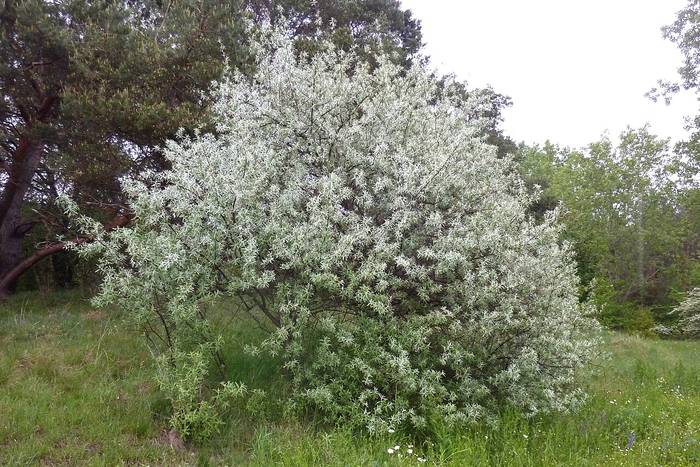
Russian olive
Russian olive (Elaeagnus angustifolia) is a tree. It grows best in full sun and has low water needs.
About Russian olive
Russian olive is a perennial, deciduous tree that grows 3–9 m tall.[1][2] It grows fast.[1] It is self-fertile, so you only need one.[1] It can live for around 50 years.
The flowers give nectar and pollen to pollinators.[1] Birds eat the fruit and spread the seeds.[2] It gives shelter to birds.[1]
How to plant russian olive
Russian olive does best in full sun.[1] It grows in sandy soil, loam and clay, as long as the soil is well drained.[1] It does best at a pH of 6.5–7.5.[1] In a forest garden it belongs in the lower tree layer.[1]
Plant trees 4.5 m apart, at least 3 m. Expect the first harvest 3 years after planting.[3] It can be propagated from seed, from cuttings or by layering.[1]
A year with Russian olive
Spring. It comes into leaf in March–May.
Summer. It has white flowers in June and July.[1] Harvest falls in August.[1] The fruit can be eaten.[1] The seeds can be eaten too.[1] Recorded from the source text, not a safety check. Confirm with a trusted guide before eating anything.
Winter. It rests through the winter.[1] It needs around 400 hours of winter cold to crop well. Prune it in February and March. Cut out dead, damaged, or crossing branches, and suckers. Take a little off to tidy the shape. Less than you think.
Pests and diseases
Diseases include verticillium wilt.
Companions and wildlife
Russian oliveSources
- Plants For A Future — Elaeagnus angustifolia · CC BY 4.0, Plants For A Future
- Wikipedia — Elaeagnus angustifolia · CC BY-SA 4.0
- research.fs.usda.gov
- Berlin tree register · DL-DE-Zero-2.0
Added to the wiki 8 July 2026
Plan your garden with perma
Open app