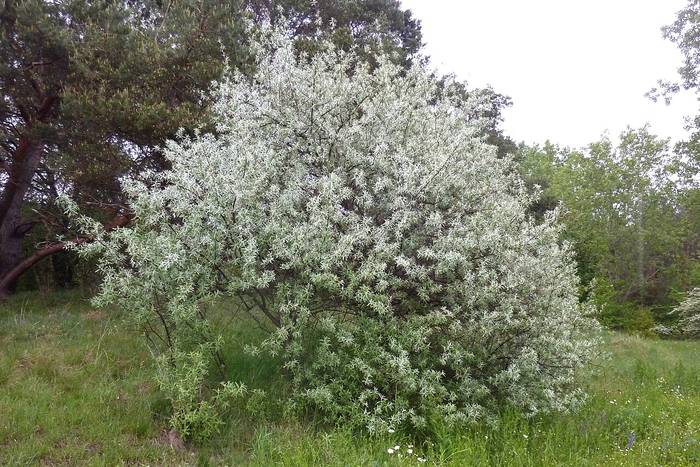
Katrin Schneider / korina.info · CC BY-SA 4.0
Russian olive
Tree·Elaeagnus angustifolia
Full sun
Sun
Dry to moist soil
Water
Well-drained soil
Drainage
Zones 2–8
Hardiness
Coverage · 126 fields
No obvious inconsistencies found.
Growth and size11 fields
Plant type
Deciduous tree“Elaeagnus angustifolia is a deciduous Shrub growing to 7 m (23ft) by 7 m (23ft) at a fast rate.”
Height
700 cm · the source gives 300–900 cm · other sources: 1,100 cm“Mature plants commonly reach about 3–9 m tall and 3–8 m wide, though old trees along waterways can become broader and more substantial than drought-stressed plants on drier ground.”PFAF“Elaeagnus angustifolia is a deciduous Shrub growing to 7 m (23ft) by 7 m (23ft) at a fast rate.”Wikipedia“Elaeagnus angustifolia is a thorny tree growing to 11 metres (35 feet) in height.”
Spread
700 cm · the source gives 300–800 cm“Mature plants commonly reach about 3–9 m tall and 3–8 m wide, though old trees along waterways can become broader and more substantial than drought-stressed plants on drier ground.”PFAF“Elaeagnus angustifolia is a deciduous Shrub growing to 7 m (23ft) by 7 m (23ft) at a fast rate.”
Height at age
—
empty
Size after planting
26 yrs: 7 m tall, 6 m crown · 34 yrs: 7 m tall, 6.5 m crown · 71 yrs: 8.5 m tall, 8.5 m crown“Berlin tree register: 172 trees of this species measured with years since planting, height and crown diameter; median crown 8.5 m and height 8.5 m at 60–100 years after planting (24 trees).”Median of 172 measured trees in Berlin. Years count from planting nursery stock, so a small tree reaches each size later.
Spacing
450 cm (at least 300 cm)
AI estimate55 % agree
Growth rate
Fast“Elaeagnus angustifolia is a deciduous Shrub growing to 7 m (23ft) by 7 m (23ft) at a fast rate.”
Root depth
Deep
AI estimate63 % agree
Forest garden layer
Lower tree layer
AI estimate90 % agree
Lifespan
~50 years
AI estimatenot measured yet
Roots6 fields
Root form
—
empty
Storage organ
None
AI estimate100 % agree
Spreads
—
empty
Lateral spread in cm
—
empty
Root depth in cm
—
empty
Mycorrhiza
—
empty
Light, water and soil9 fields
Hours of sun
6 h
AI estimatenot measured yet
Water
Dry, moist · Low“It prefers dry or moist soil and can tolerate drought.”PFAFpartly“Plants are very drought and wind resistant, they tolerate conditions of considerable salinity and alkalinity.”
Tolerates waterlogging
—
empty
Soil type
Sand, loam, clay · best: sand“Prefers a light sandy soil that is only moderately fertile, succeeding in poor soils and dry soils.”PFAF“Suitable for: light (sandy), medium (loamy) and heavy (clay) soils”
pH
6–8.5 · best 6.5–7.5“Suitable pH: mildly acid, neutral and basic (mildly alkaline) soils”PFAF“can grow in very alkaline and saline soils”
Compacted soil
Copes well
AI estimatenot measured yet
Climate5 fields
Hardiness
Zone 2–8
AI estimatenot measured yet
Killing frost
-1 °C“Killing temp. early growth: -1”EcoCrop's figure is frost during early growth (spring frost on new shoots), not winter cold.
Growing temperature
5–36 °C · optimal 20–32 °C“Temperature absolute min: 5 · Temperature absolute max: 36 · Temperature optimal min: 20 · Temperature optimal max: 32”
Chill hours
400 h
AI estimatenot measured yet
Native range
AF, AM, AZ, CN, GE, GR, HK, IL, IN, IR, JO, KG, KZ, LB, MM, MN, MO, PK, RU, SY, TJ, TM, TR, TW, UZ
Care (becomes tasks in Manage)2 fields
Pruning
February · lasts 28 days · dead, damaged, or crossing branches, and suckers
AI estimatenot measured yet
Watering
After rain · lasts 90 days
AI estimatenot measured yet
Through the year7 fields
Flowering
June · lasts 30 days“It is in flower in June, and the seeds ripen from September to October.”
Fruiting
September · lasts 60 days“It is in flower in June, and the seeds ripen from September to October.”
Harvest
August · lasts 60 days“Fruits from Elaeagnus species are usually harvested in late summer to early autumn, depending on the species and local climate.”
PFAFpartly
Leafing out
After the last frost · lasts 30 days
AI estimatenot measured yet
Dormant
After the first frost · lasts 150 days“Elaeagnus angustifolia is a deciduous Shrub growing to 7 m (23ft) by 7 m (23ft) at a fast rate.”
PFAFpartly
Dying back
After the first frost · lasts 30 days
AI estimatenot measured yet
First harvest
3–5 years after plantingCounted from transplanting a nursery seedling, matching this field's convention directly (Borell, as cited in the USDA FEIS species review). The same page also reports field data on wild (non-planted) trees on Montana rivers where 'the average age of 1st reproduction for Russian-olive on both rivers is around 10 years' — but that is age since germination in the wild, not years after planting a nursery plant, so it is not used as the value here.
Edible parts and pollination5 fields
The fruit
The seeds
Pollination
Self-fertile · hermaphrodite“The species is hermaphrodite (has both male and female organs) and is pollinated by Bees.”PFAF“The plant is self-fertile.”
Pollinated by
Bees“The species is hermaphrodite (has both male and female organs) and is pollinated by Bees.”
Ecology6 fields
Attracts
Bees, butterflies, other beneficial insects, birds, small mammals“The species is hermaphrodite (has both male and female organs) and is pollinated by Bees.”PFAF“Yes – Elaeagnus species, especially autumn olive and silverberry, have flowers that produce nectar and attract pollinators such as bees, butterflies, and other beneficial insects.”Wikipedia“The fruit is readily eaten and the seeds disseminated by many species of birds.”PFAF“The fruit of Elaeagnus species is highly favored by birds and small mammals.”
Pests
—
empty
Diseases
Verticillium wilt
AI estimatenot measured yet
Takes up
Nitrogen
AI estimatenot measured yet
Mycorrhiza
Yes
AI estimatenot measured yet
Propagation and names4 fields
Methods
Seed, half-ripe wood cuttings, mature wood cuttings, layering, root cuttings“Seed - best sown as soon as it is ripe in a cold frame.”PFAF“Cuttings of half-ripe wood, 7 - 10cm with a heel, July/August in a frame.”PFAF“Cuttings of mature wood of the current year's growth, 10 - 12cm with a heel, October/November in a frame.”PFAF“Layering in September/October.”PFAF“Root cuttings in the winter.”
Difficulty
3 / 5
AI estimatenot measured yet
Seed
A warm stratification for 4 weeks followed by 12 weeks cold stratification can help.“A warm stratification for 4 weeks followed by 12 weeks cold stratification can help.”
Not sorted yet71 fields
Fields the parser stores that this page has no row for yet. They show up here automatically, so nothing is hidden.
forage.DK.local_name
Smalbladet sølvblad
AI estimatenot measured yet
forage.DK.prep_cautions
Fruit must be fully ripe before eating raw; under-ripe fruit is quite astringent, Seed case is rather fibrous“The fruit must be fully ripe before it can be enjoyed raw, if even slightly under-ripe it will be quite astringent”PFAF“It can be eaten with the fruit though the seed case is rather fibrous”
forage.DK.edibility_basis
inferred
AI estimatenot measured yet
forage.DK.foraging_months.notes
Fruit is usually harvested in late summer to early autumn; seeds ripen September to October“Fruits from Elaeagnus species are usually harvested in late summer to early autumn, depending on the species and local climate.”
forage.DK.foraging_months.months
9, 10“It is in flower in June, and the seeds ripen from September to October.”
PFAFpartly
forage.DK.foraging_months.year_round
false
AI estimatenot measured yet
forage.US.local_name
Russian olive
AI estimatenot measured yet
forage.US.edible_parts
[{"part":"fruit","caution":"must be fully ripe to eat raw; under-ripe fruit is quite astringent","preparation":"raw or cooked as a seasoning in soups; can also be made into jellies or sherbets"},{"part":"seed","cautio…“Edible Parts: Fruit Seed”PFAF“The fruit must be fully ripe before it can be enjoyed raw, if even slightly under-ripe it will be quite astringent”PFAF“It can be eaten with the fruit though the seed case is rather fibrous”PFAF“Seed - raw or cooked.”PFAFpartly“Fruit - raw or cooked as a seasoning in soups.”
forage.US.prep_cautions
Fruit must be fully ripe before eating raw; under-ripe fruit is quite astringent, Seed case is rather fibrous“The fruit must be fully ripe before it can be enjoyed raw, if even slightly under-ripe it will be quite astringent”PFAF“It can be eaten with the fruit though the seed case is rather fibrous”
forage.US.edibility_basis
inferred
AI estimatenot measured yet
forage.US.foraging_months.notes
Fruit is usually harvested in late summer to early autumn; seeds ripen September to October“Fruits from Elaeagnus species are usually harvested in late summer to early autumn, depending on the species and local climate.”
forage.US.foraging_months.months
9, 10“It is in flower in June, and the seeds ripen from September to October.”
PFAFpartly
forage.US.foraging_months.year_round
false
AI estimatenot measured yet
forage.TROPICAL.edible_parts
[{"part":"fruit","caution":"astringent if unripe","preparation":"raw or cooked","season_months":[8,9]}]
AI estimatenot measured yet
forage.TROPICAL.prep_cautions
Remove seeds before consumption as they are hard.
AI estimatenot measured yet
forage.TROPICAL.edibility_basis
inferred
AI estimatenot measured yet
forage.TROPICAL.foraging_months.months
8, 9
AI estimatenot measured yet
forage.TROPICAL.foraging_months.year_round
false
AI estimatenot measured yet
forage.TROPICAL.habitat_affinity
disturbed_ground, verge
AI estimatenot measured yet
ornamental.basis
documented
AI estimatenot measured yet
ornamental.confidence
high
AI estimatenot measured yet
ornamental.fall_interest
true
AI estimatenot measured yet
ornamental.evidence_quote
Elaeagnus angustifolia, commonly known as Russian olive, is valued for its silvery foliage, fragrant yellow flowers, and persistent yellow fruit. The foliage turns a dull yellow-green in autumn. The bark is also ornamental, often exfoliating.
AI estimatenot measured yet
ornamental.foliage_colour
silver“Its stems, buds, and leaves have a dense covering of silvery to rusty scales.”
ornamental.foliage_texture
fine
AI estimatenot measured yet
ornamental.winter_structure
persistent_fruit, ornamental_bark“It is widely grown across southern and central Europe as a drought- and cold-resistant ornamental plant for its scented flowers, edible fruit, attractive yellow foliage and black bark.”
Wikipediapartly
ornamental.autumn_foliage_colour
yellow_green
AI estimatenot measured yet
care_regime
none
AI estimatenot measured yet
propagation.self_seeding
aggressive
AI estimate20 % agree
propagation.division_season
spring
AI estimatenot measured yet
size_at_age.v
1
AI estimatenot measured yet
size_at_age.basis
years_after_planting
AI estimatenot measured yet
spatial_profile.canopy_density
medium
AI estimatenot measured yet
forage_proposals.DK.edibility_tier.tier
edible
AI estimatenot measured yet
forage_proposals.DK.edibility_tier.confidence
high
AI estimatenot measured yet
forage_proposals.DK.edibility_tier.evidence_quote
The fruit is edible, raw or cooked. It is mealy and dry but sweet.
AI estimatenot measured yet
forage_proposals.US.edibility_tier.tier
edible
AI estimatenot measured yet
forage_proposals.US.edibility_tier.confidence
high
AI estimatenot measured yet
forage_proposals.US.edibility_tier.evidence_quote
The fruit is edible, raw or cooked. It is mealy and dry but sweet.
AI estimatenot measured yet
forage_proposals.TROPICAL.edibility_tier.tier
edible
AI estimatenot measured yet
forage_proposals.TROPICAL.edibility_tier.confidence
high
AI estimatenot measured yet
forage_proposals.TROPICAL.edibility_tier.evidence_quote
The fruit is edible, raw or cooked. It is mealy and dry but sweet.
AI estimatenot measured yet
function_profile.biomass_return.confidence
medium
AI estimatenot measured yet
function_profile.nutrient_flows.consumes
[{"basis":"documented","demand":"low","nutrient":"nitrogen","confidence":"high"},{"basis":"inferred","demand":"moderate","nutrient":"phosphorus","confidence":"medium"},{"basis":"inferred","demand":"moderate","nutrient…“can grow in nutritionally poor soil”
PFAFpartly
function_profile.nutrient_flows.provides
[{"basis":"documented","nutrient":"nitrogen","mechanism":"fixation","confidence":"high","evidence_quote":"It can fix Nitrogen."}]“It can fix Nitrogen.”
function_profile.biotic_interactions
[{"taxa":["bees"],"basis":"documented","valence":"beneficial","relation":"attracts","confidence":"high","evidence_quote":"The species is hermaphrodite (has both male and female organs) and is pollinated by Bees.","org…“The species is hermaphrodite (has both male and female organs) and is pollinated by Bees.”Wikipedia“The fruit is readily eaten and the seeds disseminated by many species of birds.”PFAF“The dense branches provide excellent shelter, nesting, and roosting spots for birds.”PFAF“The fruit of Elaeagnus species is highly favored by birds and small mammals.”Wikipedia“The caterpillars of the high altitude alpine moth Lachana alpherakii use it as a host plant.”
function_profile.aromatic_pest_effect.value
false“No – Elaeagnus does not emit a strong enough smell to act as a pest confuser.”
function_profile.aromatic_pest_effect.confidence
low
AI estimatenot measured yet
function_profile.structural_interfaces.provides_shelter.basis
documented
AI estimatenot measured yet
function_profile.structural_interfaces.provides_shelter.kinds
wind“Agroforestry Services: Windbreak”
function_profile.structural_interfaces.provides_shelter.confidence
high
AI estimatenot measured yet
function_profile.structural_interfaces.provides_shelter.evidence_quote
Its dense growth habit makes it effective as a windbreak and provides shade.
AI estimatenot measured yet
function_profile.structural_interfaces.requires_shelter.basis
taxonomic
AI estimatenot measured yet
function_profile.structural_interfaces.requires_shelter.confidence
high
AI estimatenot measured yet
function_profile.structural_interfaces.provides_physical_support.form
dense_thicket
AI estimatenot measured yet
function_profile.structural_interfaces.provides_physical_support.basis
documented
AI estimatenot measured yet
function_profile.structural_interfaces.provides_physical_support.confidence
medium
AI estimatenot measured yet
function_profile.structural_interfaces.provides_physical_support.evidence_quote
Elaeagnus angustifolia forms dense, thorny thickets that can provide physical support and protection.
AI estimatenot measured yet
function_profile.structural_interfaces.requires_physical_support.basis
taxonomic
AI estimatenot measured yet
function_profile.structural_interfaces.requires_physical_support.confidence
high
AI estimatenot measured yet
climate_tolerance.photoperiod_response
day_neutral
AI estimatenot measured yet
soil_interactions.organic_matter_contribution
medium
AI estimatenot measured yet
component_metadata.growth_cycle
perennial
AI estimate100 % agree
resource_interfaces.inputs
[{"resource":"light","quantity_description":"full sun, growing very well in hot dry positions"},{"resource":"water","quantity_description":"prefers dry or moist soil and can tolerate drought"},{"resource":"pollination…“Requires a position in full sun, growing very well in hot dry positions.”PFAF“It prefers dry or moist soil and can tolerate drought.”PFAF“The species is hermaphrodite (has both male and female organs) and is pollinated by Bees.”
resource_interfaces.outputs
[{"resource":"wind_shelter","quantity_description":"grown as a windbreak"},{"resource":"leaf_litter","quantity_description":"leaf litter and dense growth offer overwintering sites for invertebrates"},{"resource":"grou…“Agroforestry Services: Windbreak”PFAF“The leaf litter and dense growth offer overwintering sites and protection for invertebrates.”PFAF“The shrub provides good ground cover, beneficial for many small creatures.”PFAF“Industrial Crop: Biomass”PFAF“The dense branches provide excellent shelter, nesting, and roosting spots for birds.”PFAF“Yes – Elaeagnus species, especially autumn olive and silverberry, have flowers that produce nectar and attract pollinators such as bees, butterflies, and other beneficial insects.”PFAF“Fruit - raw or cooked as a seasoning in soups.”PFAF“Seed - raw or cooked.”PFAF“Wood - hard, fine-grained. Used for posts, beams, domestic items, it is also much used for carving.”PFAF“An essential oil obtained from the flowers is used in perfumery.”