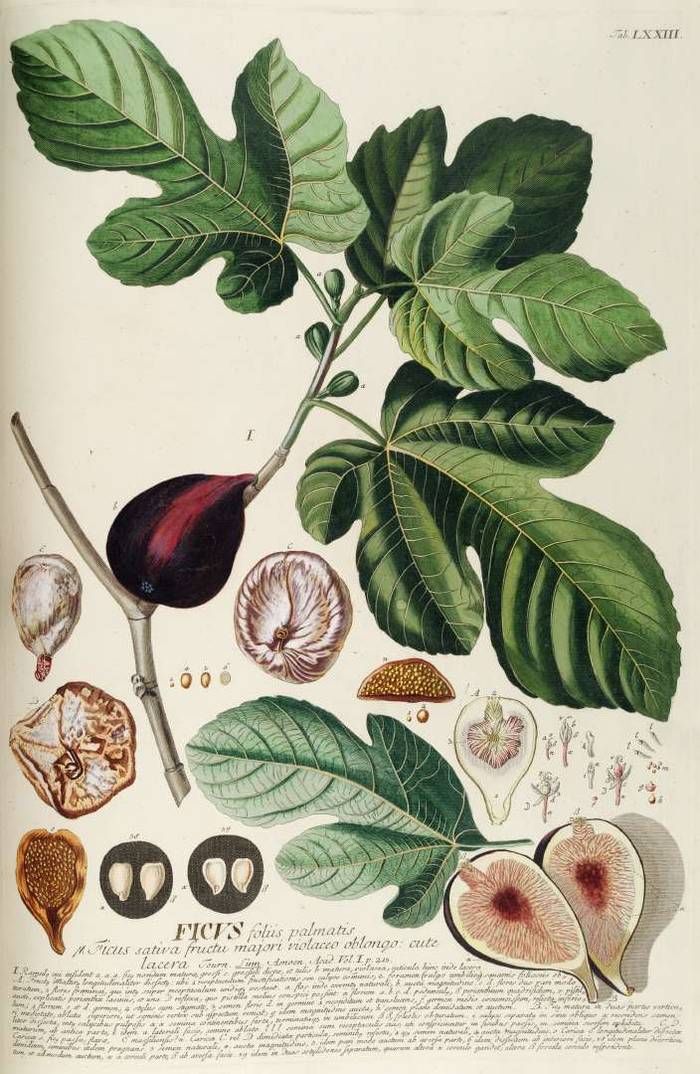
Common fig
Tree·Ficus carica
Part sun to full sun
Sun
Dry to moist soil
Water
Well-drained soil
Drainage
Zones 6–10
Hardiness
Coverage · 134 fields
Growth and size10 fields
Plant type
Deciduous tree“The fig plant is a deciduous tree or large shrub”PFAF“Ficus carica is a deciduous Tree growing to 6 m (19ft) by 6 m (19ft) at a medium rate.”
Height
600 cm · other sources: 700 cm, 1,000 cm“Ficus carica is a deciduous Tree growing to 6 m (19ft) by 6 m (19ft) at a medium rate.”Wikipedia“growing up to 7–10 m (23–33 ft) tall”
Spread
600 cm“Ficus carica is a deciduous Tree growing to 6 m (19ft) by 6 m (19ft) at a medium rate.”
Height at age
—
empty
Spacing
600 cm (at least 450 cm)
AI estimate55 % agree
Growth rate
Medium“Ficus carica is a deciduous Tree growing to 6 m (19ft) by 6 m (19ft) at a medium rate.”
Root depth
Deep
AI estimate63 % agree
Forest garden layer
Lower tree layer
AI estimate90 % agree
Roots6 fields
Root form
—
empty
Storage organ
—
empty
Spreads
By suckers“The root pattern is suckering with new plants from underground runners away from the plant”
Lateral spread in cm
—
empty
Root depth in cm
—
empty
Mycorrhiza
—
empty
Light, water and soil9 fields
Sun
Full sun, light shade · best: full sun“Prefers a very sunny position but tolerates part-day shade when grown on a warm wall”
Hours of sun
6–12 h
AI estimatenot measured yet
Tolerates waterlogging
—
empty
Soil type
Sand, loam, clay · best: loam“Requires a well-drained medium to light loam and some lime rubble incorporated into the soil”PFAF“Suitable for: light (sandy), medium (loamy) and heavy (clay) soils, prefers well-drained soil and can grow in heavy clay and nutritionally poor soils.”
pH
4.3–8.6 · best 6–7“Prefers a pH in the range 6 - 7, but tolerates 4.3 - 8.6.”PFAF“Suitable pH: mildly acid, neutral and basic (mildly alkaline) soils.”
Drainage
Well drained“Requires a well-drained medium to light loam and some lime rubble incorporated into the soil”
Compacted soil
Copes badly
AI estimatenot measured yet
Climate5 fields
Hardiness
Zone 6–10
AI estimatenot measured yet
Killing frost
-1 °C“Killing temp. early growth: -1”EcoCrop's figure is frost during early growth (spring frost on new shoots), not winter cold.
Growing temperature
4–38 °C · optimal 16–26 °C“They grow best in areas where annual daytime temperatures are within the range of 16 - 26°c, but can tolerate 4 - 38°c”
Chill hours
100 h
AI estimatenot measured yet
Care (becomes tasks in Manage)10 fields
Protection
After the first frost“Plant out in late spring after the last expected frosts and give some protection for their first winter outdoors.”
Protection
After the first frost · frost“Specimens are often wrapped in waterproof material to discourage the development of mold and fungus, then covered with a heavy layer of soil and leaves.”Wikipediapartly“People of the Italian diaspora who live in cold-winter climates have the practice of burying imported fig trees to overwinter them and protect the fruiting hard wood from cold.”
Planting out
After the last frost“Plant out in late spring after the last expected frosts and give some protection for their first winter outdoors.”
Watering
After the previous stage“It is important to make sure that the tree still gets ample moisture, especially when the fruits are ripening.”
Watering appears 2 times with different timing.
PFAFpartly
Pruning
After the previous stage · new shoots, to about six leaves“Pinch back the new shoots to about six leaves in order to encourage the second crop.”
Starting indoors
After the last frost · lasts 60 days
AI estimatenot measured yet
Pruning
February · lasts 30 days · new growth that will bear fruit · dead, damaged, or crossing branches, and to maintain an open framework
AI estimatenot measured yet
Feeding
March · lasts 30 days · a balanced granular fertiliser
AI estimatenot measured yet
Mulching
April · lasts 30 days
AI estimatenot measured yet
Watering
June · lasts 90 days
Watering appears 2 times with different timing.
AI estimatenot measured yet
Through the year7 fields
Flowering
June · lasts 122 days“It is in flower from June to September, and the seeds ripen from August to September.”
Fruiting
August · lasts 61 days“It is in flower from June to September, and the seeds ripen from August to September.”
Harvest
August · lasts 61 days“In the Northern Hemisphere, fresh figs are in season from early August to early October.”
Dying back
After the first frost
AI estimatenot measured yet
Leafing out
After the last frost
AI estimatenot measured yet
Dormant
After the first frost · lasts 150 days
AI estimatenot measured yet
First harvest
1–2 years after plantingOrdinal wording ('second or third year after planting') converted to years after planting: second year -> 1, third year -> 2. Clemson HGIC gives a longer window, but for a full crop, not the first fruit.
Edible parts and pollination4 fields
The fruit
Pollination
Self-fertile · monoecious“The species is monoecious (individual flowers are either male or female, but both sexes can be found on the same plant).”Wikipedia“the specialized fig wasp, Blastophaga psenes, to enter and pollinate the flowers”PFAF“The plant is self-fertile.”PFAFpartly“the Adriatic fig which produces fruit without pollination”
Pollinated by
Insects“the specialized fig wasp, Blastophaga psenes, to enter and pollinate the flowers”
Ecology6 fields
Pests
Fig_borer, fig_scale, spider_mites
AI estimatenot measured yet
Diseases
Fig_rust, fig_mosaic_virus
AI estimatenot measured yet
Takes up
Calcium, potassium
AI estimatenot measured yet
Fixes nitrogen
No
AI estimatenot measured yet
Mycorrhiza
Yes
AI estimatenot measured yet
Propagation and names4 fields
Methods
Seed, cuttings, layering“Seed - sow spring in a warm greenhouse.”PFAF“Cuttings of mature wood 10 - 12cm with a heel, winter in a frame.”
Difficulty
2 / 5
AI estimatenot measured yet
Seed
not_required
AI estimatenot measured yet
Not sorted yet73 fields
Fields the parser stores that this page has no row for yet. They show up here automatically, so nothing is hidden.
forage.DK.local_name
Almindelig Figen
AI estimatenot measured yet
forage.DK.warnings_da
Saften kan irritere hud og øjne.
AI estimatenot measured yet
forage.DK.warnings_en
The sap can irritate skin and eyes.
AI estimatenot measured yet
forage.DK.prep_cautions
The sap and the half-ripe fruits are said to be poisonous., The sap can be a serious eye irritant., Although the milky sap of the green parts of the plant is an irritant to human skin, figs can be eaten fresh or dried.“The sap and the half-ripe fruits are said to be poisonous.”PFAF“The sap can be a serious eye irritant.”Wikipedia“Although the milky sap of the green parts of the plant is an irritant to human skin, figs can be eaten fresh or dried.”
forage.DK.edibility_basis
inferred
AI estimatenot measured yet
forage.DK.foraging_months.notes
Main fruiting season in temperate climates.
AI estimatenot measured yet
forage.DK.foraging_months.months
8, 9, 10“In the Northern Hemisphere, fresh figs are in season from early August to early October.”
Wikipediapartly
forage.DK.foraging_months.year_round
false
AI estimatenot measured yet
forage.DK.habitat_affinity
disturbed_ground
AI estimatenot measured yet
forage.US.local_name
Common Fig
AI estimatenot measured yet
forage.US.edible_parts
[{"part":"fruit","caution":"The sap and the half-ripe fruits are said to be poisonous.","preparation":"raw or cooked; often dried","season_months":[8,9,10]}]“Edible Parts: Fruit Sap”PFAF“The sap and the half-ripe fruits are said to be poisonous.”PFAFpartly“Fruit - raw or cooked.”Wikipediapartly“In the Northern Hemisphere, fresh figs are in season from early August to early October.”
forage.US.prep_cautions
The sap and the half-ripe fruits are said to be poisonous., The sap can be a serious eye irritant., Although the milky sap of the green parts of the plant is an irritant to human skin, figs can be eaten fresh or dried.“The sap and the half-ripe fruits are said to be poisonous.”PFAF“The sap can be a serious eye irritant.”Wikipedia“Although the milky sap of the green parts of the plant is an irritant to human skin, figs can be eaten fresh or dried.”
forage.US.edibility_basis
inferred
AI estimatenot measured yet
forage.US.foraging_months.notes
Often two crops per year in warmer regions.
AI estimatenot measured yet
forage.US.foraging_months.months
8, 9, 10“In the Northern Hemisphere, fresh figs are in season from early August to early October.”
Wikipediapartly
forage.US.foraging_months.year_round
false
AI estimatenot measured yet
forage.US.habitat_affinity
disturbed_ground
AI estimatenot measured yet
forage.TROPICAL.local_name
Fig
AI estimatenot measured yet
forage.TROPICAL.edible_parts
[{"part":"fruit","caution":"The sap and the half-ripe fruits are said to be poisonous.","preparation":"raw or cooked"},{"part":"sap","caution":"The sap can be a serious eye irritant.","preparation":"used to coagulate …
AI estimatenot measured yet
forage.TROPICAL.prep_cautions
Milky sap is an irritant to human skin.
AI estimatenot measured yet
forage.TROPICAL.edibility_basis
inferred
AI estimatenot measured yet
forage.TROPICAL.foraging_months.notes
In tropical climates, figs can fruit year-round or have multiple fruiting seasons depending on the specific variety and local conditions.
AI estimatenot measured yet
forage.TROPICAL.foraging_months.year_round
true
AI estimatenot measured yet
forage.TROPICAL.habitat_affinity
disturbed_ground
AI estimatenot measured yet
ornamental.basis
documented
AI estimatenot measured yet
ornamental.fragrance.source
none“Its fragrant leaves are some 20 cm (8 in) long and 14 cm (5+1⁄2 in) wide, rough, and deeply lobed (three or five lobes).”
Wikipediapartly
ornamental.fragrance.intensity
subtle
AI estimatenot measured yet
ornamental.confidence
high
AI estimatenot measured yet
ornamental.fall_interest
true
AI estimatenot measured yet
ornamental.evidence_quote
The common fig (Ficus carica) has large, lobed green leaves that turn yellow-green in autumn. Its flowers are inconspicuous, hidden within the developing fruit. After leaf drop, the architectural form of its branches provides winter interest.
AI estimatenot measured yet
ornamental.foliage_colour
green
AI estimate82 % agree
ornamental.winter_structure
architectural_skeleton“The fig plant is a deciduous tree or large shrub, growing up to 7–10 m (23–33 ft) tall, with smooth white bark.”
Wikipediapartly
ornamental.autumn_foliage_colour
yellow_green
AI estimatenot measured yet
care_regime
routine
AI estimatenot measured yet
propagation.self_seeding
none
AI estimate20 % agree
propagation.division_season
spring
AI estimatenot measured yet
propagation.establishment_years
3“Figs grow moderately fast, often reaching maturity and starting to bear fruit in 3-5 years.”
forage_proposals.DK.edibility_tier.tier
choice
AI estimatenot measured yet
forage_proposals.DK.edibility_tier.confidence
high
AI estimatenot measured yet
forage_proposals.DK.edibility_tier.evidence_quote
The fruit of Ficus carica is widely consumed fresh or dried and is considered a choice edible.
AI estimatenot measured yet
forage_proposals.US.edibility_tier.tier
choice
AI estimatenot measured yet
forage_proposals.US.edibility_tier.confidence
high
AI estimatenot measured yet
forage_proposals.US.edibility_tier.evidence_quote
Ficus carica produces delicious and highly valued fruit, eaten fresh, dried, or preserved.
AI estimatenot measured yet
forage_proposals.TROPICAL.edibility_tier.tier
choice
AI estimatenot measured yet
forage_proposals.TROPICAL.edibility_tier.confidence
high
AI estimatenot measured yet
forage_proposals.TROPICAL.edibility_tier.evidence_quote
In tropical regions, the fig fruit is a common and highly prized food source.
AI estimatenot measured yet
function_profile.biomass_return.confidence
medium
AI estimatenot measured yet
function_profile.nutrient_flows.consumes
[{"basis":"documented","demand":"moderate","nutrient":"nitrogen","confidence":"high"},{"basis":"documented","demand":"moderate","nutrient":"phosphorus","confidence":"high"},{"basis":"documented","demand":"high","nutri…
AI estimatenot measured yet
function_profile.nutrient_flows.provides
[{"basis":"inferred","nutrient":"calcium","mechanism":"mineral_extraction","confidence":"low"},{"basis":"inferred","nutrient":"potassium","mechanism":"mineral_extraction","confidence":"low"}]
AI estimatenot measured yet
function_profile.biotic_interactions
[{"taxa":["birds"],"basis":"documented","valence":"beneficial","relation":"attracts","confidence":"medium","organism_group":"bird","ecological_function":"habitat"},{"taxa":["mammals"],"basis":"documented","valence":"b…“It is noted for attracting wildlife.”PFAF“The dense foliage can provide shelter, nesting, and roosting sites for birds and small animals.”Wikipedia“A small opening or ostiole, at the apex of the fruit, is a narrow passage that allows the specialized fig wasp, Blastophaga psenes, to enter and pollinate the flowers.”PFAFpartly“Figs produce edible fruits that are a valuable food source for birds, mammals, and insects.”PFAFpartly“The rough bark, dense foliage, and leaf litter offer shelter and overwintering sites for beneficial invertebrates.”
function_profile.aromatic_pest_effect.value
false“No – Fig trees do not have a strong odor that functions as a pest confuser.”
function_profile.aromatic_pest_effect.confidence
high
AI estimatenot measured yet
function_profile.structural_interfaces.provides_shelter.basis
documented
AI estimatenot measured yet
function_profile.structural_interfaces.provides_shelter.kinds
shade
AI estimatenot measured yet
function_profile.structural_interfaces.provides_shelter.confidence
high
AI estimatenot measured yet
function_profile.structural_interfaces.provides_shelter.evidence_quote
Figs can be used as shade trees and for erosion control.
AI estimatenot measured yet
function_profile.structural_interfaces.requires_shelter.basis
documented
AI estimatenot measured yet
function_profile.structural_interfaces.requires_shelter.kinds
frost
AI estimatenot measured yet
function_profile.structural_interfaces.requires_shelter.stage
establishment
AI estimatenot measured yet
function_profile.structural_interfaces.requires_shelter.confidence
high
AI estimatenot measured yet
function_profile.structural_interfaces.provides_physical_support.form
trunk
AI estimatenot measured yet
function_profile.structural_interfaces.provides_physical_support.basis
taxonomic
AI estimatenot measured yet
function_profile.structural_interfaces.provides_physical_support.confidence
high
AI estimatenot measured yet
function_profile.structural_interfaces.requires_physical_support.basis
taxonomic
AI estimatenot measured yet
function_profile.structural_interfaces.requires_physical_support.confidence
high
AI estimatenot measured yet
climate_tolerance.photoperiod_response
day_neutral
AI estimatenot measured yet
soil_interactions.organic_matter_contribution
medium
AI estimatenot measured yet
component_metadata.growth_cycle
perennial
AI estimate100 % agree
resource_interfaces.inputs
[{"resource":"light","quantity_description":"very sunny position; tolerates part-day shade on a warm wall"},{"resource":"water","quantity_description":"dry or moist soil; tolerates drought"},{"resource":"pollination",…“Prefers a very sunny position but tolerates part-day shade when grown on a warm wall”PFAF“It prefers dry or moist soil and can tolerate drought.”Wikipedia“Unlike other fig species, F. carica does not always require pollination by a wasp or from another tree, but can be pollinated by the fig wasp, Blastophaga psenes, to produce seeds.”
resource_interfaces.outputs
[{"resource":"fruit","quantity_description":"sweet, succulent fruit; eaten fresh or dried"},{"resource":"habitat","quantity_description":"dense foliage gives shelter, nesting and roosting for birds and small animals"}…“The dense foliage can provide shelter, nesting, and roosting sites for birds and small animals.”PFAF“Leaf litter also supports insect life.”PFAF“Their leaves can also provide ground cover.”PFAF“Wood - pliable but porous and of little value.”PFAFpartly“The fruit is sweet and succulent; a fully ripe specimen is an exquisite fruit that almost literally melts in the mouth.”PFAFpartly“Figs can be used as shade trees and for erosion control.”