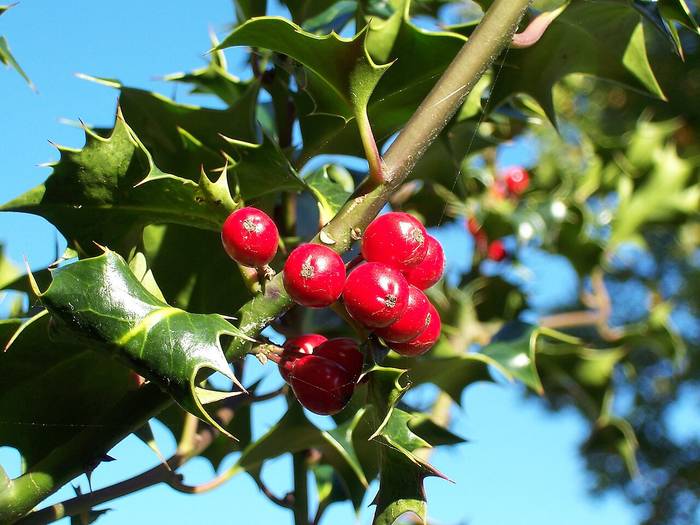
common holly
common holly (Ilex aquifolium) is a tree. It grows best in shade to full sun and has low water needs.
About common holly
Common holly is a perennial, evergreen tree that grows 8–10 m tall.[1][2] It grows slowly.[1][3] It can live for around 300 years.[3] Common holly grows wild in Denmark. It spreads by suckers.[4]
The flowers give nectar and pollen to pollinators.[1][3] It gives shelter to birds and mammals.[3]
The leaves can be eaten.[1] The fruit can be eaten too.[1] Recorded from the source text, not a safety check. Confirm with a trusted guide before eating anything.
How to plant common holly
Common holly does best in part shade, but also copes with shade.[1] It grows in sandy soil, loam, clay and peat.[1] It does best at a pH of 3.5–7.2.[1] In a forest garden it belongs in the lower tree layer.[1][2]
Plant trees 4 m apart, at least 3 m. It is well established after about 3 years. It can be propagated from seed, from cuttings or by layering.[1]
A year with common holly
Spring. Mulch around it in March and April. Prune it in April. It has white, green and red flowers in May and June.[1][3]
Summer. Prune it in August and September.
Autumn. Mulch around it in September. Plant out in September.
Winter. Protect it from frost and cold in January–December.
Pests and diseases
Common holly can be attacked by phytomyza ilicis and rabbits.[1][3] Diseases include phytophthora, root rot, canker and leaf blight.[2][3]
Companions and wildlife
common hollySources
- Plants For A Future — Ilex aquifolium · CC BY 4.0, Plants For A Future
- JRC forest tree atlas · CC BY 4.0
- Wikipedia — Ilex aquifolium · CC BY-SA 4.0
- CLO-PLA (clonal growth) · Klimešová et al. 2017
Added to the wiki 4 October 2026
Plan your garden with perma
Open app