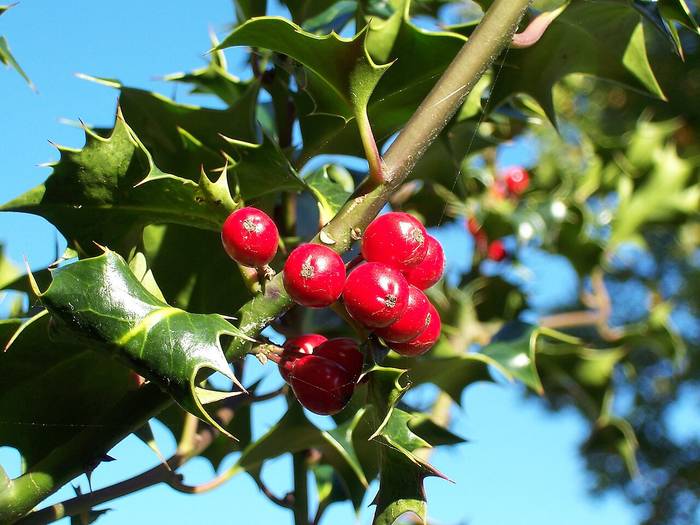
Jürgen Howaldt · CC BY-SA 2.0 de
common holly
Tree·Ilex aquifolium
Shade to full sun
Sun
Dry to moist soil
Water
Not recorded
Drainage
Zones 6–9
Hardiness
Coverage · 119 fields
Growth and size10 fields
Plant type
Evergreen tree“It is an evergreen tree or shrub found, for example, in shady areas of forests of oak and in beech hedges.”
Height
900 cm · the source gives 800–1,000 cm“The European holly (Ilex aquifolium L.) is a small evergreen tree or shrub 8-10 m in height, which rarely exceeds 20 m.”PFAF“Ilex aquifolium is an evergreen Shrub growing to 9 m (29ft) by 5 m (16ft) at a slow rate.”
Spread
500 cm“Ilex aquifolium is an evergreen Shrub growing to 9 m (29ft) by 5 m (16ft) at a slow rate.”
Height at age
—
empty
Spacing
400 cm (at least 300 cm)
AI estimate55 % agree
Habit
Columnar
AI estimate50 % agree
Root depth
Shallow“The root system is a fibrous mat near the surface with only a few roots that descend to greater depths.”
Forest garden layer
Lower tree layer“This species occurs within different plant communities, mainly as an understorey tree or in edges of temperate deciduous forests and woodlands dominated by oaks (Quercus robur, Quercus petraea, Quercus pubescent) or beech (Fagus sylvatica).”
Roots6 fields
Root form
Fibrous roots“The root system is a fibrous mat near the surface with only a few roots that descend to greater depths.”
Storage organ
None
AI estimate100 % agree
Lateral spread in cm
—
empty
Root depth in cm
—
empty
Mycorrhiza
—
empty
Light, water and soil9 fields
Sun
Full sun, light shade, part shade, shade · best: part shade“It can grow in full shade (deep woodland) semi-shade (light woodland) or no shade.”
Hours of sun
3–6 h
AI estimatenot measured yet
Tolerates waterlogging
No“Holly can grow in a wide variety of difficult soils including clay, acidic, and nutrient poor soils, but is intollerant of poor drainage.”
Soil type
Sand, loam, clay, peat“Suitable for: light (sandy), medium (loamy) and heavy (clay) soils and can grow in heavy clay and nutritionally poor soils.”PFAF“Grows well in heavy clay soils.”PFAF“Succeeds in most soils, including peat, chalk, gravels, sand and shales, so long as they are not water-logged, though wild plants are occasionally found in situations with standing winter water.”
pH
3.5–7.2“Tolerates a pH range from 3.5 to 7.2.”PFAF“Suitable pH: mildly acid, neutral and basic (mildly alkaline) soils and can grow in very acid soils.”
Drainage
Well-drained; intolerant of poor drainage“Holly can grow in a wide variety of difficult soils including clay, acidic, and nutrient poor soils, but is intollerant of poor drainage.”
Wikipediapartly
Compacted soil
Copes fairly well
AI estimatenot measured yet
Climate5 fields
Hardiness
Zone 6–9
AI estimatenot measured yet
Killing frost
-20 °C
AI estimatenot measured yet
Growing temperature
5–30 °C · optimal 10–25 °C
AI estimatenot measured yet
Chill hours
0 h
AI estimatenot measured yet
Native range
AD, AL, AT, BA, BE, BG, CH, DE, DK, DZ, ES, FR, GB, GG, GI, GR, HR, IE, IT, JE, LI, LU, MA, MC, ME, MK, MT, NL, NO, PT, RO, RS, SE, SI, SM, TN, VA, XK
Care (becomes tasks in Manage)6 fields
Pruning
After the last frost
AI estimatenot measured yet
Protection
After the first frost · lasts 730 days · frost
AI estimatenot measured yet
Mulching
After the first frost
Mulching appears 2 times with different timing.
AI estimatenot measured yet
Planting out
September
AI estimatenot measured yet
Pruning
August · lasts 30 days · dead, diseased, or crossing branches, and to shape
AI estimatenot measured yet
Mulching
March · lasts 30 days
Mulching appears 2 times with different timing.
AI estimatenot measured yet
Through the year4 fields
Flowering
May · lasts 61 days“It is in leaf all year, in flower from May to June, and the seeds ripen from November to March.”
Dying back
January · lasts 31 days“Most leaves are shed during middle of winter, though some fall during all seasons of the year”
Leafing out
After the last frost
AI estimatenot measured yet
Edible parts and pollination4 fields
The fruit
Roasted, used as a coffee substitute“The roasted fruit has been used as a coffee substitute.”PFAF“Some caution is advised here, since the fruit can be purgative and emetic”
Pollination
Needs a partner · a male plant · dioecious“The species is dioecious (individual flowers are either male or female, but only one sex is to be found on any one plant so both male and female plants must be grown if seed is required).”PFAF“and is pollinated by Bees.”PFAF“The plant is not self-fertile.”Wikipedia“The fruit only appears on female plants, which require male plants nearby to fertilise them.”
Ecology6 fields
Attracts
Pests
Phytomyza ilicis, rabbits“The commonly-encountered pale patches on leaves are due to the leaf-mine insect Phytomyza ilicis.”PFAF“Rabbits are particularly fond of this species and will quickly remove the bark.”
Diseases
Phytophthora, root rot, canker, leaf blight“Various fungi of genus Phytophthora cause roots to rot in cultivated hollies.”Wikipedia“In wet conditions it is likely to have problems such as root rot, canker, or leaf blight.”
Takes up
—
empty
Fixes nitrogen
No
AI estimatenot measured yet
Mycorrhiza
Yes
AI estimatenot measured yet
Propagation and names4 fields
Methods
Difficulty
3 / 5
AI estimatenot measured yet
Seed
Scarification, followed by a warm stratification and then a cold stratification“Scarification, followed by a warm stratification and then a cold stratification may speed up the germination time.”
Not sorted yet65 fields
Fields the parser stores that this page has no row for yet. They show up here automatically, so nothing is hidden.
forage.DK.local_name
Almindelig kristorn
AI estimatenot measured yet
forage.DK.prep_cautions
Berries are very bitter until late winter after frost softens them, Do not exceed recommended doses., The berries are generally regarded as toxic to humans., Fruits particularly poisonous to children“at this time they are very bitter due to the ilicin content and so are rarely eaten until late winter after frost has made them softer and more palatable.”PFAF“Do not exceed recommended doses.”Wikipedia“The berries are generally regarded as toxic to humans.”PFAF“Fruits particularly poisonous to children”
forage.DK.edibility_basis
inferred
AI estimatenot measured yet
forage.DK.foraging_months.notes
Fruit matures around October or November and is rarely eaten until late winter after frost.“at this time they are very bitter due to the ilicin content and so are rarely eaten until late winter after frost has made them softer and more palatable.”
forage.DK.foraging_months.months
10, 11
AI estimatenot measured yet
forage.DK.foraging_months.year_round
false“It is in leaf all year, in flower from May to June, and the seeds ripen from November to March.”
PFAFpartly
forage.DK.habitat_affinity
hedgerow, woodland“Found in most well-drained soils in scrub, hedges and woodland where it is often the dominant under-storey shrub.”JRC forest tree atlas“occurs within different plant communities, mainly as an understorey tree or in edges of temperate deciduous forests and woodlands”
forage.US.local_name
English holly
AI estimatenot measured yet
forage.US.prep_cautions
berries are toxic
AI estimatenot measured yet
forage.US.edibility_basis
inferred
AI estimatenot measured yet
forage.US.foraging_months.year_round
false
AI estimatenot measured yet
forage.US.habitat_affinity
woodland, hedgerow
AI estimatenot measured yet
forage.TROPICAL.prep_cautions
berries are toxic
AI estimatenot measured yet
forage.TROPICAL.edibility_basis
inferred
AI estimatenot measured yet
forage.TROPICAL.foraging_months.year_round
false
AI estimatenot measured yet
forage.TROPICAL.habitat_affinity
woodland
AI estimatenot measured yet
ornamental.basis
documented
AI estimatenot measured yet
ornamental.fragrance.intensity
subtle
AI estimatenot measured yet
ornamental.confidence
high
AI estimatenot measured yet
ornamental.fall_interest
true“Its seeds ripen in late autumn and usually last throughout the winter, when birds, rodents and larger herbivores eat them.”
ornamental.flower_colour
white, green, red“Bloom Color: Green, White.”Wikipedia“The flowers are white, sometimes touched with red, and have four parts such as petal lobes, though rarely they can have five.”
ornamental.evidence_quote
Ilex aquifolium, commonly known as common holly, is an evergreen tree or shrub with glossy dark green leaves and bright red berries in autumn and winter. Its small white flowers are often inconspicuous.
AI estimatenot measured yet
ornamental.foliage_colour
dark_green, yellow_green“Their upper surface is dark-green and glossy and the lower surface is yellowish and matt.”
ornamental.foliage_texture
medium
AI estimatenot measured yet
ornamental.winter_structure
persistent_fruit, evergreen_form“Its seeds ripen in late autumn and usually last throughout the winter, when birds, rodents and larger herbivores eat them.”PFAF“It is in leaf all year, in flower from May to June, and the seeds ripen from November to March.”
ornamental.autumn_foliage_colour
none
AI estimatenot measured yet
care_regime
none
AI estimatenot measured yet
propagation.self_seeding
light
AI estimate20 % agree
propagation.division_season
not applicable
AI estimatenot measured yet
propagation.establishment_years
3
AI estimate40 % agree
spatial_profile.canopy_density
dense
AI estimatenot measured yet
forage_proposals.DK.edibility_tier.tier
toxic
AI estimatenot measured yet
forage_proposals.DK.edibility_tier.confidence
high
AI estimatenot measured yet
forage_proposals.DK.edibility_tier.evidence_quote
The berries of Ilex aquifolium are considered toxic to humans and can cause vomiting, diarrhoea, and drowsiness if ingested.
AI estimatenot measured yet
forage_proposals.US.edibility_tier.tier
toxic
AI estimatenot measured yet
forage_proposals.US.edibility_tier.confidence
high
AI estimatenot measured yet
forage_proposals.US.edibility_tier.evidence_quote
The berries of Ilex aquifolium are considered toxic to humans and can cause vomiting, diarrhoea, and drowsiness if ingested.
AI estimatenot measured yet
forage_proposals.TROPICAL.edibility_tier.tier
toxic
AI estimatenot measured yet
forage_proposals.TROPICAL.edibility_tier.confidence
high
AI estimatenot measured yet
forage_proposals.TROPICAL.edibility_tier.evidence_quote
The berries of Ilex aquifolium are considered toxic to humans and can cause vomiting, diarrhoea, and drowsiness if ingested.
AI estimatenot measured yet
function_profile.biomass_return.confidence
medium
AI estimatenot measured yet
function_profile.nutrient_flows.consumes
[{"basis":"inferred","demand":"moderate","nutrient":"nitrogen","confidence":"medium"},{"basis":"inferred","demand":"moderate","nutrient":"potassium","confidence":"medium"}]
AI estimatenot measured yet
function_profile.biotic_interactions
[{"taxa":["bees"],"basis":"documented","valence":"beneficial","relation":"attracts","confidence":"high","evidence_quote":"is pollinated by Bees","organism_group":"pollinator","ecological_function":"pollination"},{"tax…“is pollinated by Bees”Wikipedia“The flowers are attractive as nectar sources for insects such as bees, wasps, flies, and small butterflies.”PFAF“The fruit is a valuable winter food source for birds.”Wikipedia“Pure stands of hollies can grow into a labyrinth of vaults in which thrushes and deer take refuge, while smaller birds are protected among their spiny leaves.”Wikipedia“They are eaten by rodents, birds and larger herbivores.”Wikipedia“The commonly-encountered pale patches on leaves are due to the leaf-mine insect Phytomyza ilicis.”PFAF“Rabbits are particularly fond of this species and will quickly remove the bark.”JRC forest tree atlas“Its leaves are browsed by mammals and in the past were used as cattle fodder.”JRC forest tree atlas“Various fungi of genus Phytophthora cause roots to rot in cultivated hollies.”Wikipedia“In wet conditions it is likely to have problems such as root rot, canker, or leaf blight.”
function_profile.aromatic_pest_effect.value
false
AI estimate80 % agree
function_profile.aromatic_pest_effect.confidence
low
AI estimatenot measured yet
function_profile.structural_interfaces.provides_shelter.basis
documented
AI estimatenot measured yet
function_profile.structural_interfaces.provides_shelter.kinds
wind, shade, frost
AI estimatenot measured yet
function_profile.structural_interfaces.provides_shelter.confidence
high
AI estimatenot measured yet
function_profile.structural_interfaces.requires_shelter.basis
documented“perhaps giving some winter protection for their first year or two”
function_profile.structural_interfaces.requires_shelter.kinds
frost“perhaps giving some winter protection for their first year or two”
function_profile.structural_interfaces.requires_shelter.stage
establishment“perhaps giving some winter protection for their first year or two”
function_profile.structural_interfaces.requires_shelter.confidence
medium“perhaps giving some winter protection for their first year or two”
function_profile.structural_interfaces.requires_shelter.evidence_quote
perhaps giving some winter protection for their first year or two“perhaps giving some winter protection for their first year or two”
function_profile.structural_interfaces.provides_physical_support.form
dense_thicket
AI estimatenot measured yet
function_profile.structural_interfaces.provides_physical_support.basis
documented
AI estimatenot measured yet
function_profile.structural_interfaces.provides_physical_support.confidence
high
AI estimatenot measured yet
function_profile.structural_interfaces.provides_physical_support.evidence_quote
With its spiny leaves it can form a dense thicket that defends other woody species from herbivores aiding the regeneration of forests.
AI estimatenot measured yet
function_profile.structural_interfaces.requires_physical_support.basis
taxonomic
AI estimatenot measured yet
function_profile.structural_interfaces.requires_physical_support.confidence
high
AI estimatenot measured yet
climate_tolerance.photoperiod_response
day_neutral
AI estimatenot measured yet
soil_interactions.organic_matter_contribution
medium
AI estimatenot measured yet
component_metadata.growth_cycle
perennial
AI estimate100 % agree
resource_interfaces.inputs
[{"resource":"light","quantity_description":"full sun or fairly dense shade"},{"resource":"shade","quantity_description":"semishade species; obligate shade in Mediterranean climates"},{"resource":"water","quantity_des…“Succeeds in full sun or fairly dense shade, self-sown seedlings from woods and shady places making the most shade tolerant plants.”JRC forest tree atlas“Regarding light tolerance, holly is a semishade species while in Mediterranean climates it is an obligate shade plant.”PFAF“It prefers dry or moist soil and can tolerate drought.”Wikipedia“The fruit only appears on female plants, which require male plants nearby to fertilise them.”
resource_interfaces.outputs
[{"resource":"fruit","quantity_description":"bright red drupe of 7-12 mm"},{"resource":"nectar","quantity_description":"nectar for bees, wasps, flies and small butterflies"},{"resource":"pollinator_services","quantity…“The fruit is a bright red drupe of 7-12 mm size.”Wikipedia“The flowers are attractive as nectar sources for insects such as bees, wasps, flies, and small butterflies.”PFAF“A good bee plant, the minute flowers are sweetly scented.”Wikipedia“Pure stands of hollies can grow into a labyrinth of vaults in which thrushes and deer take refuge, while smaller birds are protected among their spiny leaves.”Wikipedia“Most leaves are shed during middle of winter, though some fall during all seasons of the year, with the oldest leaves falling first unless disturbed by drought.”PFAF“Wood - strong, hard and dense, it polishes well, though it must be well dried and seasoned or else it warps badly.”Wikipedia“Each fruit contains 3 to 4 seeds which typically germinate in the second or third spring.”