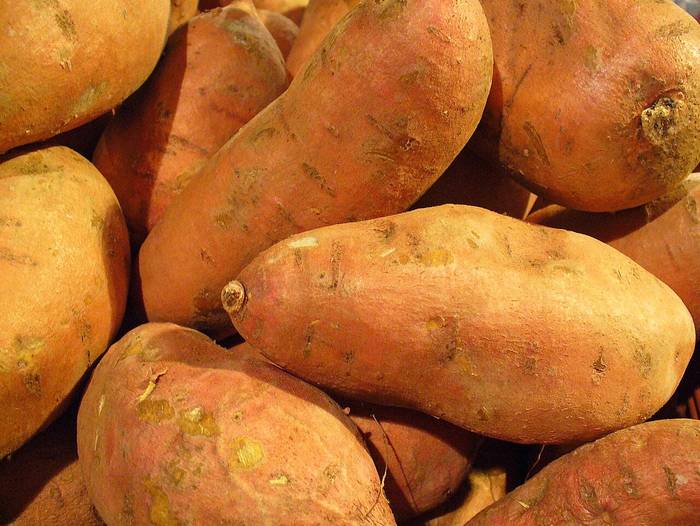
Llez · CC BY-SA 3.0
Sweet potato
Plant·Ipomoea batatas
Full sun
Sun
Moist soil
Water
Well-drained soil
Drainage
Zones 9–11
Hardiness
Coverage · 109 fields
- Parser flag (lifecycle_mismatch): The growth_cycle is listed as 'perennial' but the lifespan_years is 1, and phenology events describe senescence due to frost, indicating it's treated as an annual in most climates, which contradicts a perennial lifecycle.
Growth and size10 fields
Plant type
Deciduous plant“The sweet potato or sweetpotato (Ipomoea batatas) is a dicotyledonous plant in the morning glory family, Convolvulaceae.”
Spread
300 cm
AI estimate58 % agree
Height at age
—
empty
Spacing
30 cm (at least 20 cm)
AI estimate55 % agree
Growth rate
Fast“Ipomoea batatas is a PERENNIAL CLIMBER growing to 3 m (9ft 10in) at a fast rate.”
Root depth
Shallow
AI estimate63 % agree
Forest garden layer
Climber“Sweet Potato Vine is a perennial flowering climber that grows wild in warm climates worldwide.”
Lifespan
~1 years
AI estimatenot measured yet
Roots6 fields
Root form
—
empty
Storage organ
Root tuber“The edible, tuberous root is long and tapered, with a smooth skin whose color ranges between beige, yellow, orange, red, brown, and purple.”
Spreads
By runners“The stems usually crawl on the ground and form adventitious roots at the nodes.”
Lateral spread in cm
—
empty
Root depth in cm
—
empty
Mycorrhiza
Arbuscular (AM)
AI estimatenot measured yet
Light, water and soil9 fields
Hours of sun
6–12 h
AI estimatenot measured yet
Drought tolerant
—
empty
Soil type
Sand, loam · best: loam“An easily grown plant, it prefers a well-drained, sandy loam soil and requires a sunny position”PFAF“Suitable for: light (sandy) and medium (loamy) soils and prefers well-drained soil.”
pH
Drainage
Well drained“Suitable for: light (sandy) and medium (loamy) soils and prefers well-drained soil.”
Compacted soil
Copes badly
AI estimatenot measured yet
Climate5 fields
Hardiness
Zone 9–11
AI estimatenot measured yet
Killing frost
5 °C“When dormant, the roots can survive temperatures down to about 1°c, but young growth can be killed by temperatures of 5°c”EcoCrop's figure is frost during early growth (spring frost on new shoots), not winter cold.
Growing temperature
10–38 °C · optimal 18–28 °C“It grows best in areas where annual daytime temperatures are within the range 18 - 28°c, but can tolerate 10 - 38°c”
Chill hours
0 h
AI estimatenot measured yet
Care (becomes tasks in Manage)5 fields
Planting out
After the last frost“Grow them on in the greenhouse for at least their first winter then plant them out into their permanent positions in late spring or early summer, after the last expected frosts.”
Sowing
Above 18 °C · lasts 30 days
AI estimatenot measured yet
Watering
After the previous stage · lasts 120 days
AI estimatenot measured yet
Feeding
After the previous stage · 30 days after · low-nitrogen fertiliser
AI estimatenot measured yet
Weeding
After the previous stage · lasts 60 days
AI estimatenot measured yet
Through the year2 fields
Harvest
After the first frost“Harvest typically occurs in late summer to early autumn, usually around 90-120 days after planting, depending on the variety.”Wikipediapartly“In temperate regions, sweet potatoes are most often grown on larger farms and are harvested before first frosts.”
Edible parts and pollination2 fields
Pollination
Needs a partner · hermaphrodite“The species is hermaphrodite (has both male and female organs) and is pollinated by Insects, especially bees.”Wikipedia“Seeds are only produced from cross-pollination.”
Pollinated by
Insects, bees“The species is hermaphrodite (has both male and female organs) and is pollinated by Insects, especially bees.”
Ecology5 fields
Attracts
Bees, insects, wildlife“The species is hermaphrodite (has both male and female organs) and is pollinated by Insects, especially bees.”PFAF“It is noted for attracting wildlife.”
Pests
Sweet potato weevil, aphids, spider mites
AI estimatenot measured yet
Diseases
Sweet potato chlorotic stunt virus (spcsv), phytophthora spp.“Sweet potato suffers from the Sweet Potato Chlorotic Stunt Virus SPCSV (Crinivirus ipomeae).”Wikipedia“Oomycetes of the genus Phytophthora can also cause disease, including P. carotovorum, P. odoriferum, and P. wasabiae.”
Takes up
—
empty
Fixes nitrogen
No
AI estimatenot measured yet
Propagation and names4 fields
Methods
Stem cuttings, root cuttings, slips, seed“Stem cuttings obtained from terminal shoots.”Wikipedia“They are mostly propagated by stem or root cuttings or by adventitious shoots called "slips" that grow out from the tuberous roots during storage.”PFAFpartly“Pre-soak the seed for 12 hours in warm water, or scarify the seed, and sow in individual pots in a greenhouse in early spring.”
Seed
none
AI estimatenot measured yet
Not sorted yet61 fields
Fields the parser stores that this page has no row for yet. They show up here automatically, so nothing is hidden.
forage.DK.edibility_basis
inferred
AI estimatenot measured yet
forage.DK.foraging_months.notes
Sweet potato is not typically foraged in Denmark as it is not native and requires warmer climates.
AI estimatenot measured yet
forage.DK.foraging_months.year_round
false
AI estimatenot measured yet
forage.US.local_name
Sweetpotato
AI estimatenot measured yet
forage.US.edible_parts
[{"part":"tubers","caution":null,"preparation":"Baked, boiled, fried, roasted, mashed, used in desserts.","season_months":[8,9,10,11]},{"part":"leaves","caution":null,"preparation":"Cooked like spinach, stir-fried, ad…
AI estimatenot measured yet
forage.US.edibility_basis
inferred
AI estimatenot measured yet
forage.US.foraging_months.notes
Tubers are typically harvested in late summer to fall before the first frost. Leaves can be harvested throughout the growing season.
AI estimatenot measured yet
forage.US.foraging_months.months
6, 7, 8, 9, 10, 11
AI estimatenot measured yet
forage.US.foraging_months.year_round
false
AI estimatenot measured yet
forage.US.habitat_affinity
disturbed_ground
AI estimatenot measured yet
forage.TROPICAL.local_name
Sweet potato
AI estimatenot measured yet
forage.TROPICAL.edible_parts
[{"part":"root","caution":null,"preparation":"cooked"},{"part":"leaves","caution":null,"preparation":"sautéed, stir-fried, or finely chopped into salads"},{"part":"young shoots","caution":null,"preparation":"eaten as …“The sweet and fleshy root is cooked and is a rich source of vitamins and minerals.”PFAF“The leaves and shoots are excellent edible greens.”PFAF“The raw leaves have a strong flavour that is improved by sautéing them, adding them to stir-fries, or chopping them finely and adding them to salads.”Wikipedia“Moreover, the young shoots and leaves are eaten as greens with nutritional composition comparable to spinach.”PFAFpartly“The leaves, young shoots and roots are all edible and used to make various foods, including tamales and paella.”
forage.TROPICAL.prep_cautions
Raw leaves have a strong flavour; sautéing them improves it.
AI estimatenot measured yet
forage.TROPICAL.edibility_basis
inferred
AI estimatenot measured yet
forage.TROPICAL.foraging_months.notes
Tubers are typically harvested 3-5 months after planting, depending on the variety and climate.“Leaves and shoots - young growth.”
PFAFpartly
forage.TROPICAL.foraging_months.months
8, 9, 10, 11, 12, 1, 2, 3“Harvesting: Roots late summer to early spring, usually around 90-120 days after planting.”
PFAFpartly
forage.TROPICAL.foraging_months.year_round
true
AI estimatenot measured yet
forage.TROPICAL.habitat_affinity
disturbed_ground
AI estimatenot measured yet
ornamental.basis
documented
AI estimatenot measured yet
ornamental.confidence
high
AI estimatenot measured yet
ornamental.flower_colour
purple, white“can be lavender to purple-lavender in color”Wikipedia“but white crowns can also appear”
ornamental.evidence_quote
Ipomoea batatas, commonly known as sweet potato, typically has white to purple flowers. The foliage is green, but many ornamental cultivars exist with purple or variegated leaves. As a tender perennial, it does not exhibit autumn foliage colour change in temperate climates and dies back with frost, offering no winter structure.
AI estimatenot measured yet
ornamental.foliage_colour
ornamental.foliage_texture
medium
AI estimatenot measured yet
ornamental.winter_structure
none
AI estimatenot measured yet
ornamental.autumn_foliage_colour
none
AI estimatenot measured yet
care_regime
light
AI estimatenot measured yet
propagation.self_seeding
none
AI estimate20 % agree
propagation.division_season
spring
AI estimatenot measured yet
propagation.establishment_years
1
AI estimate40 % agree
forage_proposals.DK.edibility_tier.confidence
low
AI estimatenot measured yet
forage_proposals.US.edibility_tier.tier
choice
AI estimatenot measured yet
forage_proposals.US.edibility_tier.confidence
high
AI estimatenot measured yet
forage_proposals.US.edibility_tier.evidence_quote
The tubers of Ipomoea batatas, commonly known as sweet potato, are a widely consumed and highly nutritious staple food, often baked, boiled, or fried. The young leaves and shoots are also edible and can be cooked as a leafy green.
AI estimatenot measured yet
forage_proposals.TROPICAL.edibility_tier.tier
edible“The leaves, young shoots and roots are all edible and used to make various foods, including tamales and paella.”
forage_proposals.TROPICAL.edibility_tier.confidence
high
AI estimatenot measured yet
forage_proposals.TROPICAL.edibility_tier.evidence_quote
Sweet potato leaves and tubers are widely consumed as a staple food in tropical regions, known for their nutritional value and versatility in cooking.
AI estimatenot measured yet
function_profile.biomass_return.confidence
medium
AI estimatenot measured yet
function_profile.nutrient_flows.consumes
[{"basis":"documented","demand":"high","nutrient":"potassium","confidence":"medium","evidence_quote":"Ample potash in the soil is essential for a good crop"}]“Ample potash in the soil is essential for a good crop”
function_profile.biotic_interactions
[{"taxa":["insects","bees"],"basis":"documented","valence":"beneficial","relation":"attracts","confidence":"high","evidence_quote":"The species is hermaphrodite (has both male and female organs) and is pollinated by I…“The species is hermaphrodite (has both male and female organs) and is pollinated by Insects, especially bees.”PFAF“It is noted for attracting wildlife.”PFAF“The sprawling nature of the sweet potato vine can create ground cover, providing habitat for invertebrates and helping to retain moisture in the soil.”Wikipedia“Oomycetes of the genus Phytophthora can also cause disease, including P. carotovorum, P. odoriferum, and P. wasabiae.”Wikipediapartly“Sweet potato suffers from the Sweet Potato Chlorotic Stunt Virus SPCSV (Crinivirus ipomeae).”
function_profile.aromatic_pest_effect.value
true“The aromatic leaves may have pest-repelling properties and can help confuse some pests, benefiting neighboring plants.”
function_profile.aromatic_pest_effect.confidence
high
AI estimatenot measured yet
function_profile.structural_interfaces.provides_shelter.basis
documented
AI estimatenot measured yet
function_profile.structural_interfaces.provides_shelter.kinds
shade
AI estimatenot measured yet
function_profile.structural_interfaces.provides_shelter.confidence
high
AI estimatenot measured yet
function_profile.structural_interfaces.provides_shelter.evidence_quote
Dense foliage provides ground cover and shades the soil.
AI estimatenot measured yet
function_profile.structural_interfaces.requires_shelter.basis
documented
AI estimatenot measured yet
function_profile.structural_interfaces.requires_shelter.kinds
frost
AI estimatenot measured yet
function_profile.structural_interfaces.requires_shelter.stage
permanent
AI estimatenot measured yet
function_profile.structural_interfaces.requires_shelter.confidence
high
AI estimatenot measured yet
function_profile.structural_interfaces.requires_shelter.evidence_quote
Sweet potatoes are very sensitive to frost and require warm growing conditions.
AI estimatenot measured yet
function_profile.structural_interfaces.requires_physical_support.basis
documented
AI estimatenot measured yet
function_profile.structural_interfaces.requires_physical_support.mechanism
scrambler“The stems usually crawl on the ground and form adventitious roots at the nodes.”
Wikipediapartly
function_profile.structural_interfaces.requires_physical_support.confidence
high
AI estimatenot measured yet
function_profile.structural_interfaces.requires_physical_support.evidence_quote
Sweet potato vines are sprawling and can benefit from trellising or support to manage growth and improve air circulation.
AI estimatenot measured yet
climate_tolerance.photoperiod_response
short_day“A short-day plant, it requires less than 11 hours of sunlight per day to initiate flowering”
soil_interactions.organic_matter_contribution
medium
AI estimatenot measured yet
component_metadata.growth_cycle
perennial“The plant is a herbaceous perennial vine, bearing alternate, triangle-shaped or palmately lobed leaves and medium-sized, sympetalous flowers.”
resource_interfaces.inputs
[{"resource":"light","quantity_description":"a sunny position"},{"resource":"water","quantity_description":"moist soil"},{"resource":"pollination","quantity_description":"insects, especially bees"}]“An easily grown plant, it prefers a well-drained, sandy loam soil and requires a sunny position”PFAF“It prefers moist soil.”PFAF“The species is hermaphrodite (has both male and female organs) and is pollinated by Insects, especially bees.”
resource_interfaces.outputs
[{"resource":"ground_cover","quantity_description":"spreads for many metres without support; prevents soil erosion and suppresses weeds"},{"resource":"pollinator_services","quantity_description":"attractive flowers th…“It can be used as ground cover to prevent soil erosion, improve soil structure, and suppress weeds.”PFAF“Sweet potato vines produce attractive flowers that can provide nectar and pollen for pollinators.”PFAF“Additionally, the leaf litter can serve as shelter.”PFAF“The aromatic leaves may have pest-repelling properties and can help confuse some pests, benefiting neighboring plants.”PFAFpartly“The vines also provide habitat for beneficial organisms.”PFAFpartly“Without support, the rambling vine will cover the ground for many metres and climb anything upright, sometimes to the detriment of young trees.”