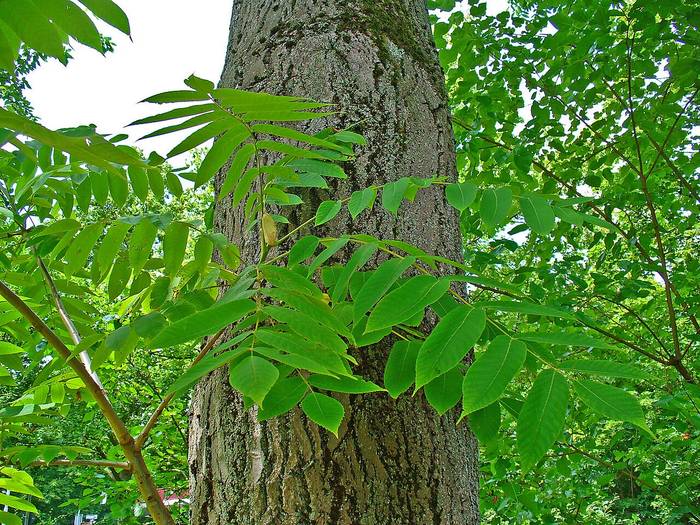
H. Zell · CC BY-SA 3.0
butternut
Tree·Juglans cinerea
Full sun
Sun
Dry to moist soil
Water
Well-drained soil
Drainage
Zones 3–7
Hardiness
Coverage · 95 fields
- Parser flag (climate_tolerance_low_confidence): Climate tolerance values are LLM-extracted (no authoritative EcoCrop match found). EcoCrop covers ~2,568 food-crop taxa; ornamental/native/medicinal species rely on LLM extraction.
Growth and size10 fields
Plant type
Deciduous tree“J. cinerea is a deciduous tree growing to 30 metres (98 ft) tall, rarely more.”
Height
3,000 cm“J. cinerea is a deciduous tree growing to 30 metres (98 ft) tall, rarely more.”
Spread
2,000 cm
AI estimate58 % agree
Height at age
—
empty
Spacing
1,200 cm (at least 900 cm)
AI estimate55 % agree
Growth rate
Slow“Butternut is a slow-growing species, and rarely lives longer than 75 years.”
Habit
Spreading
AI estimate50 % agree
Root depth
Deep
AI estimate63 % agree
Forest garden layer
Canopy
AI estimate90 % agree
Lifespan
~75 years“Butternut is a slow-growing species, and rarely lives longer than 75 years.”
Roots6 fields
Root form
Taproot
AI estimate43 % agree
Storage organ
None
AI estimate100 % agree
Spreads
No
AI estimate75 % agree
Lateral spread in cm
—
empty
Root depth in cm
—
empty
Mycorrhiza
Arbuscular (AM)
AI estimatenot measured yet
Light, water and soil9 fields
Sun
Full sun“Although young trees may withstand competition from the side, butternut does not survive under shade from above.”
Hours of sun
6 h
AI estimatenot measured yet
Water
Moist, dry · Medium“It grows better than black walnut, however, on dry, rocky soils, especially those of limestone origin.”Wikipediapartly“Butternut grows best on stream banks and on well-drained soils.”
Drought tolerant
—
empty
Tolerates waterlogging
—
empty
Soil type
—“Butternut grows best on stream banks and on well-drained soils.”Wikipedia“It grows better than black walnut, however, on dry, rocky soils, especially those of limestone origin.”
Compacted soil
Copes badly
AI estimatenot measured yet
Climate5 fields
Hardiness
Zone 3–7
AI estimatenot measured yet
Killing frost
-35 °C
AI estimatenot measured yet
Growing temperature
5–30 °C · optimal 15–25 °C
AI estimatenot measured yet
Chill hours
800 h
AI estimatenot measured yet
Care (becomes tasks in Manage)3 fields
Pruning
January · lasts 30 days · healthy branches that contribute to the tree's structure · dead, damaged, or crossing branches
AI estimatenot measured yet
Mulching
April · lasts 30 days
AI estimatenot measured yet
Watering
July · lasts 60 days
AI estimatenot measured yet
Through the year6 fields
Leafing out
Set by day length · lasts 21 days“Like other members of the family Juglandaceae, butternut's leafout in spring is tied to photoperiod rather than air temperature and occurs when daylight length reaches 14 hours.”
Flowering
After the previous stage · lasts 30 days
AI estimatenot measured yet
Dying back
Set by day length · lasts 30 days“Leaf drop in fall is early and is initiated when daylight drops to 11 hours.”
Harvest
After the previous stage · lasts 30 days
AI estimatenot measured yet
Dormant
After the first frost · Set by day length · lasts 150 days
AI estimatenot measured yet
Edible parts and pollination5 fields
The nuts
Made into a butter-like oil“The butternuts are edible and were made into a butter-like oil by Native Americans for various purposes.”
Young green nut
Pickled in salt water, changed every other day for a week, then seasoned for at least two weeks“The young green nuts, while still soft, can be pickled; survivalist Bradford Angier recommends this be done with a change of salt water every other day for a week, and a subsequent seasoning of at least two weeks.”
Pollinated by
—
empty
Ecology5 fields
Attracts
Wildlife (eats the nuts), squirrels and rodents (distribute the seeds)“The nuts are eaten by wildlife.”Wikipedia“Rodents such as squirrels help distribute the seeds.”
Pests
Common grackle (destroys immature fruit)“The common grackle has been reported to destroy immature fruit and may be considered a butternut pest when populations are high.”
Diseases
Butternut canker (ophiognomonia clavigignenti-juglandacearum), bunch disease (mycoplasma-like organism)“the primary causal organism of the disease has been identified as another species of fungus, Ophiognomonia clavigignenti-juglandacearum.”Wikipedia“Bunch disease also attacks butternut.”
Takes up
Calcium, potassium
AI estimatenot measured yet
Fixes nitrogen
No
AI estimatenot measured yet
Propagation and names4 fields
Methods
Seed, grafting“Approximately 60 grafted butternut trees were planted in a seed orchard in Huntingburg, Indiana, in 2012”
Difficulty
3 / 5
AI estimatenot measured yet
Seed
cold_moist_stratification_90-120_days
AI estimatenot measured yet
Not sorted yet42 fields
Fields the parser stores that this page has no row for yet. They show up here automatically, so nothing is hidden.
forage.US.local_name
Butternut
AI estimatenot measured yet
forage.US.prep_cautions
nuts require cracking, sap requires boiling
AI estimatenot measured yet
forage.US.edibility_basis
inferred
AI estimatenot measured yet
forage.US.foraging_months.notes
Sap in late winter/early spring, nuts in fall.
AI estimatenot measured yet
forage.US.foraging_months.months
10“surrounded by a green husk before maturity in midautumn.”
forage.US.foraging_months.year_round
false
AI estimatenot measured yet
forage.US.habitat_affinity
riverbank, woodland“Butternut grows best on stream banks and on well-drained soils.”Wikipedia“Butternut is found with many other tree species in several hardwood types in the mixed mesophytic forest.”
ornamental.basis
documented
AI estimatenot measured yet
ornamental.fragrance.source
none
AI estimate100 % agree
ornamental.confidence
high
AI estimatenot measured yet
ornamental.fall_interest
true
AI estimatenot measured yet
ornamental.flower_colour
insignificant“Male (staminate) flowers are inconspicuous, yellow-green slender catkins”
ornamental.evidence_quote
Butternut trees have insignificant flowers, green foliage that turns yellow-green in autumn, and a medium foliage texture. They offer fall interest and an architectural skeleton in winter.
AI estimatenot measured yet
ornamental.foliage_colour
green“The whole leaf is downy-pubescent, and a somewhat brighter, yellower green than many other tree leaves.”
ornamental.foliage_texture
medium
AI estimatenot measured yet
ornamental.winter_structure
architectural_skeleton
AI estimatenot measured yet
ornamental.autumn_foliage_colour
yellow_green
AI estimatenot measured yet
care_regime
none
AI estimatenot measured yet
propagation.self_seeding
moderate
AI estimate20 % agree
propagation.division_season
not applicable
AI estimatenot measured yet
propagation.establishment_years
3
AI estimate40 % agree
spatial_profile.canopy_density
medium
AI estimatenot measured yet
forage_proposals.US.edibility_tier.tier
edible“The butternuts are edible and were made into a butter-like oil by Native Americans for various purposes.”
forage_proposals.US.edibility_tier.confidence
medium“The butternuts are edible and were made into a butter-like oil by Native Americans for various purposes.”
forage_proposals.US.edibility_tier.evidence_quote
The butternuts are edible and were made into a butter-like oil by Native Americans for various purposes.“The butternuts are edible and were made into a butter-like oil by Native Americans for various purposes.”
function_profile.biomass_return.confidence
medium
AI estimatenot measured yet
function_profile.nutrient_flows.consumes
[{"basis":"documented","demand":"high","nutrient":"nitrogen","confidence":"high"},{"basis":"inferred","demand":"moderate","nutrient":"phosphorus","confidence":"medium"},{"basis":"documented","demand":"high","nutrient"…
AI estimatenot measured yet
function_profile.nutrient_flows.provides
[{"basis":"inferred","nutrient":"calcium","mechanism":"mineral_extraction","confidence":"low"},{"basis":"inferred","nutrient":"potassium","mechanism":"mineral_extraction","confidence":"low"}]
AI estimatenot measured yet
function_profile.biotic_interactions
[{"taxa":["squirrels","rodents"],"basis":"documented","valence":"beneficial","relation":"attracts","confidence":"high","evidence_quote":"Rodents such as squirrels help distribute the seeds.","organism_group":"mammal",…“Rodents such as squirrels help distribute the seeds.”Wikipedia“The nuts are eaten by wildlife.”Wikipedia“The common grackle has been reported to destroy immature fruit and may be considered a butternut pest when populations are high.”Wikipedia“the primary causal organism of the disease has been identified as another species of fungus, Ophiognomonia clavigignenti-juglandacearum.”Wikipediapartly“Currently, the causal agent is thought to be a mycoplasma-like organism.”
function_profile.aromatic_pest_effect.value
false
AI estimate80 % agree
function_profile.aromatic_pest_effect.confidence
low
AI estimatenot measured yet
function_profile.structural_interfaces.provides_shelter.basis
documented
AI estimatenot measured yet
function_profile.structural_interfaces.provides_shelter.kinds
shade
AI estimatenot measured yet
function_profile.structural_interfaces.provides_shelter.confidence
high
AI estimatenot measured yet
function_profile.structural_interfaces.provides_physical_support.form
trunk
AI estimatenot measured yet
function_profile.structural_interfaces.provides_physical_support.basis
taxonomic
AI estimatenot measured yet
function_profile.structural_interfaces.provides_physical_support.confidence
high
AI estimatenot measured yet
climate_tolerance.photoperiod_response
day_neutral
AI estimatenot measured yet
soil_interactions.organic_matter_contribution
medium
AI estimatenot measured yet
component_metadata.growth_cycle
perennial
AI estimate100 % agree
resource_interfaces.inputs
[{"resource":"light","quantity_description":"full sun to partial shade"},{"resource":"water","quantity_description":"moderate"}]“It must be in the overstory to thrive.”
Wikipediapartly
resource_interfaces.outputs
[{"resource":"fruit","quantity_description":"lemon-shaped nuts borne in bunches of two to six, eaten by wildlife"},{"resource":"seeds","quantity_description":"nut seeds distributed by rodents such as squirrels"},{"res…“The fruit is a lemon-shaped nut, produced in bunches of two to six together”Wikipedia“Rodents such as squirrels help distribute the seeds.”Wikipedia“Butternut wood is light in weight and takes polish well, and is highly rot-resistant, but is much softer than black walnut wood.”Wikipediapartly“Leaf drop in fall is early and is initiated when daylight drops to 11 hours.”