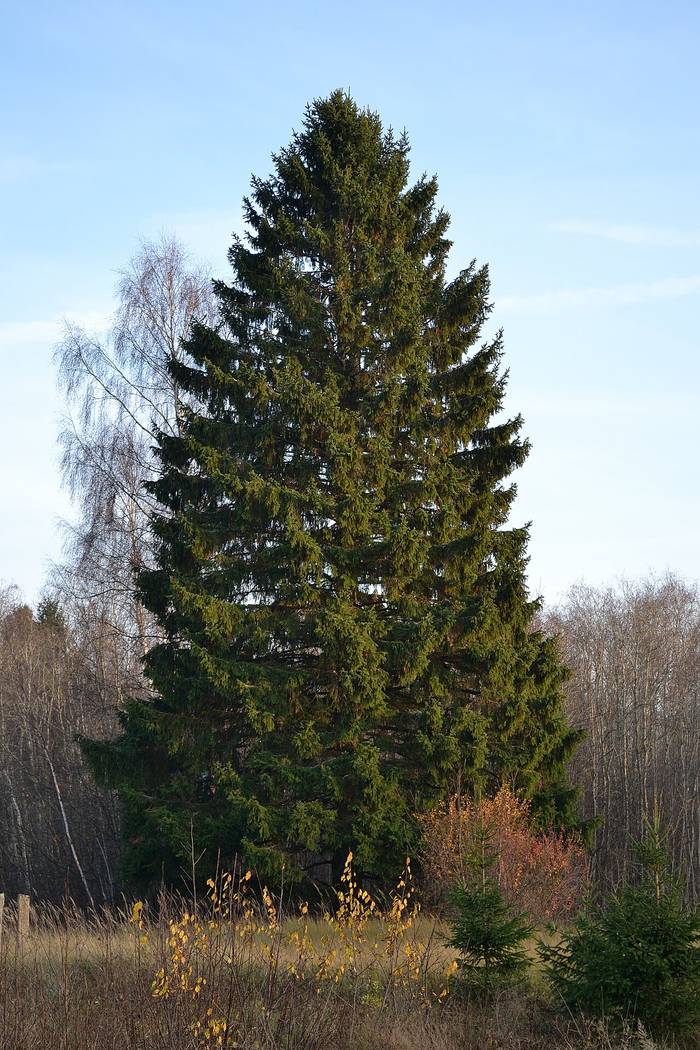
Norway spruce
Norway spruce (Picea abies) is a tree. It grows best in part shade to full sun and has moderate water needs.
About Norway spruce
Norway spruce is a perennial, evergreen tree that grows 30 m tall.[1][2][3] It grows fast.[1] It is self-fertile, so you only need one. It can live for around 200 years.[1]
Birds eat the fruit and spread the seeds.[2]
The flowers can be eaten.[1] The cones can be eaten too.[1] The bark can be eaten too.[1] The seeds can be eaten raw.[1] The young shoots can be eaten too.[1] Recorded from the source text, not a safety check. Confirm with a trusted guide before eating anything.
How to plant norway spruce
Norway spruce does best in full sun, but also copes with part shade.[1] It grows in sandy soil, loam, clay and peat.[1] It does best at a pH of 4–6.[1] In a forest garden it belongs in the canopy.[1]
Plant trees 9 m apart, at least 6 m. It struggles in compacted soil, so keep the soil loose. It is well established after about 3 years. It can be propagated from seed or from cuttings.[1]
A year with Norway spruce
Spring. Mulch around it in April and May. Spread bark chips on the soil around the plant.
Summer. It has small, inconspicuous flowers in June.[1]
Winter. Prune it in February and March. Cut out dead or damaged branches. Take a little off to tidy the shape. Less than you think.
Pests and diseases
Norway spruce can be attacked by bark beetles (ips typographus), large pine weevil (hylobius abietis), cydia illutana caterpillars, cydia duplicana caterpillars and caterpillars (many species).[1][2][3] Diseases include honey fungus (armillaria) and heterobasidion annosum.[1][2]
Companions and wildlife
Norway spruceSources
- Plants For A Future — Picea abies · CC BY 4.0, Plants For A Future
- JRC forest tree atlas · CC BY 4.0
- Wikipedia — Picea abies · CC BY-SA 4.0
- CLO-PLA (clonal growth) · Klimešová et al. 2017
- Berlin tree register · DL-DE-Zero-2.0
Added to the wiki 4 October 2026
Plan your garden with perma
Open app