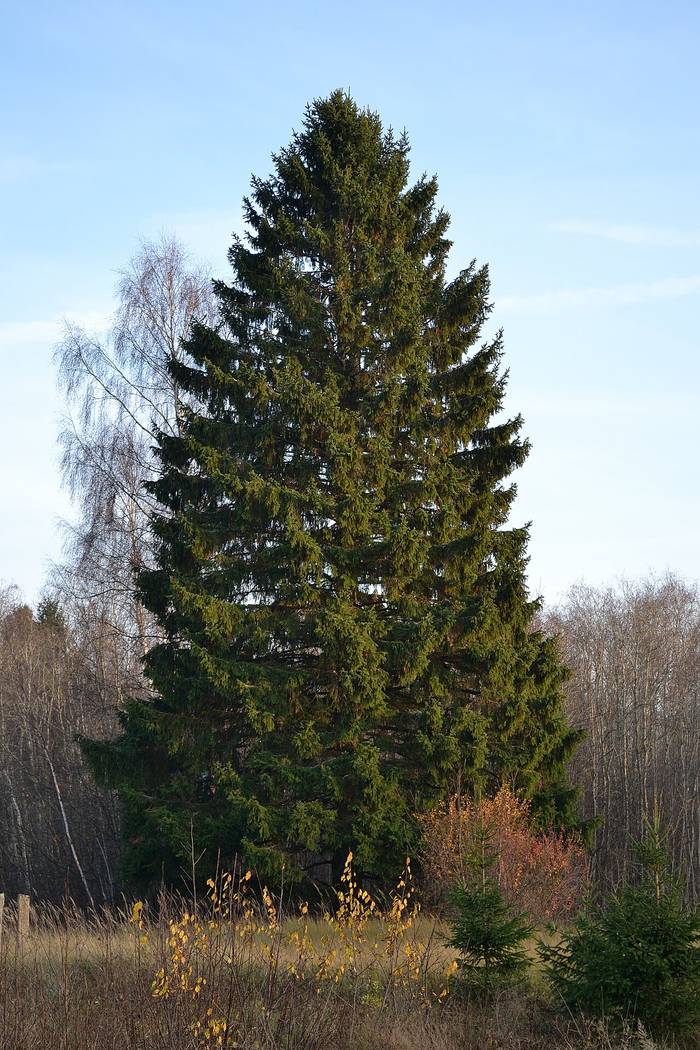
Ivar Leidus · CC BY-SA 3.0 ee
Norway spruce
Tree·Picea abies
Part shade to full sun
Sun
Moist to wet soil
Water
Not recorded
Drainage
Zones 2–7
Hardiness
Coverage · 104 fields
No obvious inconsistencies found.
Growth and size11 fields
Plant type
Evergreen tree“Picea abies is an evergreen Tree growing to 30 m (98ft) by 10 m (32ft) at a fast rate.”
Height
3,000 cm · other sources: 5,500 cm, 6,000 cm“Picea abies is an evergreen Tree growing to 30 m (98ft) by 10 m (32ft) at a fast rate.”Wikipedia“Norway spruce is a large, fast-growing evergreen coniferous tree growing 35–55 m (115–180 ft) tall”JRC forest tree atlas“reaching 50-60 m in height”
Spread
1,000 cm“Picea abies is an evergreen Tree growing to 30 m (98ft) by 10 m (32ft) at a fast rate.”
Height at age
—
empty
Size after planting
12 yrs: 7.5 m tall, 2.5 m crown · 17 yrs: 8 m tall, 3 m crown · 34 yrs: 14 m tall, 5 m crown · 66 yrs: 20 m tall, 7 m crown“Berlin tree register: 1004 trees of this species measured with years since planting, height and crown diameter; median crown 7.0 m and height 20.0 m at 60–100 years after planting (137 trees).”Median of 1,004 measured trees in Berlin. Years count from planting nursery stock, so a small tree reaches each size later.
Spacing
900 cm (at least 600 cm)
AI estimate55 % agree
Growth rate
Fast“Picea abies is an evergreen Tree growing to 30 m (98ft) by 10 m (32ft) at a fast rate.”
Habit
Columnar“The crown is regularly conic, columnar, with whorled, short and stout branches, the upper level ascending and the lower drooping.”
JRC forest tree atlaspartly
Forest garden layer
Canopy
AI estimate90 % agree
Lifespan
~200 years“Probably not that long-lived in Britain, about 200 years seems the absolute maximum.”
Roots6 fields
Storage organ
None“No clonal growth organ is recorded: it does not spread vegetatively (no suckers, no rhizomes).”
Spreads
No“No clonal growth organ is recorded: it does not spread vegetatively (no suckers, no rhizomes).”
Lateral spread in cm
—
empty
Root depth in cm
—
empty
Mycorrhiza
Ectomycorrhizal (EcM)
AI estimatenot measured yet
Light, water and soil9 fields
Sun
Full sun, part shade, light shade · best: full sun“It cannot grow in the shade.”PFAFpartly“Dislikes shade according to one report whilst another says that it is moderately shade tolerant.”
PFAFpartly
Hours of sun
6 h
AI estimatenot measured yet
Drought tolerant
No
AI estimatenot measured yet
Tolerates waterlogging
—
empty
Soil type
Sand, loam, clay, peat“Suitable for: light (sandy), medium (loamy) and heavy (clay) soils and can grow in nutritionally poor soil.”PFAF“Tolerates poor peaty soils.”
pH
3.7–6 · best 4–6“Prefers a pH between 4 to 6.”PFAF“Suitable pH: mildly acid and neutral soils and can grow in very acid soils.”
Drainage
Moist, deep soil; abundant moisture at the roots“Likes abundant moisture at the roots, if grown in drier areas it must be given a deep moist soil.”
Compacted soil
Copes badly
AI estimatenot measured yet
Climate5 fields
Hardiness
Zone 2–7
AI estimatenot measured yet
Killing frost
-1 °C“Killing temp. early growth: -1”EcoCrop's figure is frost during early growth (spring frost on new shoots), not winter cold.
Growing temperature
3–25 °C · optimal 5–15 °C“Temperature absolute min: 3 · Temperature absolute max: 25 · Temperature optimal min: 5 · Temperature optimal max: 15”
Chill hours
1,000 h
AI estimatenot measured yet
Native range
AL, AT, BA, BG, BY, CH, CZ, DE, EE, FI, FR, GG, GR, HR, HU, IT, JE, LI, LT, LV, MC, MD, ME, MK, NO, PL, RO, RS, RU, SE, SI, SK, SM, TR, UA, VA, XK
Care (becomes tasks in Manage)3 fields
Mulching
April · lasts 30 days
AI estimatenot measured yet
Watering
After rain · lasts 180 days
AI estimatenot measured yet
Pruning
February · lasts 28 days · dead or damaged branches
AI estimatenot measured yet
Through the year4 fields
Flowering
May · lasts 61 days“It is in leaf all year, in flower from May to June, and the seeds ripen from October to November.”
Fruiting
October · lasts 61 days“It is in leaf all year, in flower from May to June, and the seeds ripen from October to November.”
Leafing out
After the last frost · lasts 30 days
AI estimatenot measured yet
Dormant
After the first frost · lasts 150 days
AI estimatenot measured yet
Edible parts and pollination7 fields
Flowers (young male catkins)
Raw or cooked; used as a flavouring · May–June“Young male catkins - raw or cooked. Used as a flavouring.”PFAFpartly“It is in leaf all year, in flower from May to June, and the seeds ripen from October to November.”
Immature female cones
Cooked; the central portion, when roasted, is sweet and syrupy“The central portion, when roasted, is sweet and syrupy.”PFAFpartly“Immature female cones - cooked.”
Inner bark
Dried, ground into a powder and used as a thickener in soups or added to cereals when making bread“Inner bark - dried, ground into a powder and used as a thickener in soups etc or added to cereals when making bread.”
The seeds
Raw · October–November“Rich in oil and with a pleasant slightly resinous flavour, but too small and fiddly to be worthwhile unless you are desperate.”PFAFpartly“It is in leaf all year, in flower from May to June, and the seeds ripen from October to November.”
Young shoot tips
Made into a refreshing tea, rich in vitamin C“A refreshing tea, rich in vitamin C, can be made from the young shoot tips.”
Pollination
Self-fertile · monoecious“The species is monoecious (individual flowers are either male or female, but both sexes can be found on the same plant) and is pollinated by Wind.”
Pollinated by
Wind“The species is monoecious (individual flowers are either male or female, but both sexes can be found on the same plant) and is pollinated by Wind.”
Ecology5 fields
Pests
Bark beetles (ips typographus), large pine weevil (hylobius abietis), cydia illutana caterpillars, cydia duplicana caterpillars, caterpillars (many species)“The bark beetles Ips typographus is one of the most destructive forest pests causing damage to spruce forest ecosystems in Europe.”JRC forest tree atlas“The large pine weevil (Hylobius abietis L.) is among the most serious pests affecting young coniferous forests in Europe.”Wikipedia“Norway spruce cone scales are used as food by the caterpillars of the tortrix moth Cydia illutana, whereas Cydia duplicana feeds on the bark around injuries or canker.”PFAF“A food plant for many caterpillars.”
Diseases
Honey fungus (armillaria), heterobasidion annosum“This species is susceptible to honey fungus.”JRC forest tree atlas“The fungus Heterobasidion annosum causes root and butt rot throughout the northern hemisphere, which leads to important economic losses both in growth and wood quality.”
Takes up
—
empty
Fixes nitrogen
No
AI estimatenot measured yet
Propagation and names4 fields
Methods
Seed, semi-ripe terminal-shoot cuttings, mature terminal-shoot cuttings, soft to semi-ripe wood cuttings“Seed - stratification will probably improve germination so sow fresh seed in the autumn in a cold frame if possible.”PFAF“Cuttings of semi-ripe terminal shoots, 5 - 8cm long, August in a frame.”PFAF“Cuttings of mature terminal shoots, 5 - 10cm long, September/October in a cold frame.”PFAF“Cuttings of soft to semi-ripe wood, early summer in a frame.”
Difficulty
3 / 5
AI estimatenot measured yet
Seed
probably improves germination“Seed - stratification will probably improve germination so sow fresh seed in the autumn in a cold frame if possible.”
Not sorted yet50 fields
Fields the parser stores that this page has no row for yet. They show up here automatically, so nothing is hidden.
forage.DK.local_name
Rød-gran
AI estimatenot measured yet
forage.DK.edibility_basis
inferred
AI estimatenot measured yet
forage.DK.foraging_months.notes
Young shoots are seasonal, needles can be harvested year-round.
AI estimatenot measured yet
forage.DK.foraging_months.months
1, 2, 3, 4, 5, 6, 7, 8, 9, 10, 11, 12“It is in leaf all year, in flower from May to June, and the seeds ripen from October to November.”
PFAFpartly
forage.DK.foraging_months.year_round
true
AI estimatenot measured yet
forage.DK.habitat_affinity
woodland“Spruce forests dominates in the Boreal zone of N and N-E Europe”
forage.US.edible_parts
[{"part":"young shoots","caution":"consume in moderation due to potential laxative effect","preparation":"raw or cooked","season_months":[4,5]},{"part":"needles","caution":null,"preparation":"tea","season_months":[1,2…
AI estimatenot measured yet
forage.US.edibility_basis
inferred
AI estimatenot measured yet
forage.US.foraging_months.notes
Young shoots are seasonal, needles can be harvested year-round.
AI estimatenot measured yet
forage.US.foraging_months.months
1, 2, 3, 4, 5, 6, 7, 8, 9, 10, 11, 12
AI estimatenot measured yet
forage.US.foraging_months.year_round
true
AI estimatenot measured yet
forage.US.habitat_affinity
woodland
AI estimatenot measured yet
ornamental.basis
documented
AI estimatenot measured yet
ornamental.fragrance.intensity
subtle
AI estimatenot measured yet
ornamental.confidence
high
AI estimatenot measured yet
ornamental.fall_interest
false
AI estimatenot measured yet
ornamental.evidence_quote
Picea abies has dark green needles and retains its foliage year-round, providing evergreen form in winter. The foliage has a subtle resinous fragrance.
AI estimatenot measured yet
ornamental.foliage_colour
dark_green“dark green on all four sides with inconspicuous stomatal lines.”
ornamental.foliage_texture
fine
AI estimatenot measured yet
ornamental.winter_structure
evergreen_form“Norway spruce is a large, fast-growing evergreen coniferous tree”
ornamental.autumn_foliage_colour
none
AI estimatenot measured yet
care_regime
none
AI estimatenot measured yet
propagation.self_seeding
light
AI estimate20 % agree
propagation.establishment_years
3
AI estimate40 % agree
size_at_age.v
1
AI estimatenot measured yet
size_at_age.basis
years_after_planting
AI estimatenot measured yet
function_profile.biomass_return.confidence
high
AI estimatenot measured yet
function_profile.nutrient_flows.consumes
[{"basis":"documented","demand":"moderate","nutrient":"nitrogen","confidence":"high"},{"basis":"documented","demand":"moderate","nutrient":"phosphorus","confidence":"high"},{"basis":"documented","demand":"moderate","n…
AI estimatenot measured yet
function_profile.nutrient_flows.provides
[{"basis":"inferred","nutrient":"potassium","mechanism":"mineral_extraction","confidence":"medium"},{"basis":"inferred","nutrient":"calcium","mechanism":"mineral_extraction","confidence":"medium"}]
AI estimatenot measured yet
function_profile.biotic_interactions
[{"taxa":["wildlife"],"basis":"documented","valence":"beneficial","relation":"attracts","confidence":"medium","evidence_quote":"It is noted for attracting wildlife.","organism_group":"wildlife","ecological_function":"…“It is noted for attracting wildlife.”JRC forest tree atlas“Seeds are dispersed mainly by wind, but also by birds and other animals.”JRC forest tree atlas“The bark beetles Ips typographus is one of the most destructive forest pests causing damage to spruce forest ecosystems in Europe.”JRC forest tree atlas“The large pine weevil (Hylobius abietis L.) is among the most serious pests affecting young coniferous forests in Europe.”Wikipedia“Norway spruce cone scales are used as food by the caterpillars of the tortrix moth Cydia illutana, whereas Cydia duplicana feeds on the bark around injuries or canker.”PFAF“A food plant for many caterpillars.”PFAF“This species is susceptible to honey fungus.”JRC forest tree atlas“The fungus Heterobasidion annosum causes root and butt rot throughout the northern hemisphere, which leads to important economic losses both in growth and wood quality.”
function_profile.aromatic_pest_effect.value
false
AI estimate80 % agree
function_profile.structural_interfaces.provides_shelter.basis
documented“A fairly wind resistant tree and fast growing, it can be planted in shelterbelts to provide protection from the wind.”
function_profile.structural_interfaces.provides_shelter.kinds
wind“A fairly wind resistant tree and fast growing, it can be planted in shelterbelts to provide protection from the wind.”
function_profile.structural_interfaces.provides_shelter.confidence
high“A fairly wind resistant tree and fast growing, it can be planted in shelterbelts to provide protection from the wind.”
function_profile.structural_interfaces.provides_shelter.evidence_quote
A fairly wind resistant tree and fast growing, it can be planted in shelterbelts to provide protection from the wind.“A fairly wind resistant tree and fast growing, it can be planted in shelterbelts to provide protection from the wind.”
function_profile.structural_interfaces.requires_shelter.basis
documented“They might need protection from spring frosts.”
function_profile.structural_interfaces.requires_shelter.kinds
frost“They might need protection from spring frosts.”
function_profile.structural_interfaces.requires_shelter.stage
establishment“They might need protection from spring frosts.”
function_profile.structural_interfaces.requires_shelter.confidence
medium“They might need protection from spring frosts.”
function_profile.structural_interfaces.requires_shelter.evidence_quote
They might need protection from spring frosts.“They might need protection from spring frosts.”
function_profile.structural_interfaces.provides_physical_support.form
trunk
AI estimatenot measured yet
function_profile.structural_interfaces.provides_physical_support.basis
taxonomic
AI estimatenot measured yet
function_profile.structural_interfaces.provides_physical_support.confidence
high
AI estimatenot measured yet
climate_tolerance.photoperiod_response
day_neutral
AI estimatenot measured yet
soil_interactions.organic_matter_contribution
high
AI estimatenot measured yet
component_metadata.growth_cycle
perennial
AI estimate100 % agree
resource_interfaces.inputs
[{"resource":"water","quantity_description":"abundant moisture at the roots; deep moist soil where grown in drier areas"}]“Likes abundant moisture at the roots, if grown in drier areas it must be given a deep moist soil.”
resource_interfaces.outputs
[{"resource":"wind_shelter","quantity_description":"fairly wind resistant; planted in shelterbelts to provide protection from the wind"},{"resource":"timber","quantity_description":"medium hard, fairly elastic, durabl…“A fairly wind resistant tree and fast growing, it can be planted in shelterbelts to provide protection from the wind.”PFAF“Wood - medium hard, fairly elastic, durable under water, light in weight and colour. Used for general carpentry, joinery, musical instruments etc.”PFAF“An essential oil from the leaves is used in perfumery.”PFAFpartly“Seed - raw. Rich in oil and with a pleasant slightly resinous flavour, but too small and fiddly to be worthwhile unless you are desperate.”