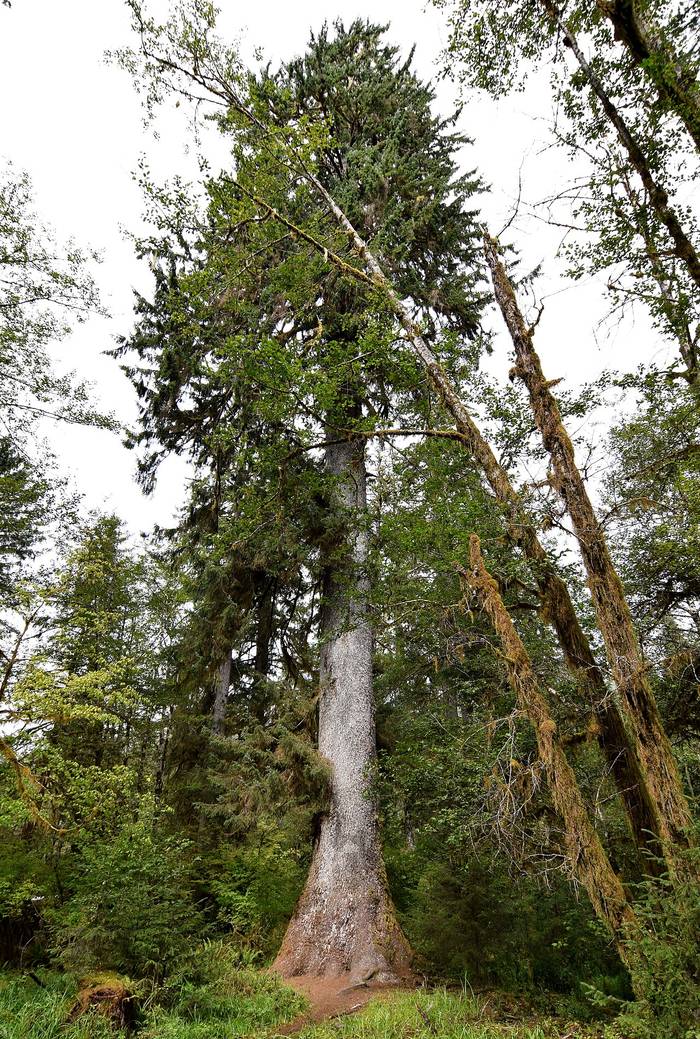
Sitka spruce
Sitka spruce (Picea sitchensis) is a tree. It grows best in full sun and has moderate water needs.
About Sitka spruce
Sitka spruce is a perennial, evergreen tree that grows 50 m tall.[1][2] It grows fast.[1] It is self-fertile, so you only need one. It can live for around 500 years.[2]
It gives shelter to birds and mammals.[3]
The young shoots can be eaten raw.[1][3] The catkins can be eaten too.[1] The cones can be eaten cooked.[1] The seeds can be eaten raw.[1] The bark can be eaten too.[1] The needles can be eaten too.[1][3] Be sure of the identification, as some conifers are poisonous. Recorded from the source text, not a safety check. Confirm with a trusted guide before eating anything.
How to plant sitka spruce
Sitka spruce does best in full sun.[1][3] It grows in sandy soil, loam, clay and peat.[1] It does best at a pH of 4–6.[1] In a forest garden it belongs in the canopy.[1]
Plant trees 10 m apart, at least 5 m. It struggles in compacted soil, so keep the soil loose. It is well established after about 5 years. It can be propagated from seed or from cuttings.[1]
A year with Sitka spruce
Pests and diseases
Sitka spruce can be attacked by spruce aphid and spruce budworm. Diseases include spruce needle rust and root rot.
Companions and wildlife
Sitka spruceSources
- Plants For A Future — Picea sitchensis · CC BY 4.0, Plants For A Future
- JRC forest tree atlas · CC BY 4.0
- Wikipedia — Picea sitchensis · CC BY-SA 4.0
Added to the wiki 4 October 2026
Plan your garden with perma
Open app