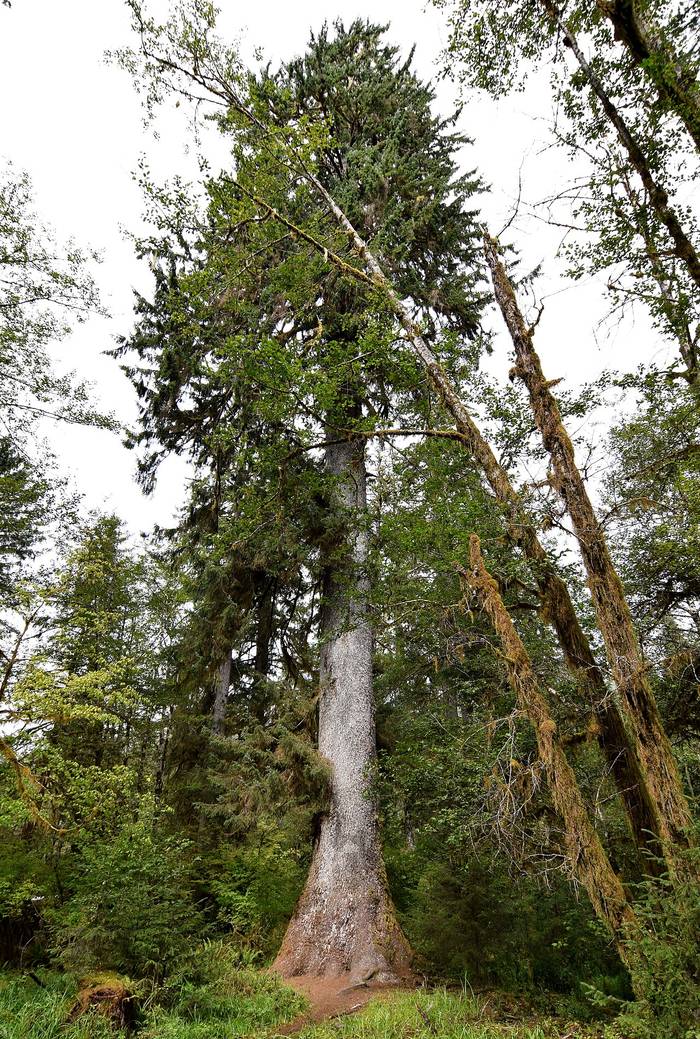
Graaf van Vlaanderen · CC BY-SA 4.0
Sitka spruce
Tree·Picea sitchensis
Full sun
Sun
Moist to wet soil
Water
Not recorded
Drainage
Zones 6–9
Hardiness
Coverage · 118 fields
- Parser flag (climate_tolerance_low_confidence): Climate tolerance values are LLM-extracted (no authoritative EcoCrop match found). EcoCrop covers ~2,568 food-crop taxa; ornamental/native/medicinal species rely on LLM extraction.
Growth and size10 fields
Height
5,000 cm · other sources: 10,000 cm“growing to 50 m (164ft) by 10 m (32ft) at a fast rate”JRC forest tree atlas“It can attain heights approaching 100 m in its native habitat”
Height at age
—
empty
Spacing
1,000 cm (at least 500 cm)
AI estimate55 % agree
Habit
Columnar
AI estimate50 % agree
Root depth
Shallow“the Sitka spruce has a shallow root system with long lateral roots and few branchings”
Forest garden layer
Canopy
AI estimate90 % agree
Roots6 fields
Storage organ
None
AI estimate100 % agree
Spreads
No
AI estimate75 % agree
Lateral spread in cm
—
empty
Root depth in cm
—
empty
Mycorrhiza
Ectomycorrhizal (EcM)
AI estimatenot measured yet
Light, water and soil9 fields
Hours of sun
6 h
AI estimatenot measured yet
Water
Drought tolerant
—
empty
Tolerates waterlogging
—
empty
Soil type
Sand, loam, clay, peat“Suitable for: light (sandy), medium (loamy) and heavy (clay) soils”PFAFpartly“Tolerates poor peaty soils.”
pH
Drainage
Deep, moist but not waterlogged“prefers deep, moist but not waterlogged soils”
Compacted soil
Copes badly
AI estimatenot measured yet
Climate5 fields
Hardiness
Zone 6–9
AI estimatenot measured yet
Killing frost
-25 °C
AI estimatenot measured yet
Growing temperature
0–25 °C · optimal 5–20 °C
AI estimatenot measured yet
Chill hours
1,000 h
AI estimatenot measured yet
Through the year4 fields
Flowering
May · lasts 31 days“It is in leaf all year, in flower in May, and the seeds ripen from September to October.”
Fruiting
September · lasts 61 days“It is in leaf all year, in flower in May, and the seeds ripen from September to October.”
Leafing out
May · lasts 123 days“New growth takes place from May to July or August and some very vigorous trees will produce a second flush of growth until September.”
Dormant
After the first frost
AI estimatenot measured yet
Edible parts and pollination11 fields
The young shoots
Raw · May–August“Young shoots - raw.”PFAFpartly“New growth takes place from May to July or August and some very vigorous trees will produce a second flush of growth until September.”
Young male catkins
Raw or cooked · May“Young male catkins - raw or cooked.”PFAFpartly“It is in leaf all year, in flower in May, and the seeds ripen from September to October.”
The seeds
Raw · September–October“It is rich in fats and has a pleasant slightly resinous flavour but is too small and fiddly to be worthwhile unless you are desperate[172, K].”PFAFpartly“It is in leaf all year, in flower in May, and the seeds ripen from September to October.”
Inner bark
Gum from bark
Hardened in cold water, then chewed“It should be aged for 3 days or more before using it.”PFAF“A gum obtained from the bark is hardened in cold water and then used for chewing.”
Young shoot tips
Tea, rich in vitamin C“A refreshing tea, rich in vitamin C, can be made from the young shoot tips.”
Newly grown branch tips
Used to flavour spruce beer; boiled to make syrup“Newly grown tips of Sitka spruce branches are used to flavor spruce beer”Wikipedia“and are boiled to make syrup.”
Pollination
Self-fertile · monoecious“The species is monoecious (individual flowers are either male or female, but both sexes can be found on the same plant)”PFAF“is pollinated by Wind”
Ecology5 fields
Attracts
—
empty
Pests
Spruce aphid, spruce budworm
AI estimatenot measured yet
Diseases
Spruce needle rust, root rot
AI estimatenot measured yet
Takes up
—
empty
Fixes nitrogen
No
AI estimatenot measured yet
Propagation and names4 fields
Methods
Seed, cuttings of semi-ripe terminal shoots, cuttings of mature terminal shoots, cuttings of soft to semi-ripe wood“Seed - stratification will probably improve germination so sow fresh seed in the autumn in a cold frame if possible.”PFAF“Cuttings of semi-ripe terminal shoots, 5 - 8cm long, August in a frame.”PFAF“Cuttings of mature terminal shoots, 5 - 10cm long, September/October in a cold frame.”PFAF“Cuttings of soft to semi-ripe wood, early summer in a frame.”
Difficulty
3 / 5
AI estimatenot measured yet
Seed
Stratification probably improves germination; sow fresh seed in the autumn in a cold frame if possible.“Seed - stratification will probably improve germination so sow fresh seed in the autumn in a cold frame if possible.”
Not sorted yet64 fields
Fields the parser stores that this page has no row for yet. They show up here automatically, so nothing is hidden.
forage.DK.local_name
Sitka-gran
AI estimatenot measured yet
forage.DK.warnings_da
Vær sikker på bestemmelsen, da nogle nåletræer er giftige.
AI estimatenot measured yet
forage.DK.warnings_en
Be sure of the identification, as some conifers are poisonous.
AI estimatenot measured yet
forage.DK.prep_cautions
ensure positive identification as some conifers are toxic
AI estimatenot measured yet
forage.DK.edibility_basis
inferred
AI estimatenot measured yet
forage.DK.foraging_months.notes
Needles can be harvested year-round for tea; young shoots and inner bark are best in spring.
AI estimatenot measured yet
forage.DK.foraging_months.months
3, 4, 5, 6, 7, 8, 9, 10“The inner bark was usually harvested in the spring, though it was also sometimes taken in the summer.”
PFAFpartly
forage.DK.foraging_months.year_round
true
AI estimatenot measured yet
forage.DK.habitat_affinity
coast, woodland“Alluvial soils from sea level to 300 metres, usually close to the coast.”Wikipediapartly“It is closely associated with the temperate rainforests and is found within a few kilometers of the coast in the southern portion of its range.”
forage.US.edible_parts
[{"part":"young shoots","caution":null,"preparation":"raw","season_months":[5,6,7,8]},{"part":"young male catkins","caution":null,"preparation":"raw or cooked","season_months":[5]},{"part":"immature female cones","cau…“Newly grown tips of Sitka spruce branches are used to flavor spruce beer”PFAF“It is rich in fats and has a pleasant slightly resinous flavour but is too small and fiddly to be worthwhile unless you are desperate[172, K].”PFAF“An emergency food, it is only used when all else fails.”PFAF“It should be aged for 3 days or more before using it.”PFAF“Young shoots - raw.”PFAF“Young male catkins - raw or cooked.”PFAF“Immature female cones - cooked.”PFAF“Inner bark - raw or cooked.”PFAF“A gum obtained from the bark is hardened in cold water and then used for chewing.”PFAF“A refreshing tea, rich in vitamin C, can be made from the young shoot tips.”Wikipedia“Needles can be used to make an aromatic tea.”Wikipedia“and are boiled to make syrup.”PFAFpartly“New growth takes place from May to July or August and some very vigorous trees will produce a second flush of growth until September.”PFAFpartly“It is in leaf all year, in flower in May, and the seeds ripen from September to October.”PFAFpartly“The inner bark was usually harvested in the spring, though it was also sometimes taken in the summer.”
forage.US.prep_cautions
ensure positive identification as some conifers are toxic
AI estimatenot measured yet
forage.US.edibility_basis
inferred
AI estimatenot measured yet
forage.US.foraging_months.notes
Needles can be harvested year-round for tea; young shoots and inner bark are best in spring.
AI estimatenot measured yet
forage.US.foraging_months.months
3, 4, 5, 6, 7, 8, 9, 10“The inner bark was usually harvested in the spring, though it was also sometimes taken in the summer.”
PFAFpartly
forage.US.foraging_months.year_round
true
AI estimatenot measured yet
forage.US.habitat_affinity
coast, woodland“Alluvial soils from sea level to 300 metres, usually close to the coast.”Wikipediapartly“It is closely associated with the temperate rainforests and is found within a few kilometers of the coast in the southern portion of its range.”
forage.TROPICAL.edibility_basis
inferred
AI estimatenot measured yet
forage.TROPICAL.foraging_months.year_round
false
AI estimatenot measured yet
ornamental.basis
documented
AI estimatenot measured yet
ornamental.fragrance.intensity
subtle
AI estimatenot measured yet
ornamental.confidence
high
AI estimatenot measured yet
ornamental.fall_interest
false
AI estimatenot measured yet
ornamental.evidence_quote
The needles are stiff, sharp, and blue-green to green, emitting a subtle resinous scent when crushed. As an evergreen conifer, it retains its foliage year-round with no autumn colour change.
AI estimatenot measured yet
ornamental.foliage_colour
blue_green“The leaves are stiff, sharp, and needle-like, 15–25 millimeters long, flattened in cross-section, dark glaucous blue-green above with two or three thin lines of stomata, and blue-white below with two dense bands of stomata.”
ornamental.foliage_texture
fine“The leaves are stiff, sharp, and needle-like, 15–25 millimeters long, flattened in cross-section, dark glaucous blue-green above with two or three thin lines of stomata, and blue-white below with two dense bands of stomata.”
Wikipediapartly
ornamental.winter_structure
evergreen_form“Picea sitchensis is an evergreen Tree growing to 50 m (164ft) by 10 m (32ft) at a fast rate.”
ornamental.autumn_foliage_colour
none“It is in leaf all year, in flower in May, and the seeds ripen from September to October.”
PFAFpartly
care_regime
none
AI estimatenot measured yet
propagation.self_seeding
moderate
AI estimate20 % agree
propagation.division_season
not applicable
AI estimatenot measured yet
propagation.establishment_years
5
AI estimate40 % agree
forage_proposals.DK.edibility_tier.tier
edible
AI estimatenot measured yet
forage_proposals.DK.edibility_tier.confidence
high
AI estimatenot measured yet
forage_proposals.DK.edibility_tier.evidence_quote
The young shoots, inner bark, and needles of Sitka spruce are traditionally consumed by indigenous peoples and foragers.
AI estimatenot measured yet
forage_proposals.US.edibility_tier.tier
edible
AI estimatenot measured yet
forage_proposals.US.edibility_tier.confidence
high
AI estimatenot measured yet
forage_proposals.US.edibility_tier.evidence_quote
The young shoots, inner bark, and needles of Sitka spruce are traditionally consumed by indigenous peoples and foragers.
AI estimatenot measured yet
forage_proposals.TROPICAL.edibility_tier.confidence
low
AI estimatenot measured yet
function_profile.biomass_return.confidence
high
AI estimatenot measured yet
function_profile.nutrient_flows.consumes
[{"basis":"documented","demand":"moderate","nutrient":"calcium","confidence":"medium","evidence_quote":"prefers soils high in magnesium, calcium, and phosphorus"},{"basis":"documented","demand":"moderate","nutrient":"…“prefers soils high in magnesium, calcium, and phosphorus”PFAF“can grow in nutritionally poor soil”
function_profile.biotic_interactions
[{"taxa":["green spruce aphid"],"basis":"documented","valence":"harmful","relation":"hosts","confidence":"high","evidence_quote":"Subject to damage by the green spruce aphid","organism_group":"pest_insect","ecological…“Subject to damage by the green spruce aphid”PFAF“trees are also often attacked by a bark beetle”JRC forest tree atlas“Sitka spruce partly coexists with the natural niche of this weevil, to which it is highly susceptible.”JRC forest tree atlas“the species is susceptible to fungal attack when injured”Wikipedia“Sitka spruce provides critical habitat for a large variety of mammals, birds, reptiles, and amphibians.”Wikipedia“the needles of Picea sitchensis comprise up to 90% of the winter diet of blue grouse”Wikipediapartly“good nesting and roosting habitat for birds”Wikipediapartly“It provides cover and hiding places for a large variety of mammals”Wikipediapartly“only the new spring growth is eaten”
function_profile.aromatic_pest_effect.value
false
AI estimate80 % agree
function_profile.aromatic_pest_effect.confidence
low
AI estimatenot measured yet
function_profile.structural_interfaces.provides_shelter.basis
documented
AI estimatenot measured yet
function_profile.structural_interfaces.provides_shelter.kinds
wind, shade
AI estimatenot measured yet
function_profile.structural_interfaces.provides_shelter.confidence
high
AI estimatenot measured yet
function_profile.structural_interfaces.requires_shelter.basis
documented
AI estimatenot measured yet
function_profile.structural_interfaces.requires_shelter.kinds
frost“They might need protection from spring frosts.”
function_profile.structural_interfaces.requires_shelter.stage
establishment
AI estimatenot measured yet
function_profile.structural_interfaces.requires_shelter.confidence
medium
AI estimatenot measured yet
function_profile.structural_interfaces.requires_shelter.evidence_quote
They might need protection from spring frosts.
AI estimatenot measured yet
function_profile.structural_interfaces.provides_physical_support.form
trunk
AI estimatenot measured yet
function_profile.structural_interfaces.provides_physical_support.basis
taxonomic
AI estimatenot measured yet
function_profile.structural_interfaces.provides_physical_support.confidence
high
AI estimatenot measured yet
function_profile.structural_interfaces.requires_physical_support.basis
taxonomic
AI estimatenot measured yet
function_profile.structural_interfaces.requires_physical_support.confidence
high
AI estimatenot measured yet
climate_tolerance.photoperiod_response
day_neutral
AI estimatenot measured yet
soil_interactions.organic_matter_contribution
high
AI estimatenot measured yet
component_metadata.growth_cycle
perennial
AI estimate100 % agree
resource_interfaces.inputs
[{"resource":"light","quantity_description":"full sun preferred; dislikes shade"},{"resource":"water","quantity_description":"abundant moisture at the roots; native forests average 200 to 500 cm of rain a year"},{"res…“Picea sitchensis is an evergreen Tree growing to 50 m (164ft) by 10 m (32ft) at a fast rate.”PFAF“is pollinated by Wind”PFAFpartly“Dislikes shade.”PFAFpartly“Likes abundant moisture at the roots”
resource_interfaces.outputs
[{"resource":"leaf_litter","quantity_description":"needle litter"},{"resource":"timber","quantity_description":"major forestry timber and paper wood"},{"resource":"habitat","quantity_description":"critical habitat for…“Sitka spruce is of major importance in forestry for timber and paper production.”Wikipedia“Sitka spruce provides critical habitat for a large variety of mammals, birds, reptiles, and amphibians.”PFAF“is pollinated by Wind”PFAF“the seeds ripen from September to October”Wikipediapartly“Needles can be used to make an aromatic tea.”