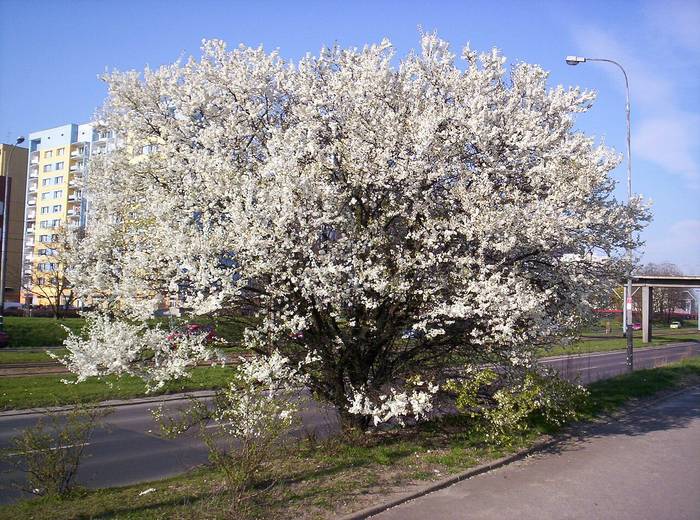
Avalokitesvara · CC BY-SA 3.0
Mirabelle plum
Tree·Prunus domestica subsp. syriaca
Part shade to full sun
Sun
Moist soil
Water
Not recorded
Drainage
Not recorded
Hardiness
Coverage · 114 fields
No obvious inconsistencies found.
Growth and size12 fields
Plant type
Deciduous tree“A deciduous tree, it includes many varieties of the fruit trees known as plums in English, though not all plums belong to this species.”
Height
1,200 cm“Prunus domestica is a deciduous Tree growing to 12 m (39ft) by 10 m (32ft) at a medium rate.”
Spread
1,000 cm“Prunus domestica is a deciduous Tree growing to 12 m (39ft) by 10 m (32ft) at a medium rate.”
Height at age
—
empty
Size after planting
6 yrs: 4 m tall, 2 m crown · 13 yrs: 4 m tall, 3 m crown · 16 yrs: 5 m tall, 4 m crown · 34 yrs: 7 m tall, 5 m crown · 76 yrs: 6 m tall, 6.5 m crown“Berlin tree register: 643 trees of this species measured with years since planting, height and crown diameter; median crown 6.5 m and height 6.0 m at 60–100 years after planting (32 trees).”Median of 643 measured trees in Berlin. Years count from planting nursery stock, so a small tree reaches each size later.
Rootstock trials
Pixy: 1.15 m after 1 yrs · G 5-22: 0.95 m after 1 yrs · Brussel: 3.3 m after 9 yrs · Damas C: 3.7 m after 9 yrs · Brompton: 3.7 m after 9 yrs · Pershore: 3.3 m after 9 yrs · Ackermann: 1.18 m after 1 yrs · Brompton S: 1.13 m after 1 yrs · Common Plum: 3.2 m after 9 yrs · Myrobalan B: 3.85 m after 9 yrs · St. Julien A: 1.04 m after 1 yrs · Common Mussel: 3.5 m after 9 yrs · Marianna GF 8-1: 1.59 m after 1 yrs · Prunus Marianna: 3.1 m after 9 yrs · St. Julien Noir: 1.2 m after 1 yrs · St. Julien INRA 2: 1.04 m after 1 yrs · Balsgård Pr. 10032: 3.46 m after 6 yrs · St. Julien GF 655/2: 1.04 m after 1 yrs · Wangenheim seedling: 0.98 m after 1 yrs · P. cerasifera Hamyra: 1.01 m after 1 yrs · St. Julien d'Orleans: 1.07 m after 1 yrs · St. Julien Waedenswil: 0.8 m after 1 yrs · Myrobalan B (English clone): 3.9 m after 9 yrs · St. Julien A (English clone): 3.3 m after 9 yrs · Dvaergmyrobalan (dwarf myrobalan): 3.65 m after 9 yrs · Myrobalan seedling (P. cerasifera local): 1.21 m after 1 yrs · Myrobalan alm. (common Myrobalan, seedling): 4 m after 9 yrs · Myrobalan seedling (P. cerasifera myrobalana): 1.01 m after 1 yrs · St. Julien alm. (common/Danish St Julien, seedling): 3.2 m after 9 yrs“4 published rootstock trials (Ackermann, Balsgård Pr. 10032, Brompton, Brompton S, Brussel, Common Mussel, Common Plum, Damas C, Dvaergmyrobalan (dwarf myrobalan), G 5-22, Marianna GF 8-1, Myrobalan B, Myrobalan B (English clone), Myrobalan alm. (common Myrobalan, seedling), Myrobalan seedling (P. cerasifera local), Myrobalan seedling (P. cerasifera myrobalana), P. cerasifera Hamyra, Pershore, Pixy, Prunus Marianna, St. Julien A, St. Julien A (English clone), St. Julien GF 655/2, St. Julien INRA 2, St. Julien Noir, St. Julien Waedenswil, St. Julien alm. (common/Danish St Julien, seedling), St. Julien d'Orleans, Wangenheim seedling) measured height and crown width at known years after planting.”
Rootstock trials
Spacing
450 cm (at least 300 cm)
AI estimate55 % agree
Growth rate
Medium“Prunus domestica is a deciduous Tree growing to 12 m (39ft) by 10 m (32ft) at a medium rate.”
Habit
—
empty
Forest garden layer
Lower tree layer
AI estimate90 % agree
Lifespan
~20 years
AI estimatenot measured yet
Roots6 fields
Root form
Plate root (shallow)“Most genus members are shallow-rooted, forming a plate near the soil surface, and will produce suckers if the roots are damaged.”
Storage organ
None
AI estimate100 % agree
Lateral spread in cm
—
empty
Root depth in cm
—
empty
Mycorrhiza
Arbuscular (AM)
AI estimatenot measured yet
Light, water and soil9 fields
Sun
Hours of sun
6 h
AI estimatenot measured yet
Drought tolerant
—
empty
Tolerates waterlogging
—
empty
Soil type
Sand, loam, clay · best: loam“Thrives in a loamy soil, doing well on limestone.”PFAF“Suitable for: light (sandy), medium (loamy) and heavy (clay) soils, prefers well-drained soil and can grow in heavy clay soil.”
pH
4.5–7.4 · best 6–6.5“Prefers a pH between 6 and 6.5.”PFAF“Suitable pH: mildly acid, neutral and basic (mildly alkaline) soils.”
Drainage
Well-drained, moisture-retentive“Requires a well-drained moisture retentive soil and a sheltered position.”
Compacted soil
Copes fairly well
AI estimatenot measured yet
Climate5 fields
Hardiness
—
empty
Killing frost
—
empty
Growing temperature
6–36 °C · optimal 18–33 °C
AI estimatenot measured yet
Chill hours
700 h
AI estimatenot measured yet
Native range
—
empty
Care (becomes tasks in Manage)8 fields
Protection
After the previous stage · lasts 30 days · frost“Their early flowering and fruiting means that they require a sheltered spot away from frosts and cold winds.”
Wikipediapartly
Protection
After the previous stage · lasts 30 days · wind“Their early flowering and fruiting means that they require a sheltered spot away from frosts and cold winds.”
Wikipediapartly
Protection
After the last frost · -30 days after · lasts 60 days · frost
AI estimatenot measured yet
Pruning
July · lasts 30 days · fruiting spurs · dead, diseased, or crossing branches, and any vigorous upright shoots (watershoots)
AI estimatenot measured yet
Feeding
March · lasts 30 days · a balanced granular fertiliser
AI estimatenot measured yet
Mulching
March · 30 days after · lasts 30 days
AI estimatenot measured yet
Watering
June · lasts 90 days
AI estimatenot measured yet
Protection
February · lasts 30 days · birds
AI estimatenot measured yet
Through the year3 fields
Flowering
April · lasts 14 days“It is in flower in April, and the seeds ripen from July to November.”
Harvest
July · 20 days after · lasts 130 days“The plum is widely cultivated for its edible fruit in temperate zones, there are many named varieties able to supply fresh fruits from late July to November or December.”
PFAFpartly
First harvest
3–5 years after plantingOregon State Table 1 agrees (Plums and prunes 3–5).
Edible parts and pollination4 fields
The fruit
In fruit preserves and dessert pies, or fermented into wine or distilled into plum brandy · July–September“The fruit is primarily used in fruit preserves and dessert pies, and its juice is commonly fermented into wine or distilled into plum brandy.”Wikipediapartly“The mirabelle reaches maturity and is harvested from July to mid-September in the Northern Hemisphere.”
Pollination
Self-fertile · hermaphrodite“The species is hermaphrodite (has both male and female organs) and is pollinated by Insects.”PFAF“The plant is self-fertile.”
Pollinated by
Insects“The species is hermaphrodite (has both male and female organs) and is pollinated by Insects.”
Ecology5 fields
Attracts
Wildlife, pollinators“It is noted for attracting wildlife.”PFAF“They also improve biodiversity by providing habitats for pollinators and other wildlife.”
Pests
Plum curculio, oriental fruit moth, aphids, scale insects
AI estimatenot measured yet
Takes up
Potassium, calcium
AI estimatenot measured yet
Fixes nitrogen
No
AI estimatenot measured yet
Propagation and names4 fields
Methods
Seed, half-ripe wood cuttings, softwood cuttings, layering“Seed - requires 2 - 3 months cold stratification and is best sown in a cold frame as soon as it is ripe.”PFAF“Cuttings of half-ripe wood with a heel, July/August in a frame.”PFAF“Softwood cuttings from strongly growing plants in spring to early summer in a frame.”PFAF“Layering in spring.”
Difficulty
2 / 5
AI estimatenot measured yet
Seed
2 - 3 months cold stratification“Seed - requires 2 - 3 months cold stratification and is best sown in a cold frame as soon as it is ripe.”
Not sorted yet58 fields
Fields the parser stores that this page has no row for yet. They show up here automatically, so nothing is hidden.
forage.DK.edibility_basis
inferred
AI estimatenot measured yet
forage.DK.foraging_months.months
7, 8, 9“The mirabelle reaches maturity and is harvested from July to mid-September in the Northern Hemisphere.”
Wikipediapartly
forage.DK.foraging_months.year_round
false
AI estimatenot measured yet
forage.US.edible_parts
[{"part":"fruit","caution":null,"preparation":"in fruit preserves and dessert pies, or fermented into wine or distilled into plum brandy","season_months":[7,8,9]}]“The fruit is primarily used in fruit preserves and dessert pies, and its juice is commonly fermented into wine or distilled into plum brandy.”Wikipediapartly“The mirabelle reaches maturity and is harvested from July to mid-September in the Northern Hemisphere.”
forage.US.edibility_basis
inferred
AI estimatenot measured yet
forage.US.foraging_months.months
7, 8, 9“The mirabelle reaches maturity and is harvested from July to mid-September in the Northern Hemisphere.”
Wikipediapartly
forage.US.foraging_months.year_round
false
AI estimatenot measured yet
ornamental.basis
documented
AI estimatenot measured yet
ornamental.fragrance.source
flower
AI estimate100 % agree
ornamental.fragrance.intensity
subtle
AI estimatenot measured yet
ornamental.confidence
high
AI estimatenot measured yet
ornamental.fall_interest
true
AI estimatenot measured yet
ornamental.flower_colour
white“It may be somewhat thorny, with white blossom, borne in early spring.”
ornamental.evidence_quote
Plum trees typically have white to pink blossoms in spring, followed by green foliage that turns yellow-green to red in autumn. The fruit often persists on the tree, providing winter interest, and the bare branches form an architectural skeleton. The flowers have a subtle fragrance.
AI estimatenot measured yet
ornamental.foliage_colour
green
AI estimate82 % agree
ornamental.foliage_texture
medium
AI estimatenot measured yet
ornamental.winter_structure
persistent_fruit, architectural_skeleton
AI estimatenot measured yet
ornamental.autumn_foliage_colour
yellow_green, red
AI estimatenot measured yet
care_regime
routine
AI estimatenot measured yet
propagation.self_seeding
none
AI estimate20 % agree
propagation.division_season
not applicable
AI estimatenot measured yet
propagation.establishment_years
3
AI estimate40 % agree
size_at_age.v
1
AI estimatenot measured yet
size_at_age.basis
years_after_planting
AI estimatenot measured yet
spatial_profile.canopy_density
medium
AI estimatenot measured yet
sun_requirement.best
full_sun“Plums prefer full sun, but cultivars are available for light shade.”
forage_proposals.DK.edibility_tier.tier
edible“The fruit is primarily used in fruit preserves and dessert pies, and its juice is commonly fermented into wine or distilled into plum brandy.”
forage_proposals.DK.edibility_tier.confidence
medium
AI estimatenot measured yet
forage_proposals.DK.edibility_tier.evidence_quote
The fruit is primarily used in fruit preserves and dessert pies, and its juice is commonly fermented into wine or distilled into plum brandy.
AI estimatenot measured yet
forage_proposals.US.edibility_tier.tier
edible“The fruit is primarily used in fruit preserves and dessert pies, and its juice is commonly fermented into wine or distilled into plum brandy.”
forage_proposals.US.edibility_tier.confidence
medium
AI estimatenot measured yet
forage_proposals.US.edibility_tier.evidence_quote
The fruit is primarily used in fruit preserves and dessert pies, and its juice is commonly fermented into wine or distilled into plum brandy.
AI estimatenot measured yet
function_profile.biomass_return.confidence
medium
AI estimatenot measured yet
function_profile.nutrient_flows.consumes
[{"basis":"documented","demand":"high","nutrient":"nitrogen","confidence":"high"},{"basis":"documented","demand":"moderate","nutrient":"phosphorus","confidence":"high"},{"basis":"documented","demand":"high","nutrient"…
AI estimatenot measured yet
function_profile.nutrient_flows.provides
[{"basis":"inferred","nutrient":"potassium","mechanism":"biomass_return","confidence":"low"},{"basis":"inferred","nutrient":"calcium","mechanism":"biomass_return","confidence":"low"}]
AI estimatenot measured yet
function_profile.biotic_interactions
[{"taxa":["insects"],"basis":"documented","valence":"beneficial","relation":"attracts","confidence":"high","evidence_quote":"The species is hermaphrodite (has both male and female organs) and is pollinated by Insects.…“The species is hermaphrodite (has both male and female organs) and is pollinated by Insects.”PFAF“They also improve biodiversity by providing habitats for pollinators and other wildlife.”PFAF“Plants in this genus are notably susceptible to honey fungus.”
function_profile.aromatic_pest_effect.value
false
AI estimate80 % agree
function_profile.aromatic_pest_effect.confidence
high
AI estimatenot measured yet
function_profile.structural_interfaces.provides_shelter.basis
taxonomic
AI estimatenot measured yet
function_profile.structural_interfaces.provides_shelter.kinds
wind“Prunus species can be used as windbreaks and in alley cropping systems.”
function_profile.structural_interfaces.provides_shelter.confidence
high
AI estimatenot measured yet
function_profile.structural_interfaces.provides_shelter.evidence_quote
Prunus species can be used as windbreaks and in alley cropping systems.
AI estimatenot measured yet
function_profile.structural_interfaces.requires_shelter.basis
documented
AI estimatenot measured yet
function_profile.structural_interfaces.requires_shelter.kinds
frost, wind“Their early flowering and fruiting means that they require a sheltered spot away from frosts and cold winds.”
function_profile.structural_interfaces.requires_shelter.stage
establishment
AI estimatenot measured yet
function_profile.structural_interfaces.requires_shelter.confidence
medium
AI estimatenot measured yet
function_profile.structural_interfaces.requires_shelter.evidence_quote
Their early flowering and fruiting means that they require a sheltered spot away from frosts and cold winds.
AI estimatenot measured yet
function_profile.structural_interfaces.provides_physical_support.form
trunk
AI estimatenot measured yet
function_profile.structural_interfaces.provides_physical_support.basis
taxonomic
AI estimatenot measured yet
function_profile.structural_interfaces.provides_physical_support.confidence
high
AI estimatenot measured yet
function_profile.structural_interfaces.requires_physical_support.basis
inferred
AI estimatenot measured yet
function_profile.structural_interfaces.requires_physical_support.confidence
low
AI estimatenot measured yet
climate_tolerance.photoperiod_response
day_neutral
AI estimatenot measured yet
soil_interactions.organic_matter_contribution
medium
AI estimatenot measured yet
component_metadata.growth_cycle
perennial
AI estimate100 % agree
resource_interfaces.inputs
[{"resource":"light","quantity_description":"full sun preferred; cultivars available for light shade"},{"resource":"shade","quantity_description":"tolerates semi-shade (light woodland) or no shade"},{"resource":"water…“Plums prefer full sun, but cultivars are available for light shade.”PFAF“It can grow in semi-shade (light woodland) or no shade.”PFAF“It prefers moist soil.”PFAF“Requires a well-drained moisture retentive soil and a sheltered position.”PFAFpartly“The species is hermaphrodite (has both male and female organs) and is pollinated by Insects.”
resource_interfaces.outputs
[{"resource":"fruit","quantity_description":"primary use: fruit preserves, dessert pies, wine and plum brandy"},{"resource":"shade","quantity_description":"dense canopy of a mature tree (estimate)"}]“The fruit is primarily used in fruit preserves and dessert pies, and its juice is commonly fermented into wine or distilled into plum brandy.”