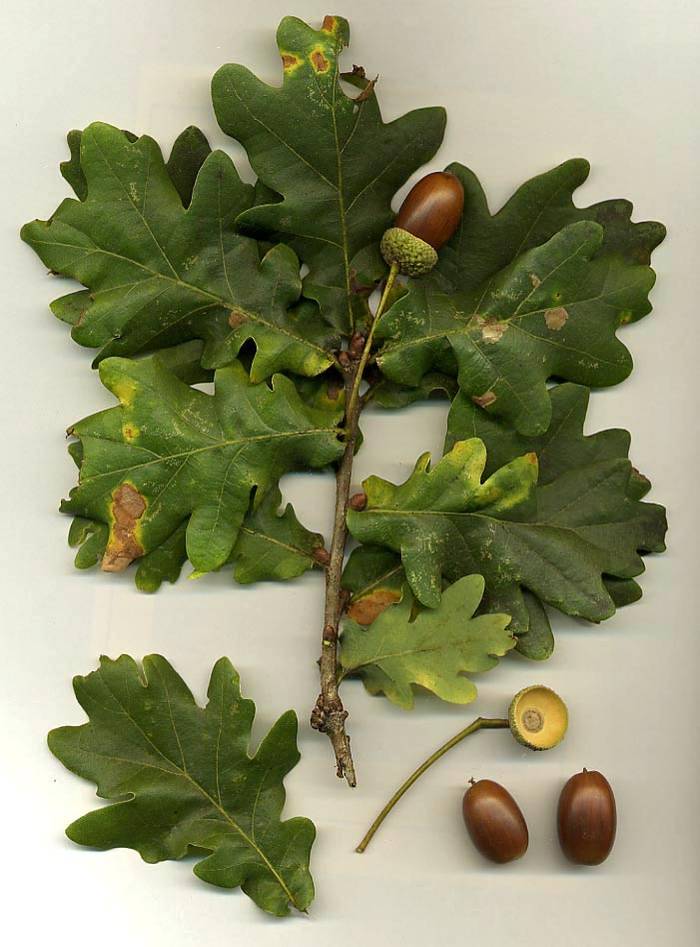
English oak
English oak (Quercus robur) is a tree. It grows best in part shade to full sun and has moderate water needs. It grows well with sessile oak and common hornbeam.
About English oak
English oak is a perennial, deciduous tree that grows 30–40 m tall.[1][2][3] It grows slowly.[1] It needs another plant of its kind to pollinate it, so plant at least two. It can live for around 500 years.[2] English oak grows wild in Denmark. In autumn the leaves turn bronze.
Birds and mammals eat the fruit and spread the seeds.[3]
The seeds can be eaten.[1][2] Acorns must be washed in running water before eating. Harmful to dogs and cats. Recorded from the source text, not a safety check. Confirm with a trusted guide before eating anything.
How to plant english oak
English oak does best in full sun, but also copes with part shade.[1][3] It grows in loam and clay.[1] It does best at a pH of 4.5–7.5.[1][2] In a forest garden it belongs in the canopy.[1]
Plant trees 15 m apart, at least 10 m. It is well established after about 5 years. It can be propagated from seed.[1]
A year with English oak
Spring. It has small yellow flowers in April–June.[1][3]
Winter. It rests through the winter. It needs around 600 hours of winter cold to crop well.
Pests and diseases
English oak can be attacked by winter moth, green tortrix, mottled umber, gall wasps and mice and squirrels (seed predation).[1][2] Diseases include powdery mildew (erysiphe alphitoides), acute oak decline and sudden oak death.[2]
Companions and wildlife
English oakSources
- Plants For A Future — Quercus robur · CC BY 4.0, Plants For A Future
- Wikipedia — Quercus robur · CC BY-SA 4.0
- JRC forest tree atlas · CC BY 4.0
- CLO-PLA (clonal growth) · Klimešová et al. 2017
- Berlin tree register · DL-DE-Zero-2.0
Added to the wiki 4 October 2026
Plan your garden with perma
Open app