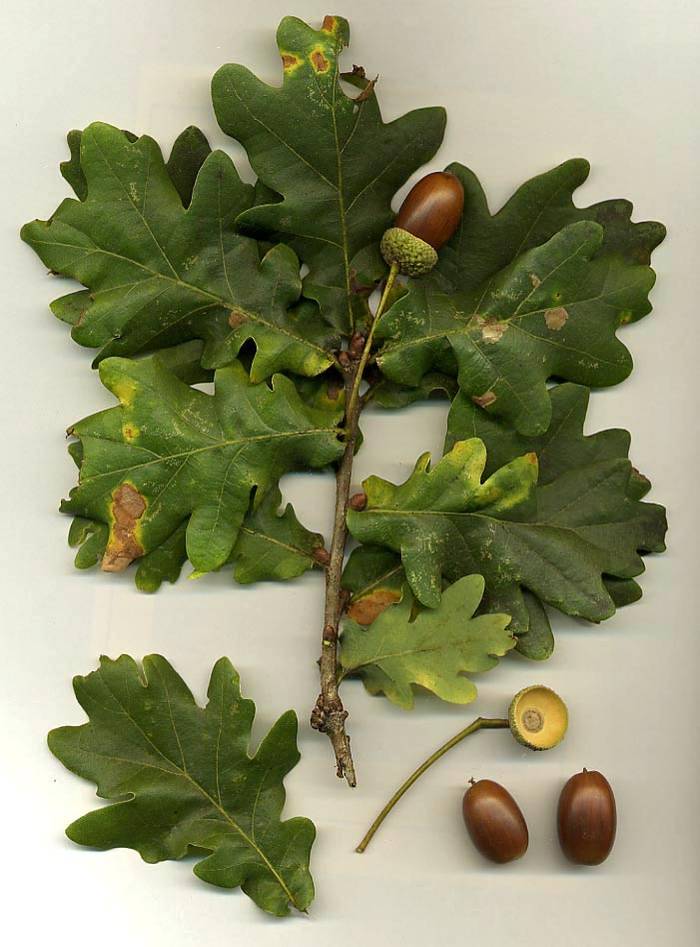
NickShaforostoff · CC BY-SA 3.0
English oak
Tree·Quercus robur
Part shade to full sun
Sun
Moist to wet soil
Water
Not recorded
Drainage
Zones 5–8
Hardiness
Coverage · 111 fields
No obvious inconsistencies found.
Growth and size11 fields
Plant type
Deciduous tree“Quercus robur is a deciduous Tree growing to 30 m (98ft) by 30 m (98ft) at a slow rate.”
Height
Spread
3,000 cm“Quercus robur is a deciduous Tree growing to 30 m (98ft) by 30 m (98ft) at a slow rate.”
Height at age
—
empty
Size after planting
3 yrs: 5 m tall, 1 m crown · 7 yrs: 5 m tall, 2 m crown · 17 yrs: 8 m tall, 3.5 m crown · 35 yrs: 13 m tall, 6 m crown · 74 yrs: 20 m tall, 12 m crown“Berlin tree register: 35263 trees of this species measured with years since planting, height and crown diameter; median crown 12.0 m and height 20.0 m at 60–100 years after planting (11473 trees).”Median of 35,263 measured trees in Berlin. Years count from planting nursery stock, so a small tree reaches each size later.
Spacing
1,500 cm (at least 1,000 cm)
AI estimate55 % agree
Growth rate
Slow“Quercus robur is a deciduous Tree growing to 30 m (98ft) by 30 m (98ft) at a slow rate.”
Habit
Spreading“The crown is spreading and unevenly domed, and trees often have massive lower branches.”
Root depth
Taproot“Plants produce a deep taproot and need to be planted out into their permanent positions as soon as possible, in fact seed sown in situ will produce the best trees.”
Forest garden layer
Canopy
AI estimate90 % agree
Lifespan
~500 years“English oaks can live to very old ages, often growing for over 500 years, with some specimens believed to be over 1,000 years old.”
Roots6 fields
Root form
Taproot“Plants produce a deep taproot and need to be planted out into their permanent positions as soon as possible, in fact seed sown in situ will produce the best trees.”
Storage organ
None“No clonal growth organ is recorded: it does not spread vegetatively (no suckers, no rhizomes).”
Spreads
No“No clonal growth organ is recorded: it does not spread vegetatively (no suckers, no rhizomes).”
Lateral spread in cm
—
empty
Root depth in cm
—
empty
Mycorrhiza
Ectomycorrhizal (EcM)
AI estimatenot measured yet
Light, water and soil9 fields
Sun
Full sun, light shade, part shade · best: full sun“It can grow in semi-shade (light woodland) or no shade.”JRC forest tree atlaspartly“They are both light-demanding trees (Q. robur more so than Q. petraea)”
Hours of sun
6 h
AI estimatenot measured yet
Tolerates waterlogging
—
empty
Soil type
Loam, clay · best: loam“Prefers a good deep fertile loam which can be on the stiff side.”PFAF“Suitable for: medium (loamy) and heavy (clay) soils and can grow in heavy clay soil.”
pH
4.5–7.5“Suitable pH: mildly acid, neutral and basic (mildly alkaline) soils.”Wikipedia“It grows on soils of near neutral acidity in the lowlands”
Drainage
Moist to wet, but not waterlogged for long periods“Succeeds in heavy clay soils and in wet soils so long as the ground is not water-logged for long periods.”
Compacted soil
Copes fairly well
AI estimatenot measured yet
Climate5 fields
Hardiness
Zone 5–8
AI estimatenot measured yet
Killing frost
-1 °C“Killing temp. early growth: -1”EcoCrop's figure is frost during early growth (spring frost on new shoots), not winter cold.
Growing temperature
5–41 °C · optimal 10–18 °C“Temperature absolute min: 5 · Temperature absolute max: 41 · Temperature optimal min: 10 · Temperature optimal max: 18”
Chill hours
600 h
AI estimatenot measured yet
Native range
AD, AL, AM, AT, AZ, BA, BE, BG, BY, CH, CZ, DE, DK, EE, ES, FI, FR, GB, GE, GG, GI, GR, HR, HU, IE, IR, IT, JE, LI, LT, LU, LV, MC, MD, ME, MK, NL, NO, PL, PT, RO, RS, RU, SE, SI, SK, SM, TR, UA, VA, XK
Through the year5 fields
Leafing out
April · lasts 15 days“do not come into leaf until relatively late in the year (late April to early May)”
Dying back
After the first frost · lasts 30 days
AI estimatenot measured yet
Dormant
After the first frost · 30 days after · lasts 150 days
AI estimatenot measured yet
Edible parts and pollination6 fields
Seed (acorn)
Seed (acorn)
Roasted and chopped as an almond substitute“Chopped and roasted, the seed is used as an almond substitute.”PFAFpartly“Edible Parts: Seed”
Seed (acorn)
Roasted and ground into a coffee substitute“Additionally, although bitter due to their high tannin content, the acorns can be roasted and ground into a coffee substitute.”PFAFpartly“Edible Parts: Seed”
Pollination
Needs a partner · monoecious“The species is monoecious (individual flowers are either male or female, but both sexes can be found on the same plant) and is pollinated by Wind.”
Pollinated by
Wind“The species is monoecious (individual flowers are either male or female, but both sexes can be found on the same plant) and is pollinated by Wind.”
Ecology5 fields
Attracts
Wildlife, herbivorous insects, acorn-eating mammals and birds“It is noted for attracting wildlife.”Wikipedia“famously supporting the highest biodiversity of insect herbivores of any British plant (at least 400 species)”Wikipediapartly“form a valuable food resource for several small mammals and some birds, notably Eurasian jays Garrulus glandarius.”
Pests
Winter moth, green tortrix, mottled umber, gall wasps, mice and squirrels (seed predation)“The most common caterpillar species include the winter moth, the green tortrix and the mottled umber, all of which can become extremely abundant on the first flush of leaves in May, but the oak trees do recover their foliage later in the year.”Wikipedia“One of the most distinctive galls is the oak apple, a 4.5 cm diameter spongy ball created from the buds by the wasp Biorhiza pallida.”PFAF“though it must be protected from mice, squirrels etc.”
Diseases
Takes up
—
empty
Fixes nitrogen
No
AI estimatenot measured yet
Propagation and names4 fields
Methods
Seed, direct sowing in situ“Seed - it quickly loses viability if it is allowed to dry out.”PFAF“in fact seed sown in situ will produce the best trees”
Difficulty
3 / 5
AI estimatenot measured yet
Not sorted yet60 fields
Fields the parser stores that this page has no row for yet. They show up here automatically, so nothing is hidden.
forage.DK.local_name
Almindelig eg
AI estimatenot measured yet
forage.DK.warnings_da
Agern skal vaskes i rindende vand, før de spises., Skadelig for hunde og katte.
AI estimatenot measured yet
forage.DK.warnings_en
Acorns must be washed in running water before eating., Harmful to dogs and cats.
AI estimatenot measured yet
forage.DK.prep_cautions
Leach the bitter tannins out in running water; many minerals are lost too., Whole acorns can take several days or even weeks to leach fully.“The seed contains bitter tannins, these can be leached out by thoroughly washing the seed in running water though many minerals will also be lost.”PFAF“It can take several days or even weeks to properly leach whole seeds”
forage.DK.edibility_basis
inferred
AI estimatenot measured yet
forage.DK.foraging_months.year_round
false
AI estimatenot measured yet
forage.DK.habitat_affinity
hedgerow, woodland, riverbank“Pedunculate oak is a long-lived tree of high-canopy woodland, coppice and wood pasture, and it is commonly planted in hedges.”Wikipediapartly“Sometimes it is found on the margins of swamps, rivers and ponds”
forage.US.local_name
English Oak
AI estimatenot measured yet
forage.US.edible_parts
[{"part":"seed (acorn)","caution":"Possible digestive complaints.","preparation":"leach out the tannins by washing in running water"},{"part":"seed (acorn)","preparation":"roasted and chopped as an almond substitute"}…“An edible gum is obtained from the bark.”PFAF“Possible digestive complaints.”PFAF“The seed contains bitter tannins, these can be leached out by thoroughly washing the seed in running water though many minerals will also be lost.”PFAF“Chopped and roasted, the seed is used as an almond substitute.”Wikipedia“Additionally, although bitter due to their high tannin content, the acorns can be roasted and ground into a coffee substitute.”PFAFpartly“Edible Parts: Seed”
forage.US.prep_cautions
Leach the bitter tannins out in running water; many minerals are lost too., Whole acorns can take several days or even weeks to leach fully.“The seed contains bitter tannins, these can be leached out by thoroughly washing the seed in running water though many minerals will also be lost.”PFAF“It can take several days or even weeks to properly leach whole seeds”
forage.US.edibility_basis
inferred
AI estimatenot measured yet
forage.US.foraging_months.year_round
false
AI estimatenot measured yet
forage.US.habitat_affinity
woodland“Pedunculate oak is a long-lived tree of high-canopy woodland, coppice and wood pasture, and it is commonly planted in hedges.”
ornamental.basis
documented
AI estimatenot measured yet
ornamental.fragrance.source
none
AI estimate100 % agree
ornamental.fragrance.intensity
subtle
AI estimatenot measured yet
ornamental.confidence
high
AI estimatenot measured yet
ornamental.fall_interest
true
AI estimatenot measured yet
ornamental.flower_colour
yellow, insignificant“with drooping male flowers in yellow catkins about 5 cm long”JRC forest tree atlas“inconspicuous globular female flowers of 1 mm at terminal shots”
ornamental.evidence_quote
The leaves turn yellow-brown in autumn and often persist on the tree until spring. Flowers are inconspicuous catkins.
AI estimatenot measured yet
ornamental.foliage_colour
dark_green“They are dark green above, paler below, and are often covered in small disks of spangle gall by autumn.”
ornamental.foliage_texture
medium
AI estimatenot measured yet
ornamental.winter_structure
architectural_skeleton, persistent_fruit“The bark is greyish-brown and closely grooved, with vertical plates.”
Wikipediapartly
ornamental.autumn_foliage_colour
yellow_green, bronze
AI estimatenot measured yet
care_regime
none
AI estimatenot measured yet
propagation.self_seeding
moderate
AI estimate20 % agree
propagation.division_season
null
AI estimatenot measured yet
propagation.establishment_years
5
AI estimate40 % agree
size_at_age.v
1
AI estimatenot measured yet
size_at_age.basis
years_after_planting
AI estimatenot measured yet
spatial_profile.canopy_density
light“their canopies permit a good deal of light to pass through to the undergrowth”
forage_proposals.DK.edibility_tier.tier
caution
AI estimatenot measured yet
forage_proposals.DK.edibility_tier.confidence
high
AI estimatenot measured yet
forage_proposals.DK.edibility_tier.evidence_quote
Acorns of Quercus robur are edible after leaching to remove bitter tannins.
AI estimatenot measured yet
forage_proposals.US.edibility_tier.tier
caution
AI estimatenot measured yet
forage_proposals.US.edibility_tier.confidence
high
AI estimatenot measured yet
forage_proposals.US.edibility_tier.evidence_quote
Acorns of Quercus robur are edible after leaching to remove bitter tannins.
AI estimatenot measured yet
function_profile.biomass_return.confidence
high
AI estimatenot measured yet
function_profile.nutrient_flows.consumes
[{"basis":"inferred","demand":"high","nutrient":"nitrogen","confidence":"medium"},{"basis":"inferred","demand":"moderate","nutrient":"phosphorus","confidence":"medium"},{"basis":"inferred","demand":"moderate","nutrien…
AI estimatenot measured yet
function_profile.nutrient_flows.provides
[{"basis":"documented","nutrient":"calcium","mechanism":"biomass_return","confidence":"medium","evidence_quote":"The bark is very rich in calcium."}]“The bark is very rich in calcium.”
function_profile.biotic_interactions
[{"taxa":["wildlife"],"basis":"documented","valence":"beneficial","relation":"attracts","confidence":"high","evidence_quote":"It is noted for attracting wildlife.","organism_group":"wildlife","ecological_function":"ha…“It is noted for attracting wildlife.”JRC forest tree atlas“Mammals and birds are important for the seed dispersal, especially the Eurasian jay (Garrulus glandarius) which can be considered the primary propagator.”Wikipedia“The most common caterpillar species include the winter moth, the green tortrix and the mottled umber, all of which can become extremely abundant on the first flush of leaves in May, but the oak trees do recover their foliage later in the year.”Wikipedia“Powdery mildew caused by Erysiphe alphitoides”PFAF“though it must be protected from mice, squirrels etc.”Wikipediapartly“with blue tits and great tits timing their egg hatching to the leaves opening”
function_profile.aromatic_pest_effect.value
false
AI estimate80 % agree
function_profile.aromatic_pest_effect.confidence
medium
AI estimatenot measured yet
function_profile.structural_interfaces.provides_shelter.basis
taxonomic“their canopies permit a good deal of light to pass through to the undergrowth”
JRC forest tree atlaspartly
function_profile.structural_interfaces.provides_shelter.kinds
wind, shade“their canopies permit a good deal of light to pass through to the undergrowth”
JRC forest tree atlaspartly
function_profile.structural_interfaces.provides_shelter.confidence
high“their canopies permit a good deal of light to pass through to the undergrowth”
JRC forest tree atlaspartly
function_profile.structural_interfaces.provides_shelter.evidence_quote
their canopies permit a good deal of light to pass through to the undergrowth“their canopies permit a good deal of light to pass through to the undergrowth”
JRC forest tree atlaspartly
function_profile.structural_interfaces.provides_physical_support.form
trunk
AI estimatenot measured yet
function_profile.structural_interfaces.provides_physical_support.basis
taxonomic
AI estimatenot measured yet
function_profile.structural_interfaces.provides_physical_support.confidence
high
AI estimatenot measured yet
function_profile.structural_interfaces.requires_physical_support.basis
taxonomic
AI estimatenot measured yet
function_profile.structural_interfaces.requires_physical_support.confidence
high
AI estimatenot measured yet
climate_tolerance.photoperiod_response
long_day
AI estimatenot measured yet
soil_interactions.organic_matter_contribution
high
AI estimatenot measured yet
component_metadata.growth_cycle
perennial“Pedunculate oak is a long-lived tree of high-canopy woodland, coppice and wood pasture, and it is commonly planted in hedges.”
Wikipediapartly
resource_interfaces.inputs
[{"resource":"light","quantity_description":"light-demanding; more so than sessile oak"},{"resource":"shade","quantity_description":"grows in semi-shade (light woodland) or no shade"},{"resource":"water","quantity_des…“They are both light-demanding trees (Q. robur more so than Q. petraea)”PFAF“It can grow in semi-shade (light woodland) or no shade.”PFAF“It prefers moist or wet soil and can tolerate drought.”
resource_interfaces.outputs
[{"resource":"shade","quantity_description":"dappled shade beneath a light canopy"},{"resource":"timber","quantity_description":"hard, durable heartwood for furniture and construction"},{"resource":"mulch_biomass","qu…“their canopies permit a good deal of light to pass through to the undergrowth”PFAF“Wood - hard, tough, durable even under water - highly valued for furniture, construction etc.”PFAF“A mulch of the leaves repels slugs, grubs etc, though fresh leaves should not be used as these can inhibit plant growth.”Wikipedia“It grows on soils of near neutral acidity in the lowlands and is notable for its value to natural ecosystems, supporting a diversity of herbivorous insects, acorn eating mammals and birds, and fungi.”Wikipedia“The fruits (acorns) are borne in clusters of 2–3 on a long peduncle (stalk) 4–8 cm long.”Wikipediapartly“form a valuable food resource for several small mammals and some birds, notably Eurasian jays Garrulus glandarius.”JRC forest tree atlaspartly“These oaks are monoecious and wind-pollinated”
biotic_relationships.repels
slugs, grubs“A mulch of the leaves repels slugs, grubs etc, though fresh leaves should not be used as these can inhibit plant growth.”