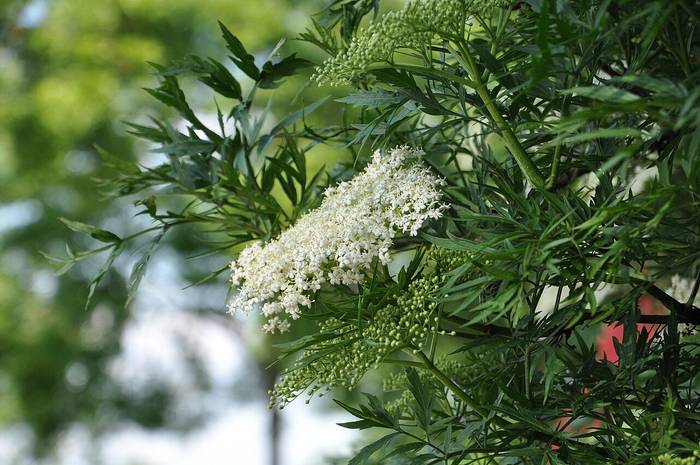
Onderwijsgek · CC BY-SA 3.0
Cut-leaved elder
Shrub·Sambucus nigra var. laciniata
Part shade to full sun
Sun
Dry to wet soil
Water
Well-drained soil
Drainage
Not recorded
Hardiness
Coverage · 94 fields
No obvious inconsistencies found.
Growth and size11 fields
Plant type
Deciduous shrub“Sambucus nigra is a deciduous Shrub growing to 6 m (19ft) by 6 m (19ft) at a fast rate.”
Height
600 cm · other sources: 1,000 cm“Sambucus nigra is a deciduous Shrub growing to 6 m (19ft) by 6 m (19ft) at a fast rate.”JRC forest tree atlas“Sambucus nigra L., also known as black elderberry, common elder or European elder, is usually a 4-5 m tall shrub or rarely a small tree, up to 10 m in height, with vigorous erect shoots, arching branches and brownish-grey and deeply furrowed bark.”
Spread
600 cm“Sambucus nigra is a deciduous Shrub growing to 6 m (19ft) by 6 m (19ft) at a fast rate.”
Height at age
—
empty
Size after planting
16 yrs: 5 m tall, 3 m crown · 36 yrs: 6 m tall, 5 m crown · 46 yrs: 7 m tall, 5 m crown“Berlin tree register: 176 trees of this species measured with years since planting, height and crown diameter; median crown 5.0 m and height 7.0 m at 40–60 years after planting (34 trees).”Median of 176 measured trees in Berlin. Years count from planting nursery stock, so a small tree reaches each size later.
Spacing
300 cm (at least 200 cm)
AI estimate55 % agree
Growth rate
Fast“Sambucus nigra is a deciduous Shrub growing to 6 m (19ft) by 6 m (19ft) at a fast rate.”
Habit
—
empty
Root depth
Medium
AI estimate63 % agree
Forest garden layer
Shrub layer
AI estimate90 % agree
Roots6 fields
Root form
Fibrous roots
AI estimate43 % agree
Storage organ
None“No clonal growth organ is recorded: it does not spread vegetatively (no suckers, no rhizomes).”
Spreads
No“No clonal growth organ is recorded: it does not spread vegetatively (no suckers, no rhizomes).”
Lateral spread in cm
—
empty
Root depth in cm
—
empty
Mycorrhiza
Arbuscular (AM)
AI estimatenot measured yet
Light, water and soil9 fields
Sun
Full sun, light shade, part shade · best: full sun“It is vigorous and adaptable, growing in sun or partial shade although it performs poorly in deep shade or dry conditions.”
Hours of sun
6–12 h
AI estimatenot measured yet
Water
Dry, moist, wet · best: moist · Medium · 2–5 l/day“It prefers moist soil.”Wikipedia“It grows in a variety of conditions including both wet and dry fertile soils, primarily in sunny locations.”
Tolerates waterlogging
—
empty
Soil type
Sand, loam, clay · best: loam“A very easily grown plant, it tolerates most soils and situations, growing well on chalk, but prefers a moist loamy soil.”PFAF“Suitable for: light (sandy), medium (loamy) and heavy (clay) soils and can grow in heavy clay soil.”
pH
5.5–8 · best 6–6.5“but grows best on well-drained, organic-rich, slightly acidic soils, about pH 6.0–6.5.”PFAF“Suitable pH: mildly acid, neutral and basic (mildly alkaline) soils and can grow in very alkaline soils.”
Drainage
Well drained“but grows best on well-drained, organic-rich, slightly acidic soils, about pH 6.0–6.5.”
Compacted soil
Copes fairly well
AI estimatenot measured yet
Climate5 fields
Hardiness
—
empty
Killing frost
—
empty
Growing temperature
5–30 °C · optimal 12–22 °C
AI estimatenot measured yet
Chill hours
400 h
AI estimatenot measured yet
Native range
—
empty
Care (becomes tasks in Manage)2 fields
Pruning
February · lasts 61 days“established plants can be hard pruned in late winter or early spring to restrict size or encourage fresh ornamental foliage.”
Wikipediapartly
Mulching
March · lasts 15 days
AI estimatenot measured yet
Through the year6 fields
Flowering
May · lasts 61 days“The hermaphroditic flowers have five stamens, which are borne in large, flat corymbs 8–24 cm in diameter in late spring to mid-summer (May or June).”
Fruiting
August · lasts 61 days“The fruit is a glossy dark purple-black berry, 3-5 mm in diameter, which ripens during August and September.”
Harvest
August · lasts 61 days“Elderberries are usually harvested in late summer to early autumn, around August to September (Northern Hemisphere), when the berries are fully ripe.”
Dying back
October · lasts 61 days“The leaves fall in October/November in exposed sites, later in sheltered positions.”
First harvest
1–2 years after plantingOrdinal "second or third season" converted to 1-2 years after planting. Article covers S. canadensis and S. nigra together.
Edible parts and pollination3 fields
Pollination
Self-fertile · another variety · hermaphrodite“The species is hermaphrodite (has both male and female organs) and is pollinated by Flies.”Wikipedia“The individual flowers are ivory white, 5.5–7.5 millimetres (7⁄32–9⁄32 in) in diameter, with five petals, and despite having no nectar, produce a strong scent which leads to pollination by flies, beetles, and bees.”PFAF“The plant is self-fertile.”
Pollinated by
Flies, bees, beetles“The species is hermaphrodite (has both male and female organs) and is pollinated by Flies.”Wikipedia“The individual flowers are ivory white, 5.5–7.5 millimetres (7⁄32–9⁄32 in) in diameter, with five petals, and despite having no nectar, produce a strong scent which leads to pollination by flies, beetles, and bees.”
Ecology5 fields
Attracts
Insects, birds, flower thrips, wildlife“The flowers are very attractive to insects.”PFAF“The fruit is very attractive to birds and this can draw them away from other cultivated fruits.”Wikipedia“Strong-scented flowers in wild populations of S. nigra attract numerous, minute flower thrips which may contribute to the transfer of pollen between inflorescences.”PFAF“It is noted for attracting wildlife.”
Pests
Euproctis chrysorrhoea, choristoneura hebenstreitella, phlyctaenia coronata“The larvae of a number of moths including Euproctis chrysorrhoea, Choristoneura hebenstreitella and Phlyctaenia coronata feed in spun or rolled leaves and may defoliate the plant.”
Diseases
Elder whitewash fungus, jelly ear fungus, cercospora depazeoides, viruses causing leaf roll or chlorotic patches“Like other elderberries, S. nigra is subject to elder whitewash fungus and jelly ear fungus.”JRC forest tree atlas“Leaf spots are produced by the fungus Cercospora depazeoides.”JRC forest tree atlas“A number of viruses cause leaf roll or chlorotic patches.”
Takes up
Potassium, calcium, phosphorus
AI estimatenot measured yet
Fixes nitrogen
No
AI estimatenot measured yet
Propagation and names4 fields
Methods
Seed, half-ripe cuttings, mature wood cuttings, hardwood cuttings“Seed - best sown as soon as it is ripe in the autumn in a cold frame, when it should germinate in early spring.”PFAF“Cuttings of half-ripe wood, 7 - 10cm with a heel, July/August in a frame.”PFAF“Cuttings of mature wood of the current season's growth, 15 - 20cm with a heel, late autumn in a frame or a sheltered outdoor bed.”Wikipedia“Plants for commercial plantations are usually propagated from own-rooted hardwood cuttings taken from one-year-old shoots.”
Difficulty
2 / 5
AI estimatenot measured yet
Seed
2 months warm followed by 2 months cold stratification“Stored seed can be sown in the spring in a cold frame but will probably germinate better if it is given 2 months warm followed by 2 months cold stratification first.”
Not sorted yet43 fields
Fields the parser stores that this page has no row for yet. They show up here automatically, so nothing is hidden.
ornamental.basis
documented
AI estimatenot measured yet
ornamental.confidence
high
AI estimatenot measured yet
ornamental.fall_interest
true
AI estimatenot measured yet
ornamental.flower_colour
ornamental.evidence_quote
Sambucus nigra, commonly known as elder, produces creamy-white flowers in late spring to early summer, followed by dark purple berries. Its foliage is green, turning yellowish-green in autumn. The flowers have a moderate, sweet fragrance.
AI estimatenot measured yet
ornamental.foliage_colour
green
AI estimate82 % agree
ornamental.foliage_texture
medium
AI estimatenot measured yet
ornamental.winter_structure
persistent_fruit, architectural_skeleton“it is rather bare in the winter though”
PFAFpartly
ornamental.autumn_foliage_colour
yellow_green
AI estimatenot measured yet
care_regime
light
AI estimatenot measured yet
propagation.self_seeding
moderate
AI estimate20 % agree
propagation.division_season
autumn
AI estimatenot measured yet
propagation.establishment_years
2
AI estimate40 % agree
size_at_age.v
1
AI estimatenot measured yet
size_at_age.basis
years_after_planting
AI estimatenot measured yet
function_profile.biomass_return.confidence
high
AI estimatenot measured yet
function_profile.nutrient_flows.consumes
[{"basis":"documented","demand":"high","nutrient":"nitrogen","confidence":"high","evidence_quote":"especially on disturbed base-rich and nitrogen rich soils."}]“especially on disturbed base-rich and nitrogen rich soils”
PFAFpartly
function_profile.nutrient_flows.provides
[{"basis":"documented","nutrient":"potassium","mechanism":"biomass_return","confidence":"high"},{"basis":"documented","nutrient":"calcium","mechanism":"biomass_return","confidence":"high"},{"basis":"inferred","nutrien…
AI estimatenot measured yet
function_profile.biotic_interactions
[{"taxa":["flies","beetles","bees"],"basis":"documented","valence":"beneficial","relation":"attracts","confidence":"high","evidence_quote":"despite having no nectar, produce a strong scent which leads to pollination b…“despite having no nectar, produce a strong scent which leads to pollination by flies, beetles, and bees.”PFAF“The flowers are very attractive to insects.”Wikipedia“Strong-scented flowers in wild populations of S. nigra attract numerous, minute flower thrips which may contribute to the transfer of pollen between inflorescences.”Wikipedia“The fruit are an important food for many fruit-eating birds, notably blackcaps.”PFAF“The elder is an early colonizer of derelict land, the seed arriving in the defecations of birds and mammals.”PFAF“The fruit is very attractive to birds and this can draw them away from other cultivated fruits.”Wikipedia“Ripe elderberries are a food for migrating band-tailed pigeons in northern California, which may sometimes strip an entire bush in a short time.”Wikipedia“Elder rates as fair to good forage for animals such as mule deer, elk, sheep, and small birds.”PFAF“It is noted for attracting wildlife.”JRC forest tree atlas“The larvae of a number of moths including Euproctis chrysorrhoea, Choristoneura hebenstreitella and Phlyctaenia coronata feed in spun or rolled leaves and may defoliate the plant.”JRC forest tree atlas“Around 19 species of phytophagous insects are associated with elder: a relatively small number.”Wikipedia“Like other elderberries, S. nigra is subject to elder whitewash fungus and jelly ear fungus.”JRC forest tree atlas“Leaf spots are produced by the fungus Cercospora depazeoides.”JRC forest tree atlas“A number of viruses cause leaf roll or chlorotic patches.”
function_profile.aromatic_pest_effect.value
true“The leaves are used as an insect repellent, very effective when rubbed on the skin though they do impart their own unique fragrance”
function_profile.aromatic_pest_effect.confidence
high
AI estimatenot measured yet
function_profile.structural_interfaces.provides_shelter.basis
documented
AI estimatenot measured yet
function_profile.structural_interfaces.provides_shelter.kinds
wind“It can be used as a hedge or windbreak and is often planted in riparian zones for erosion control.”
function_profile.structural_interfaces.provides_shelter.confidence
high
AI estimatenot measured yet
function_profile.structural_interfaces.provides_shelter.evidence_quote
Tolerant of salt-laden gales, this species can be grown as a shelter hedge in exposed maritime areas
AI estimatenot measured yet
function_profile.structural_interfaces.requires_shelter.basis
inferred
AI estimatenot measured yet
function_profile.structural_interfaces.requires_shelter.confidence
low
AI estimatenot measured yet
function_profile.structural_interfaces.provides_physical_support.form
dense_thicket
AI estimatenot measured yet
function_profile.structural_interfaces.provides_physical_support.basis
documented
AI estimatenot measured yet
function_profile.structural_interfaces.provides_physical_support.confidence
high
AI estimatenot measured yet
function_profile.structural_interfaces.provides_physical_support.evidence_quote
It can be used as a hedge or windbreak
AI estimatenot measured yet
function_profile.structural_interfaces.requires_physical_support.basis
inferred
AI estimatenot measured yet
function_profile.structural_interfaces.requires_physical_support.confidence
low
AI estimatenot measured yet
climate_tolerance.photoperiod_response
day_neutral
AI estimatenot measured yet
soil_interactions.organic_matter_contribution
high
AI estimatenot measured yet
component_metadata.growth_cycle
perennial
AI estimate100 % agree
resource_interfaces.inputs
[{"resource":"light","quantity_description":"primarily sunny locations; tolerates semi-shade"},{"resource":"water","quantity_description":"prefers moist soil"},{"resource":"shade","quantity_description":"semi-shade (l…“It prefers moist soil.”PFAF“It can grow in semi-shade (light woodland) or no shade.”Wikipedia“despite having no nectar, produce a strong scent which leads to pollination by flies, beetles, and bees.”Wikipediapartly“It grows in a variety of conditions including both wet and dry fertile soils, primarily in sunny locations.”
resource_interfaces.outputs
[{"resource":"habitat","quantity_description":"attracts wildlife"},{"resource":"fruit","quantity_description":"about 8 mm diameter, borne in large clusters from late summer to early autumn"},{"resource":"leaf_litter",…“It is noted for attracting wildlife.”PFAF“The fruit is about 8mm in diameter and is borne in large clusters in late summer to early autumn.”PFAF“The leaves fall in October/November in exposed sites, later in sheltered positions.”PFAF“It can be used as a hedge or windbreak and is often planted in riparian zones for erosion control.”PFAF“Elderberry is beneficial in agroforestry for attracting pollinators and wildlife.”PFAF“they have an aromatic smell and flavour”PFAF“The elder is an early colonizer of derelict land, the seed arriving in the defecations of birds and mammals.”JRC forest tree atlas“The wood of the elder is white, close grained and easily worked, and is suitable for making small objects such as skewers, combs and mathematical instruments.”
biotic_relationships.repels
insects, rodents“The dried flowering shoots are used to repel insects, rodents etc.”