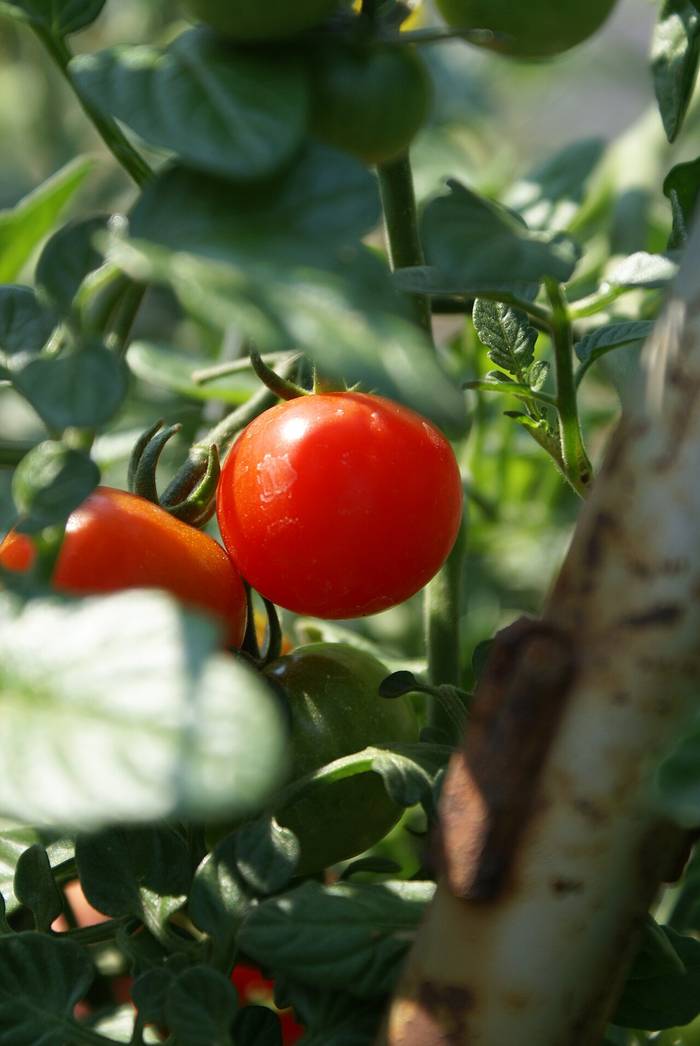
JS · CC BY-SA 3.0
cherry tomato
Plant·Solanum lycopersicum var. cerasiforme
Full sun
Sun
Moist soil
Water
Well-drained soil
Drainage
Not recorded
Hardiness
Coverage · 89 fields
- Parser flag (climate_tolerance_low_confidence): Climate tolerance values are LLM-extracted (no authoritative EcoCrop match found). EcoCrop covers ~2,568 food-crop taxa; ornamental/native/medicinal species rely on LLM extraction.
- Starting indoors appears 2 times with different timing.
Growth and size10 fields
Plant type
Plant
AI estimate100 % agree
Height
200 cm · other sources: 300 cm“Solanum lycopersicum is a ANNUAL growing to 2 m (6ft) by 1.5 m (5ft) at a fast rate.”Wikipedia“Tomato plants are vines, becoming decumbent, and can grow up to 3 m (9.8 ft); bush varieties are generally no more than 100 cm (3 ft 3 in) tall.”
Spread
150 cm“Solanum lycopersicum is a ANNUAL growing to 2 m (6ft) by 1.5 m (5ft) at a fast rate.”
Height at age
—
empty
Spacing
60 cm (at least 45 cm)
AI estimate55 % agree
Growth rate
Fast“Solanum lycopersicum is a ANNUAL growing to 2 m (6ft) by 1.5 m (5ft) at a fast rate.”
Habit
—
empty
Root depth
Medium
AI estimate63 % agree
Forest garden layer
Herb layer
AI estimate90 % agree
Lifespan
~1 years
AI estimatenot measured yet
Roots6 fields
Root form
Fibrous roots
AI estimate43 % agree
Storage organ
None“It does not multiply vegetatively: it has no rhizomes, runners, suckers or offspring bulbs or tubers.”
Spreads
No“It does not multiply vegetatively: it has no rhizomes, runners, suckers or offspring bulbs or tubers.”
Lateral spread in cm
—
empty
Root depth in cm
—
empty
Mycorrhiza
Arbuscular (AM)“The tomato has a mutualistic relationship with arbuscular mycorrhizal fungi such as Rhizophagus irregularis.”
Light, water and soil9 fields
Sun
Full sun“It cannot grow in the shade.”PFAF“Requires a fertile, humus-rich, well-drained soil in a warm sunny position.”
Hours of sun
6–8 h
AI estimatenot measured yet
Drought tolerant
—
empty
Tolerates waterlogging
—
empty
Soil type
Sand, loam, clay“Suitable for: light (sandy), medium (loamy) and heavy (clay) soils and prefers well-drained soil.”
pH
5–7.5 · best 5.8–6.8“Slightly acid conditions, with a pH in the range 5.8 - 6.8, are preferred, though the plant can tolerate 5 - 7.5.”PFAF“Suitable pH: mildly acid and neutral soils and can grow in very acid soils.”
Drainage
Well drained“Suitable for: light (sandy), medium (loamy) and heavy (clay) soils and prefers well-drained soil.”
Compacted soil
Copes badly
AI estimatenot measured yet
Climate5 fields
Hardiness
—
empty
Killing frost
—
empty
Growing temperature
7–35 °C · optimal 20–27 °C“It grows best in areas where annual daytime temperatures are within the range 20 - 27°c, but can tolerate 7 - 35°c.”
Chill hours
0 h
AI estimatenot measured yet
Native range
—
empty
Care (becomes tasks in Manage)8 fields
Starting indoors
After the last frost · -42 days after“Seed - sow in containers or in a seedbed.”
Starting indoors appears 2 times with different timing.
PFAFpartly
Sowing
After the last frost“However, by sowing the seed 15mm deep the seedcoat will remain below the soil surface when the seed germinates and the disease will be inactivated.”PFAFpartly“Seed can also be sown in situ.”
Starting indoors
March · lasts 30 days
Starting indoors appears 2 times with different timing.
AI estimatenot measured yet
Support
After the previous stage · 45 days after · lasts 30 days
AI estimatenot measured yet
Watering
June · lasts 90 days
AI estimatenot measured yet
Feeding
After the previous stage · lasts 60 days · a balanced fertiliser or compost tea
AI estimatenot measured yet
Pruning
July · lasts 60 days · suckers (side shoots that emerge between the main stem and a leaf branch)
AI estimatenot measured yet
Through the year5 fields
Leafing out
After the last frost · lasts 14 days
AI estimatenot measured yet
Flowering
After the previous stage · 30 days after · lasts 60 days
AI estimatenot measured yet
Fruiting
After the previous stage · 21 days after · lasts 45 days
AI estimatenot measured yet
Harvest
After the previous stage · 60 days after · lasts 30 days“Yields of ripe fruit from upright forms of the plant can commence 2 - 3 months after sowing the seed; other forms might take 4 - 5 months.”
Dying back
After the first frost · lasts 14 days“Tomato plants are vines, largely annual, and vulnerable to frost, though sometimes living longer in greenhouses.”
Wikipediapartly
Edible parts and pollination2 fields
Ecology5 fields
Pests
Tomato bug, stink bugs, cutworms, tomato hornworms, tobacco hornworms, aphids, cabbage loopers, whiteflies, tomato fruitworms, flea beetles, red spider mite, tuta absoluta, slugs, colorado potato beetles, tomato russet mite“Common tomato pests include the tomato bug, stink bugs, cutworms, tomato hornworms and tobacco hornworms, aphids, cabbage loopers, whiteflies, tomato fruitworms, flea beetles, red spider mite, Tuta absoluta (tomato leafminer), slugs, and Colorado potato beetles.”Wikipedia“The tomato russet mite, Aculops lycopersici, feeds on foliage and young fruit of tomato plants, causing shrivelling and necrosis of leaves, flowers, and fruit, possibly killing the plant.”
Diseases
Takes up
—
empty
Fixes nitrogen
No
AI estimatenot measured yet
Propagation and names4 fields
Methods
Seed sown in containers or in a seedbed, then planted out, Seed sown in situ“Seed - sow in containers or in a seedbed.”PFAF“Seed can also be sown in situ.”
Difficulty
2 / 5
AI estimatenot measured yet
Seed
none
AI estimatenot measured yet
Not sorted yet35 fields
Fields the parser stores that this page has no row for yet. They show up here automatically, so nothing is hidden.
ornamental.basis
documented
AI estimatenot measured yet
ornamental.fragrance.source
foliage
AI estimate100 % agree
ornamental.fragrance.intensity
strong“The strong aroma of this plant is said to repel insects from nearby plants.”
ornamental.confidence
high
AI estimatenot measured yet
ornamental.fall_interest
false
AI estimatenot measured yet
ornamental.evidence_quote
Tomato plants typically have small yellow flowers. The foliage is green and has a distinct, moderately fragrant scent. As an annual, it does not exhibit autumn foliage color or winter structure.
AI estimatenot measured yet
ornamental.foliage_colour
green
AI estimate82 % agree
ornamental.foliage_texture
medium
AI estimatenot measured yet
ornamental.winter_structure
none
AI estimatenot measured yet
ornamental.autumn_foliage_colour
none
AI estimatenot measured yet
care_regime
routine
AI estimatenot measured yet
propagation.self_seeding
light
AI estimate20 % agree
propagation.division_season
not applicable
AI estimatenot measured yet
propagation.establishment_years
0“It is perennial in its native habitat but grown as an annual in temperate climates, usually growing about 3 m in height.”
PFAFpartly
sun_requirement.best
full_sun“Requires a fertile, humus-rich, well-drained soil in a warm sunny position.”
function_profile.biomass_return.confidence
medium“which is returned to the farm for use either as green manure or to be grazed by livestock.”
Wikipediapartly
function_profile.nutrient_flows.consumes
[{"basis":"documented","demand":"heavy","nutrient":"nitrogen","confidence":"high"},{"basis":"documented","demand":"high","nutrient":"phosphorus","confidence":"high"},{"basis":"documented","demand":"heavy","nutrient":"…
AI estimatenot measured yet
function_profile.biotic_interactions
[{"taxa":["insects"],"basis":"documented","valence":"beneficial","relation":"attracts","confidence":"high","evidence_quote":"The flowers are pollinated by Insects.","organism_group":"pollinator","ecological_function":…“The flowers are pollinated by Insects.”Wikipedia“Common tomato pests include the tomato bug, stink bugs, cutworms, tomato hornworms and tobacco hornworms, aphids, cabbage loopers, whiteflies, tomato fruitworms, flea beetles, red spider mite, Tuta absoluta (tomato leafminer), slugs, and Colorado potato beetles.”Wikipediapartly“Tomatoes are attacked by many insect pests and nematodes and are subject to diseases caused by viruses, mildew, and blight fungi.”
function_profile.aromatic_pest_effect.value
true“The strong aroma of this plant is said to repel insects from nearby plants.”
function_profile.aromatic_pest_effect.confidence
low
AI estimatenot measured yet
function_profile.structural_interfaces.requires_shelter.basis
documented
AI estimatenot measured yet
function_profile.structural_interfaces.requires_shelter.kinds
frost
AI estimatenot measured yet
function_profile.structural_interfaces.requires_shelter.stage
establishment
AI estimatenot measured yet
function_profile.structural_interfaces.requires_shelter.confidence
high
AI estimatenot measured yet
function_profile.structural_interfaces.requires_shelter.evidence_quote
Tomatoes are very sensitive to frost and require protection during establishment in cooler climates.
AI estimatenot measured yet
function_profile.structural_interfaces.requires_physical_support.basis
documented
AI estimatenot measured yet
function_profile.structural_interfaces.requires_physical_support.mechanism
scrambler
AI estimatenot measured yet
function_profile.structural_interfaces.requires_physical_support.confidence
high
AI estimatenot measured yet
function_profile.structural_interfaces.requires_physical_support.evidence_quote
Tomato plants are indeterminate or determinate, with most indeterminate varieties requiring staking or caging for support due to their vining growth habit.
AI estimatenot measured yet
climate_tolerance.photoperiod_response
day_neutral
AI estimatenot measured yet
soil_interactions.organic_matter_contribution
medium
AI estimatenot measured yet
component_metadata.growth_cycle
annual“Solanum lycopersicum is a ANNUAL growing to 2 m (6ft) by 1.5 m (5ft) at a fast rate.”
resource_interfaces.inputs
[{"resource":"light","quantity_description":"full sun in a warm position; cannot grow in shade"},{"resource":"water","quantity_description":"mean annual rainfall of 600-1,300 mm preferred, tolerates 400-1,800 mm"},{"r…“It cannot grow in the shade.”PFAF“It prefers a mean annual rainfall in the range 600 - 1,300mm, but tolerates 400 - 1,800mm.”Wikipediapartly“That tomatoes pollinate themselves poorly without outside aid is clearly shown in greenhouse situations, where pollination must be aided by artificial wind, vibration of the plants, or by cultured bumblebees.”
resource_interfaces.outputs
[{"resource":"fruit","quantity_description":"thumbtip to golf-ball size, spherical to slightly oblong"}]“Cherry tomatoes range in size from a thumbtip up to the size of a golf ball, and can range from spherical to slightly oblong in shape.”