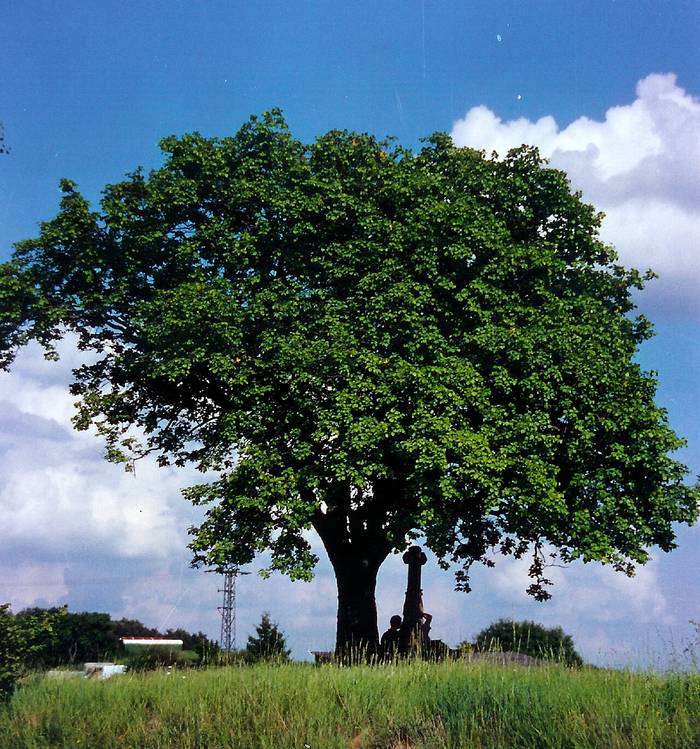
Wild service tree
Wild service tree (Sorbus torminalis) is a tree. It grows best in full sun and has moderate water needs.
About Wild service tree
Wild service tree is a perennial, deciduous tree that grows 20 m tall.[1][2] It is self-fertile, so you only need one.[1] It can live for around 300 years. It spreads by suckers.[3] In autumn the leaves turn red and bronze.[2]
The flowers give nectar and pollen to pollinators.[1] Birds and mammals eat the fruit and spread the seeds.[4] It gives shelter to birds and beneficial insects.[1]
How to plant wild service tree
It grows in sandy soil, loam and clay.[1] It does best at a pH of 3.5–8.[1][4] In a forest garden it belongs in the canopy.[1]
Plant trees 10 m apart, at least 8 m. It is well established after about 3 years. It can be propagated from seed or from suckers.[1][3]
A year with Wild service tree
Spring. It comes into leaf in March and April.[2] It has white flowers in May–July.[1][4]
Summer. Harvest falls in August.[1] The fruit can be eaten.[1][2] The seeds are probably poisonous. Recorded from the source text, not a safety check. Confirm with a trusted guide before eating anything.
Winter. It rests through the winter.[2] It needs around 800 hours of winter cold to crop well.
Pests and diseases
Wild service tree can be attacked by goat moth, scolytus mali, eriophyes torminalis, leaf aphids and apple aphid (aphis pomi).[2][4] Diseases include leaf scab (venturia inaequalis), honey fungus (armillaria spp.) and fireblight.[1][4]
Companions and wildlife
Wild service treeSources
- Plants For A Future — Sorbus torminalis · CC BY 4.0, Plants For A Future
- Wikipedia — Aria torminalis · CC BY-SA 4.0
- CLO-PLA (clonal growth) · Klimešová et al. 2017
- JRC forest tree atlas · CC BY 4.0
Added to the wiki 8 July 2026
Plan your garden with perma
Open app