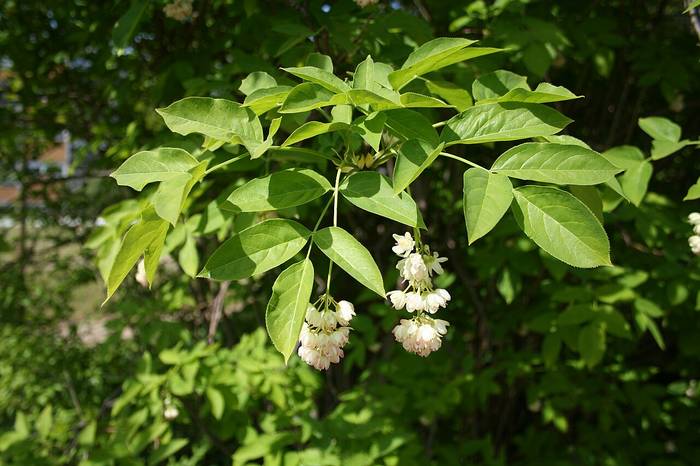
European bladdernut
European bladdernut (Staphylea pinnata) is a tree. It grows best in part shade to full sun and has moderate water needs.
About European bladdernut
European bladdernut is a perennial, deciduous tree that grows 4.5 m tall.[1][2]
The flowers attract pollinators.[2]
The seeds can be eaten raw.[1][2] Recorded from the source text, not a safety check. Confirm with a trusted guide before eating anything.
How to plant european bladdernut
European bladdernut does best in full sun, but also copes with part shade.[1][2] It grows in sandy soil, loam and clay, as long as the soil is moist.[1] It does best at a pH of 5.5–8.5.[1] In a forest garden it belongs in the lower tree layer.
Plant trees 3 m apart, at least 2 m. It is well established after about 2 years. It can be propagated from seed, from cuttings, by layering or from suckers.[1]
A year with European bladdernut
Spring. It comes into leaf in April and May.
Summer. It has white flowers in June and July.[1][2]
Winter. It rests through the winter.
Companions and wildlife
European bladdernutSources
- Plants For A Future — Staphylea pinnata · CC BY 4.0
- Wikipedia — Staphylea pinnata · CC BY-SA 4.0
- CLO-PLA (clonal growth) · Klimešová et al. 2017
Added to the wiki 21 October 2026
Plan your garden with perma
Open app