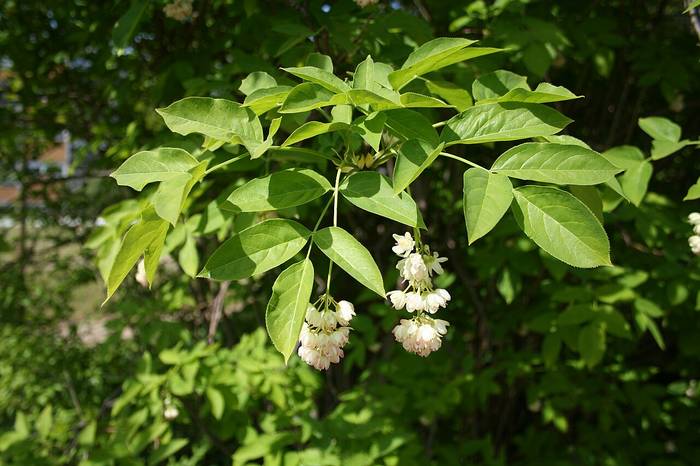
Marco Schmidt · CC BY 2.5
European bladdernut
Tree·Staphylea pinnata
Part shade to full sun
Sun
Moist soil
Water
Not recorded
Drainage
Zones 6–8
Hardiness
Coverage · 67 fields
- Parser flag (climate_tolerance_low_confidence): Climate tolerance values are LLM-extracted (no authoritative EcoCrop match found). EcoCrop covers ~2,568 food-crop taxa; ornamental/native/medicinal species rely on LLM extraction.
Growth and size10 fields
Plant type
Deciduous tree“Staphylea pinnata is a deciduous Shrub growing to 4.5 m (14ft) by 4.5 m (14ft).”
Height
450 cm · other sources: 600 cm“Staphylea pinnata is a deciduous Shrub growing to 4.5 m (14ft) by 4.5 m (14ft).”Wikipedia“It is a deciduous shrub growing up to 6 m (20 ft).”
Height at age
—
empty
Spacing
300 cm (at least 200 cm)
AI estimate55 % agree
Growth rate
—
empty
Habit
Spreading
AI estimate50 % agree
Root depth
Medium
AI estimate63 % agree
Forest garden layer
Lower tree layer
AI estimate90 % agree
Lifespan
—
empty
Roots6 fields
Root form
Fibrous roots
AI estimate43 % agree
Storage organ
None“No clonal growth organ is recorded: it does not spread vegetatively (no suckers, no rhizomes).”
Spreads
No“No clonal growth organ is recorded: it does not spread vegetatively (no suckers, no rhizomes).”
Lateral spread in cm
—
empty
Root depth in cm
—
empty
Mycorrhiza
—
empty
Light, water and soil9 fields
Sun
Full sun, light shade, part shade · best: full sun“Staphylea pinnata can be grown in full sun to partial shade, and tolerates a variety of soils.”PFAF“It can grow in semi-shade (light woodland) or no shade.”
Hours of sun
—
empty
Tolerates waterlogging
—
empty
Soil type
Sand, loam, clay · best: loam“Tolerant of a wide range of soils so long as they are not too dry, it prefers a rich loamy soil in full sun or semi-shade.”PFAF“Suitable for: light (sandy), medium (loamy) and heavy (clay) soils.”
Compacted soil
Copes fairly well
AI estimatenot measured yet
Climate5 fields
Growing temperature
—
empty
Chill hours
—
empty
Native range
AL, AM, AT, AZ, BA, BG, CH, CZ, DE, FR, GE, GG, GR, HR, HU, IT, JE, LI, MC, MD, ME, MK, PL, RO, RS, RU, SI, SK, SM, TR, UA, VA, XK
Through the year5 fields
Flowering
May · lasts 61 days“It is in flower from May to June, and the seeds ripen from September to November.”
Fruiting
September · lasts 92 days“The fruits are inflated papery capsules, 2-3 lobed, up to 4 cm (1.6 in) long, ripening from September to November.”
Leafing out
After the last frost · lasts 30 days
AI estimatenot measured yet
Dying back
After the first frost · lasts 30 days
AI estimatenot measured yet
Dormant
After the first frost · 30 days after · lasts 150 days
AI estimatenot measured yet
Edible parts and pollination3 fields
The seeds
Pollination
Hermaphrodite“The species is hermaphrodite (has both male and female organs) and is pollinated by Flies.”Wikipedia“The flowers are bisexual and pollinated by flies.”
Ecology6 fields
Pests
—
empty
Diseases
—
empty
Takes up
—
empty
Fixes nitrogen
No
AI estimatenot measured yet
Mycorrhiza
—
empty
Propagation and names4 fields
Methods
Seed, cuttings, layering, suckers“Seed - this can be very slow to germinate, sometimes taking 18 months or more.”PFAF“Cuttings of half-ripe wood, 5 - 8cm with a heel, July/August in a frame.”PFAF“Layering in July/August.”PFAF“Plants sometimes produce suckers, these can be removed in the dormant season and planted out.”
Difficulty
3 / 5
AI estimatenot measured yet
Seed
cold stratification for stored seed“Stored seed should be sown as early in the year as possible and given cold stratification - it might not germinate until spring of the following year.”
Not sorted yet19 fields
Fields the parser stores that this page has no row for yet. They show up here automatically, so nothing is hidden.
forage.DK.local_name
almindelig blærenød
AI estimatenot measured yet
forage.DK.edibility_basis
inferred
AI estimatenot measured yet
forage.DK.foraging_months.months
9, 10, 11“It is in flower from May to June, and the seeds ripen from September to November.”
ornamental.basis
documented
AI estimatenot measured yet
ornamental.fragrance.source
flower“Small, white, bell-shaped, fragrant flowers bloom from May to June, on panicles up to 13 cm (5.1 in) long.”
ornamental.confidence
medium
AI estimatenot measured yet
ornamental.flower_colour
white“Small, white, bell-shaped, fragrant flowers bloom from May to June, on panicles up to 13 cm (5.1 in) long.”
ornamental.evidence_quote
Small, white, bell-shaped, fragrant flowers bloom from May to June, on panicles up to 13 cm (5.1 in) long.
AI estimatenot measured yet
care_regime
none
AI estimatenot measured yet
propagation.division_season
dormant season“Plants sometimes produce suckers, these can be removed in the dormant season and planted out.”
propagation.establishment_years
2
AI estimate40 % agree
function_profile.biotic_interactions
[{"taxa":["flies"],"basis":"documented","valence":"beneficial","relation":"attracts","confidence":"high","evidence_quote":"The flowers are bisexual and pollinated by flies.","organism_group":"pollinator","ecological_f…“The flowers are bisexual and pollinated by flies.”
function_profile.aromatic_pest_effect.value
false
AI estimate80 % agree
function_profile.aromatic_pest_effect.confidence
medium
AI estimatenot measured yet
soil_interactions.organic_matter_contribution
low
AI estimatenot measured yet
component_metadata.growth_cycle
perennial
AI estimate100 % agree
resource_interfaces.inputs
[{"resource":"light","quantity_description":"semi-shade to full sun"},{"resource":"water","quantity_description":"prefers moist soil; low drought tolerance"}]“It can grow in semi-shade (light woodland) or no shade.”PFAFpartly“It prefers moist soil.”
resource_interfaces.outputs
[{"resource":"seeds","quantity_description":"edible seeds said to taste like pistachios"},{"resource":"habitat","quantity_description":"hedgerows and copses"},{"resource":"pollinator_services","quantity_description":"…“The seeds are edible, and are said to taste like pistachios.”PFAF“Hedgerows and copses.”Wikipedia“The flowers are bisexual and pollinated by flies.”