Yew
Yew (Taxus baccata) is a tree. It grows best in shade to full sun and has low water needs.
About Yew
Yew is a perennial, evergreen tree that grows 15 m tall.[1][2] It grows slowly.[1] It can live for around 4000 years.[1] Yew grows wild in Denmark.
Birds eat the fruit and spread the seeds.[3]
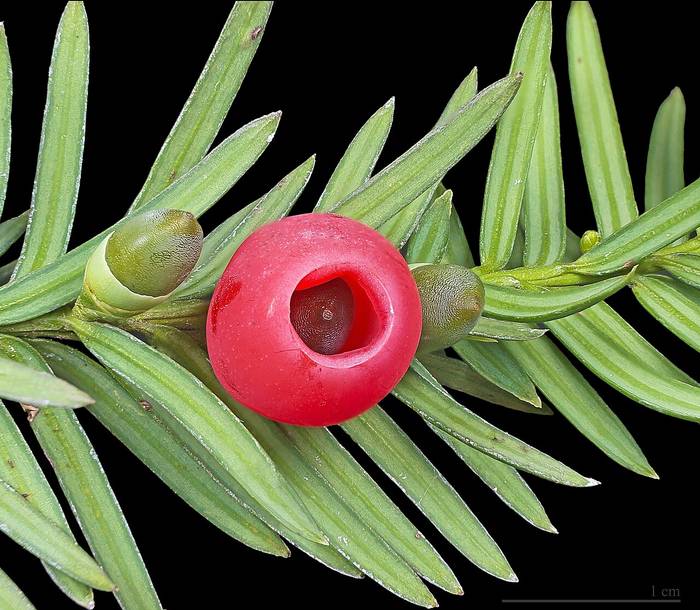
The aril can be eaten raw.[1][2] Only the red aril can be eaten; the seed and the rest of the plant are highly poisonous. Toxic to dogs and cats. Recorded from the source text, not a safety check. Confirm with a trusted guide before eating anything.
How to plant yew
Yew does best in part shade, but also copes with shade.[1] It grows in sandy soil, loam and clay.[1][3] It does best at a pH of 4.5–9.[1] In a forest garden it belongs in the lower tree layer.[1]
Plant trees 5 m apart, at least 3 m. It is well established after about 2 years.[1] It can be propagated from seed or from cuttings.[1]
A year with Yew
Spring. It has small, inconspicuous flowers in March.[1] Plant out in April.[1]
Summer. Prune it in June and July. Cut out new growth. Take a little off to tidy the shape. Less than you think.
Autumn. Prune it in September and October. Cut out new growth. Take a little off to tidy the shape. Less than you think.
Pests and diseases
Yew can be attacked by yew mite and browsing mammals.[3] Diseases include phytophthora root rot and fungal seedling pathogens.[1][3]
Companions and wildlife
YewSources
- Plants For A Future — Taxus baccata · CC BY 4.0, Plants For A Future
- JRC forest tree atlas · CC BY 4.0
- Wikipedia — Taxus baccata · CC BY-SA 4.0
- CLO-PLA (clonal growth) · Klimešová et al. 2017
- Berlin tree register · DL-DE-Zero-2.0
Added to the wiki 4 October 2026
Plan your garden with perma
Open app