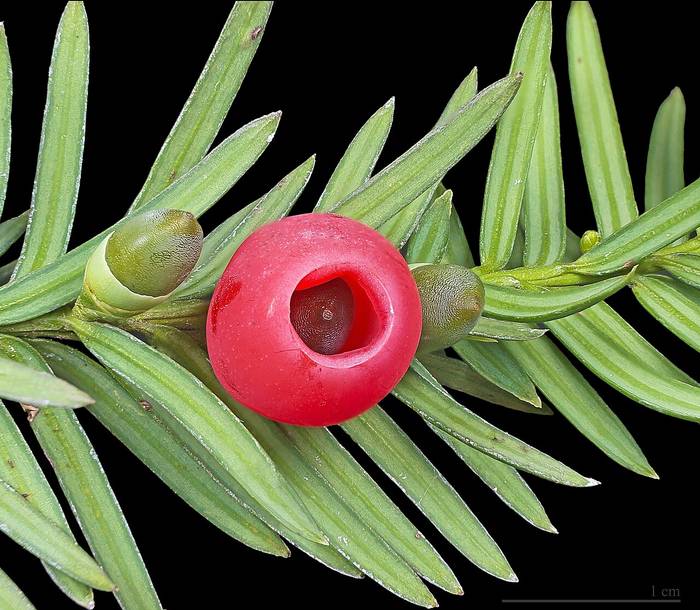
Didier Descouens · CC BY-SA 4.0
Yew
Tree·Taxus baccata
Shade to full sun
Sun
Dry to moist soil
Water
Not recorded
Drainage
Zones 6–8
Hardiness
Coverage · 117 fields
Growth and size11 fields
Plant type
Evergreen tree“Taxus baccata is a species of coniferous tree in the family Taxaceae.”PFAF“Taxus baccata is an evergreen Tree growing to 15 m (49ft) by 10 m (32ft) at a slow rate.”
Height
1,500 cm · other sources: 2,000 cm“Taxus baccata is an evergreen Tree growing to 15 m (49ft) by 10 m (32ft) at a slow rate.”JRC forest tree atlas“Yew is often multi-stemmed and its height rarely exceeds 20 m, but its longevity means that trunks can be very large: up to 4 m diameter.”
Spread
1,000 cm“Taxus baccata is an evergreen Tree growing to 15 m (49ft) by 10 m (32ft) at a slow rate.”
Height at age
450 cm after 20 years“It is, however, slow growing and usually takes about 20 years to reach a height of 4.5 metres.”
Size after planting
13 yrs: 4.5 m tall, 3 m crown · 17 yrs: 5 m tall, 4 m crown · 35 yrs: 7 m tall, 5 m crown · 73 yrs: 10 m tall, 6 m crown“Berlin tree register: 1727 trees of this species measured with years since planting, height and crown diameter; median crown 6.0 m and height 10.0 m at 60–100 years after planting (273 trees).”Median of 1,727 measured trees in Berlin. Years count from planting nursery stock, so a small tree reaches each size later.
Spacing
500 cm (at least 300 cm)
AI estimate55 % agree
Growth rate
Slow“Taxus baccata is an evergreen Tree growing to 15 m (49ft) by 10 m (32ft) at a slow rate.”
Habit
Spreading
AI estimate50 % agree
Forest garden layer
Lower tree layer
AI estimate90 % agree
Roots6 fields
Root form
Plate root (shallow)“Root systems are shallow with extensive horizontal roots.”
JRC forest tree atlaspartly
Storage organ
None“No clonal growth organ is recorded: it does not spread vegetatively (no suckers, no rhizomes).”
Spreads
No“No clonal growth organ is recorded: it does not spread vegetatively (no suckers, no rhizomes).”
Lateral spread in cm
—
empty
Root depth in cm
—
empty
Mycorrhiza
—
empty
Light, water and soil9 fields
Sun
Full sun, light shade, part shade, shade · best: part shade“It can grow in full shade (deep woodland) semi-shade (light woodland) or no shade.”
Hours of sun
3–6 h
AI estimatenot measured yet
Tolerates waterlogging
No“It has a very large environmental tolerance but is susceptible to waterlogging.”
JRC forest tree atlaspartly
Soil type
Sand, loam, clay“It grows well in well-drained soils, tolerating nearly any soil type, typically humus and base-rich soils, but also on rendzina and sand soils given adequate moisture.”PFAF“Suitable for: light (sandy), medium (loamy) and heavy (clay) soils, prefers well-drained soil and can grow in heavy clay soil.”
pH
4.5–9“Suitable pH: mildly acid, neutral and basic (mildly alkaline) soils and can grow in very acid and very alkaline soils.”
Drainage
Can cope with temporary flooding but is susceptible to long-term poor drainage“They are moderately drought tolerant and can cope with temporary flooding but are susceptible to longterm poor drainage.”
Climate5 fields
Hardiness
Zone 6–8
AI estimatenot measured yet
Killing frost
0 °C“Killing temp. early growth: 0”EcoCrop's figure is frost during early growth (spring frost on new shoots), not winter cold.
Growing temperature
0–30 °C · optimal 5–25 °C
AI estimatenot measured yet
Chill hours
0 h
AI estimatenot measured yet
Native range
AD, AL, AM, AT, AZ, BA, BE, BG, BY, CH, CZ, DE, DK, DZ, EE, ES, FI, FR, GB, GE, GG, GI, GR, HR, HU, IE, IR, IT, JE, LI, LT, LV, MA, MC, MD, ME, MK, MT, NL, NO, PL, PT, RO, RS, RU, SE, SI, SK, SM, TR, UA, VA, XK
Care (becomes tasks in Manage)3 fields
Planting out
After the last frost“Any planting out is best done in late spring or early summer, after the last expected frosts”
PFAFpartly
Pruning
June · lasts 30 days · new growth
Pruning appears 2 times with different timing.
AI estimatenot measured yet
Pruning
September · lasts 30 days · new growth
Pruning appears 2 times with different timing.
AI estimatenot measured yet
Through the year4 fields
Flowering
March · lasts 61 days“It is in leaf all year, in flower from March to April, and the seeds ripen from September to November.”
Fruiting
September · lasts 91 days“It is in leaf all year, in flower from March to April, and the seeds ripen from September to November.”
Leafing out
After the last frost“The fresh young shoots in spring, however, can be damaged by frosts”
PFAFpartly
Dormant
After the first frost · lasts 150 days
AI estimatenot measured yet
Edible parts and pollination3 fields
The aril
Raw“After wind pollination scarlet berries approximately 7 mm in diameter are produced with a red fleshy aril (the only non-toxic part of the tree) surrounding the dark central seed.”PFAF“When eating the fruit you should spit out the large seed found in the fruit's centre.”
Pollination
Needs a partner · a male plant · dioecious“The species is dioecious (individual flowers are either male or female, but only one sex is to be found on any one plant so both male and female plants must be grown if seed is required).”JRC forest tree atlas“After wind pollination scarlet berries approximately 7 mm in diameter are produced with a red fleshy aril (the only non-toxic part of the tree) surrounding the dark central seed.”PFAF“Male and female trees must be grown if fruit and seed is required[K].”PFAFpartly“The plant is not self-fertile.”
Pollinated by
Wind“After wind pollination scarlet berries approximately 7 mm in diameter are produced with a red fleshy aril (the only non-toxic part of the tree) surrounding the dark central seed.”
Ecology6 fields
Attracts
Birds, thrushes, hawfinches, greenfinches, great tits, wildlife“The arils are eaten by birds, which disperse the hard seeds undamaged in their droppings.”PFAF“The fruit is greatly relished by thrushes.”Wikipedia“Although they contain toxins, the kernels are extracted and eaten by some birds, such as hawfinches, greenfinches, and great tits.”PFAF“It is noted for attracting wildlife.”
Pests
Yew mite, browsing mammals“Its toxicity protects against many insects, but the yew mite causes significant bud mortality, and seedlings can be killed by fungi.”Wikipediapartly“Trees are often damaged by browsing and bark stripping.”
Diseases
Phytophthora root rot, fungal seedling pathogens“Very resistant to honey fungus, but susceptible to phytopthera root rot.”Wikipedia“Its toxicity protects against many insects, but the yew mite causes significant bud mortality, and seedlings can be killed by fungi.”
Takes up
—
empty
Fixes nitrogen
No
AI estimatenot measured yet
Mycorrhiza
Yes
AI estimatenot measured yet
Propagation and names4 fields
Methods
Seed, cuttings of half-ripe terminal shoots, cuttings of ripe terminal shoots“Seed - can be very slow to germinate, often taking 2 or more years.”PFAF“Cuttings of half-ripe terminal shoots, 5 - 8cm long, July/August in a shaded frame.”PFAF“Cuttings of ripe terminal shoots, taken in winter after a hard frost, in a shaded frame.”
Difficulty
2 / 5
AI estimatenot measured yet
Seed
4 months warm followed by 4 months cold stratification may help reduce the germination time.“4 months warm followed by 4 months cold stratification may help reduce the germination time.”
Not sorted yet66 fields
Fields the parser stores that this page has no row for yet. They show up here automatically, so nothing is hidden.
forage.DK.local_name
Almindelig taks
AI estimatenot measured yet
forage.DK.warnings_da
Kun frøkappen kan spises; kernen og resten af planten er meget giftig., Giftig for hunde og katte.
AI estimatenot measured yet
forage.DK.warnings_en
Only the red aril can be eaten; the seed and the rest of the plant are highly poisonous., Toxic to dogs and cats.
AI estimatenot measured yet
forage.DK.prep_cautions
Do not swallow the seed; it releases toxic taxanes when broken down., Do not use the bark as a tea substitute., All other parts, including the seed, are highly poisonous.“This will release the toxic taxanes.”PFAF“Some reports suggest using the bark as a tea substitute, this would probably be very unwise.”PFAF“All other parts of this plant, including the seed, are highly poisonous.”
forage.DK.edibility_basis
inferred
AI estimatenot measured yet
forage.DK.foraging_months.months
8, 9, 10“It is in leaf all year, in flower from March to April, and the seeds ripen from September to November.”
PFAFpartly
forage.DK.foraging_months.year_round
false
AI estimatenot measured yet
forage.US.edible_parts
[{"part":"aril","caution":"Spit out the large central seed.","preparation":"raw","season_months":[]}]“After wind pollination scarlet berries approximately 7 mm in diameter are produced with a red fleshy aril (the only non-toxic part of the tree) surrounding the dark central seed.”PFAF“When eating the fruit you should spit out the large seed found in the fruit's centre.”
forage.US.prep_cautions
Do not swallow the seed; it releases toxic taxanes when broken down., Do not use the bark as a tea substitute., All other parts, including the seed, are highly poisonous.“This will release the toxic taxanes.”PFAF“Some reports suggest using the bark as a tea substitute, this would probably be very unwise.”PFAF“All other parts of this plant, including the seed, are highly poisonous.”
forage.US.edibility_basis
inferred
AI estimatenot measured yet
forage.US.foraging_months.months
8, 9, 10“It is in leaf all year, in flower from March to April, and the seeds ripen from September to November.”
PFAFpartly
forage.US.foraging_months.year_round
false
AI estimatenot measured yet
forage.US.habitat_affinity
woodland, hedgerow
AI estimatenot measured yet
forage.TROPICAL.edibility_basis
inferred
AI estimatenot measured yet
forage.TROPICAL.foraging_months.notes
Taxus baccata is not native to tropical regions.
AI estimatenot measured yet
forage.TROPICAL.foraging_months.year_round
false
AI estimatenot measured yet
ornamental.basis
documented
AI estimatenot measured yet
ornamental.fragrance.source
none
AI estimate100 % agree
ornamental.fragrance.intensity
subtle
AI estimatenot measured yet
ornamental.confidence
high
AI estimatenot measured yet
ornamental.fall_interest
false
AI estimatenot measured yet
ornamental.evidence_quote
Taxus baccata is an evergreen conifer with dark green, needle-like foliage. Its flowers are inconspicuous, and it produces red, berry-like arils in autumn and winter.
AI estimatenot measured yet
ornamental.foliage_texture
fine
AI estimatenot measured yet
ornamental.winter_structure
evergreen_form“Taxus baccata is an evergreen Tree growing to 15 m (49ft) by 10 m (32ft) at a slow rate.”
ornamental.autumn_foliage_colour
none
AI estimatenot measured yet
care_regime
light
AI estimatenot measured yet
propagation.self_seeding
light
AI estimate20 % agree
propagation.establishment_years
2“The seedlings are very slow-growing and will probably require at least 2 years of pot cultivation before being large enough to plant out.”
size_at_age.v
1
AI estimatenot measured yet
size_at_age.basis
years_after_planting
AI estimatenot measured yet
forage_proposals.DK.edibility_tier.tier
toxic“All parts of the plant, except the flesh of the fruit, are highly poisonous, having a paralyzing affect on the heart.”
forage_proposals.DK.edibility_tier.confidence
high
AI estimatenot measured yet
forage_proposals.DK.edibility_tier.evidence_quote
The red aril (fleshy cup around the seed) is edible and sweet, but the seed itself is highly poisonous. All other parts of the yew tree are also highly toxic.
AI estimatenot measured yet
forage_proposals.US.edibility_tier.tier
toxic“All parts of the plant except the fleshy aril are poisonous, with toxins that can be absorbed through inhalation, ingestion, and transpiration through the skin.”
forage_proposals.US.edibility_tier.confidence
high
AI estimatenot measured yet
forage_proposals.US.edibility_tier.evidence_quote
The red aril (fleshy cup around the seed) is edible and sweet, but the seed itself is highly poisonous. All other parts of the yew tree are also highly toxic.
AI estimatenot measured yet
forage_proposals.TROPICAL.edibility_tier.tier
toxic
AI estimatenot measured yet
forage_proposals.TROPICAL.edibility_tier.confidence
high
AI estimatenot measured yet
forage_proposals.TROPICAL.edibility_tier.evidence_quote
Taxus baccata is not native to tropical regions and all parts of the plant, except the aril, are highly toxic. Consumption is not recommended.
AI estimatenot measured yet
function_profile.biomass_return.confidence
low
AI estimatenot measured yet
function_profile.nutrient_flows.consumes
[{"basis":"documented","demand":"low","nutrient":"nitrogen","confidence":"high"},{"basis":"inferred","demand":"low","nutrient":"potassium","confidence":"medium"},{"basis":"inferred","demand":"low","nutrient":"phosphor…
AI estimatenot measured yet
function_profile.biotic_interactions
[{"taxa":["birds","thrushes","hawfinches","greenfinches","great tits"],"basis":"documented","valence":"beneficial","relation":"attracts","confidence":"high","evidence_quote":"The arils are eaten by birds, which disper…“The arils are eaten by birds, which disperse the hard seeds undamaged in their droppings.”PFAF“It is noted for attracting wildlife.”Wikipedia“Its toxicity protects against many insects, but the yew mite causes significant bud mortality, and seedlings can be killed by fungi.”PFAF“Very resistant to honey fungus, but susceptible to phytopthera root rot.”Wikipediapartly“Trees are often damaged by browsing and bark stripping.”
function_profile.aromatic_pest_effect.value
false
AI estimate80 % agree
function_profile.aromatic_pest_effect.confidence
low
AI estimatenot measured yet
function_profile.structural_interfaces.provides_shelter.basis
documented
AI estimatenot measured yet
function_profile.structural_interfaces.provides_shelter.kinds
shade“Under its evergreen shade, no other plants can grow.”
function_profile.structural_interfaces.provides_shelter.confidence
high
AI estimatenot measured yet
function_profile.structural_interfaces.provides_shelter.evidence_quote
Under its evergreen shade, no other plants can grow.
AI estimatenot measured yet
function_profile.structural_interfaces.requires_shelter.basis
documented
AI estimatenot measured yet
function_profile.structural_interfaces.requires_shelter.kinds
frost“The fresh young shoots in spring, however, can be damaged by frosts[186, K].”
function_profile.structural_interfaces.requires_shelter.confidence
medium
AI estimatenot measured yet
function_profile.structural_interfaces.requires_shelter.evidence_quote
The fresh young shoots in spring, however, can be damaged by frosts[186, K].
AI estimatenot measured yet
function_profile.structural_interfaces.provides_physical_support.form
trunk“Very tolerant of trimming, this plant makes an excellent hedge.”
PFAFpartly
function_profile.structural_interfaces.provides_physical_support.basis
taxonomic
AI estimatenot measured yet
function_profile.structural_interfaces.provides_physical_support.confidence
high
AI estimatenot measured yet
function_profile.structural_interfaces.provides_physical_support.evidence_quote
Very tolerant of trimming, this plant makes an excellent hedge.
AI estimatenot measured yet
function_profile.structural_interfaces.requires_physical_support.basis
taxonomic
AI estimatenot measured yet
function_profile.structural_interfaces.requires_physical_support.confidence
high
AI estimatenot measured yet
climate_tolerance.photoperiod_response
day_neutral
AI estimatenot measured yet
soil_interactions.organic_matter_contribution
low
AI estimatenot measured yet
component_metadata.growth_cycle
perennial
AI estimate100 % agree
resource_interfaces.inputs
[{"resource":"light","quantity_description":"tolerates full shade, semi-shade or no shade"},{"resource":"water","quantity_description":"prefers dry or moist soil; tolerates drought"},{"resource":"shade","quantity_desc…“It can grow in full shade (deep woodland) semi-shade (light woodland) or no shade.”PFAF“It prefers dry or moist soil and can tolerate drought.”PFAF“Very shade tolerant.”PFAF“The plant is not self-fertile.”
resource_interfaces.outputs
[{"resource":"shade","quantity_description":"evergreen shade in which no other plants grow"},{"resource":"fruit","quantity_description":"fleshy berry about 10 mm across, with one seed"},{"resource":"seeds","quantity_d…“Under its evergreen shade, no other plants can grow.”PFAF“The fruit is a fleshy berry about 10mm in diameter and containing a single seed.”Wikipedia“Male yews are extremely allergenic, blooming and releasing abundant amounts of pollen in the spring, with an OPALS allergy scale rating of 10 out of 10.”PFAF“Wood - heavy, hard, durable, elastic, takes a good polish but requires long seasoning.”PFAF“It is noted for attracting wildlife.”PFAF“Some cultivars can be grown as a ground cover when planted about 1 metre or more apart each way.”JRC forest tree atlaspartly“Seeds are dispersed by birds which feed on the red flesh and pass the seeds.”